Schiaparelli: Fashion Becomes Art
I have referenced Schiaparelli’s work many times so far, it is work that I avidly adore, Daniel Rosenburys incarnation from Elsa Schiaparelli’s original style almost takes the ideas and the history of the fashion house and takes it to the next level.
I enjoyed learning that Elsa had started with sportswear, very commercial work, designed for the mass market, before she moved into haute couture. I thought this was an interesting way round, her haute couture came later, from skills learnt along the way, not through skills learnt before she started. Some of her pieces from the 1930’s feels incredibly relevant and modern. I also enjoyed the broad spectrum of influences, rarely following a continued thread, showing her development, and interest in all materials and functionality. These are things that perhaps could reflect what my own journey is becoming. I was also quite surprised that bar the embroidery work and a few key pieces from collaborations with artists, much of her work was just beautiful and not surrealist.
Something I feel I can relate to and that pleases my flighty mind. The dress that Arrianne Grande wore to the Oscars, I have always thought was an amazing engineering feat, but I had always wondered why it didn’t fit her around the bust area. However, in real life, the fit was entirely and vey cleverly purposeful, it was a second bustier inside, stripped away from the top layer in an embroidered flesh fabric. Something I thought was a flaw in real life was so cleverly and perfectly meant to be. As a milliner, I spend my time smoothing fabric over curves, it’s something I have skills in, but the construction of this dress was something else, a different level of skill and absolute perfection in the movement of fabric.
Interestingly one of the tensions I have referenced in my work so far is the notion of the value of fashion vs art. Here we have a great example of how they can be entwined, the exhibition itself called fashion becomes art. Not at becomes fashion. The fashion is the intent and the value, it has intention to fit a body or exaggerate a body…the art has come from this mindset, proving the value of fashion as an artistic endeavour.
One of the hats made from plant fibre reminded me of a hat I made 20 years ago teaching millinery in Fiji – and how pliable and mouldable that material was – I wonder if palm tree bark is available to by as a piece of fabric?
Arguably Daneil Roseberry’s work is next level compared to the original Schiaparelli, he has taken the essence but moved it forward, modernised, played but created ultimate luxury.
There were so many things that I picked up as ideas to follow up with and engage within my own practice:
Harlequin design (or pieces of colour joined with embroidery – my stained-glass piece is like this idea, but boiled wool or a softer than felt material could add more depth.
Acrylic painted PVC pieces on mesh, paint then pulled apart and put back together – could be bio plastics / shards etc.
Boning edges to create flutes shapes and circles.
Making wigs but embroidered like hair.
Make large roses out of something other than sinamay – bioplastics- plastics?
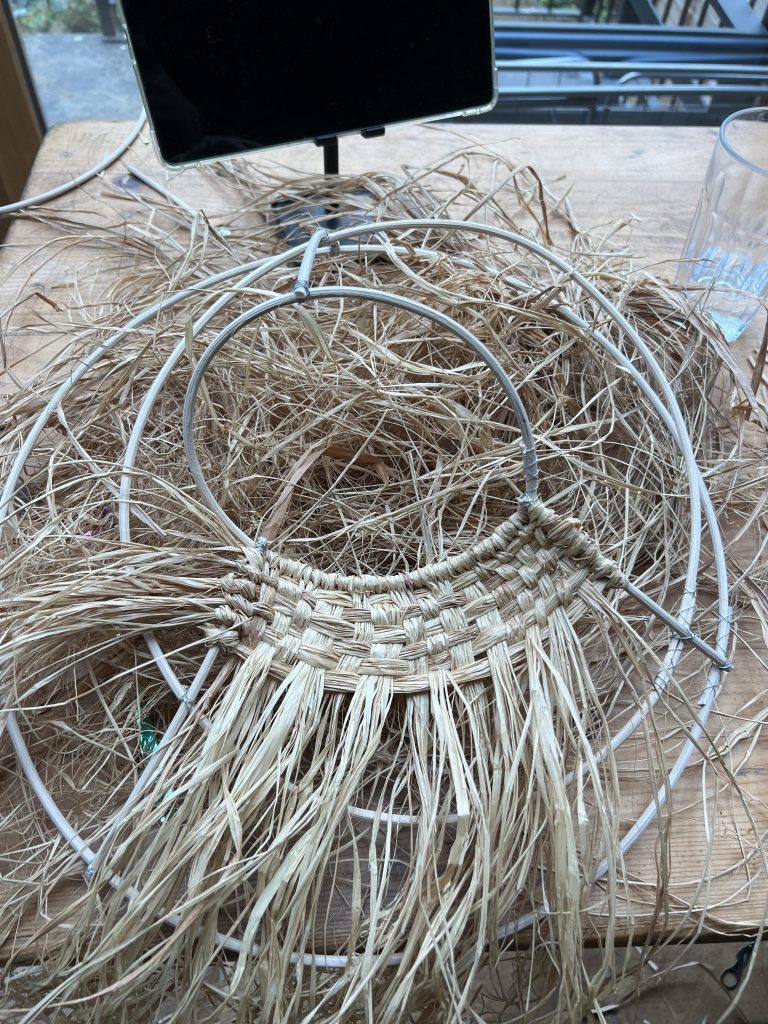
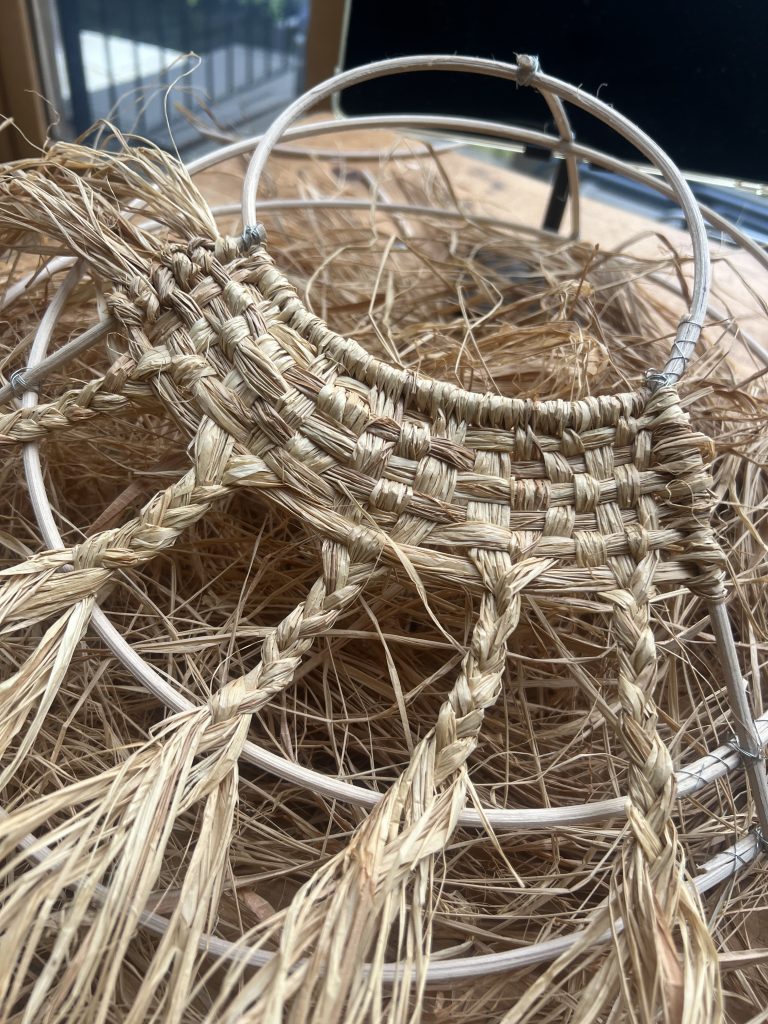
Weaving raffia – have started this but maybe make it on a blocked form?
More embroidery, since my embroidered bowler piece, I really enjoyed the slow meditative process of the stitching, seeing all the embroidery has inspired me to take it further:
Some ways I could take it further:
Do feather stitch like the bowler hat but in bright colours / mixture of colours all over the top of a bright hat.
Use tin or metal strips for embroidery to catch the light.
Using embroidery as edge binding/ overwrapped or blanket stitches or crochet stitches
Look into goldwork and stitching techniques.
Make 3d shapes from embroidery threads.
Hold embroidered pieces up on tiny wires for 3 dimensions.
Stitch articles/ beads into embroideries.
Take charity hats and embroider onto them- give them a new life, not by changing the construction but by embroidering onto them.
Embroider shapes and patterns with raffia / natural materials.
Embroidered / and / or beaded to look like straw braid.
Creative Development
Bauhaus inspired hat.
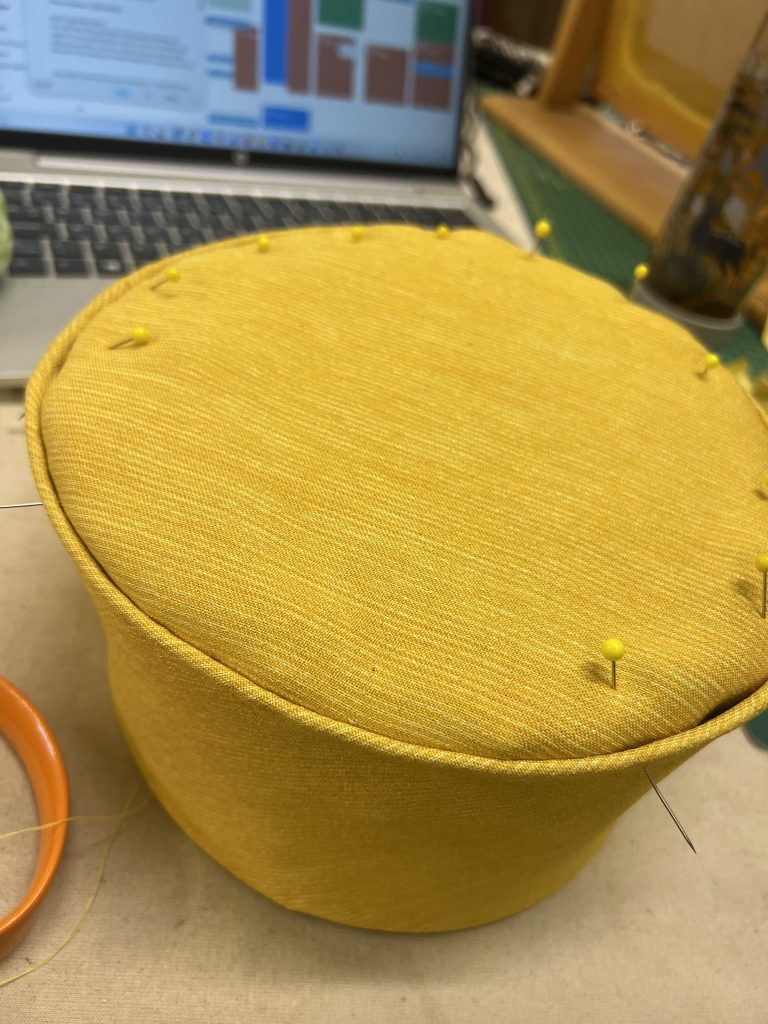
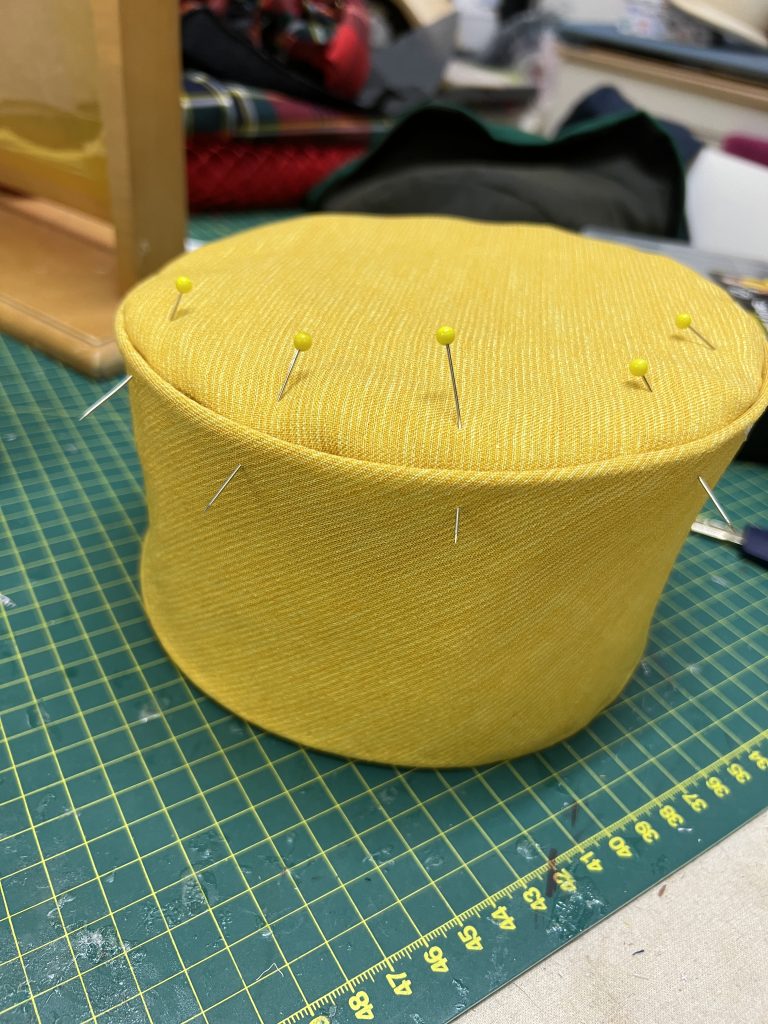
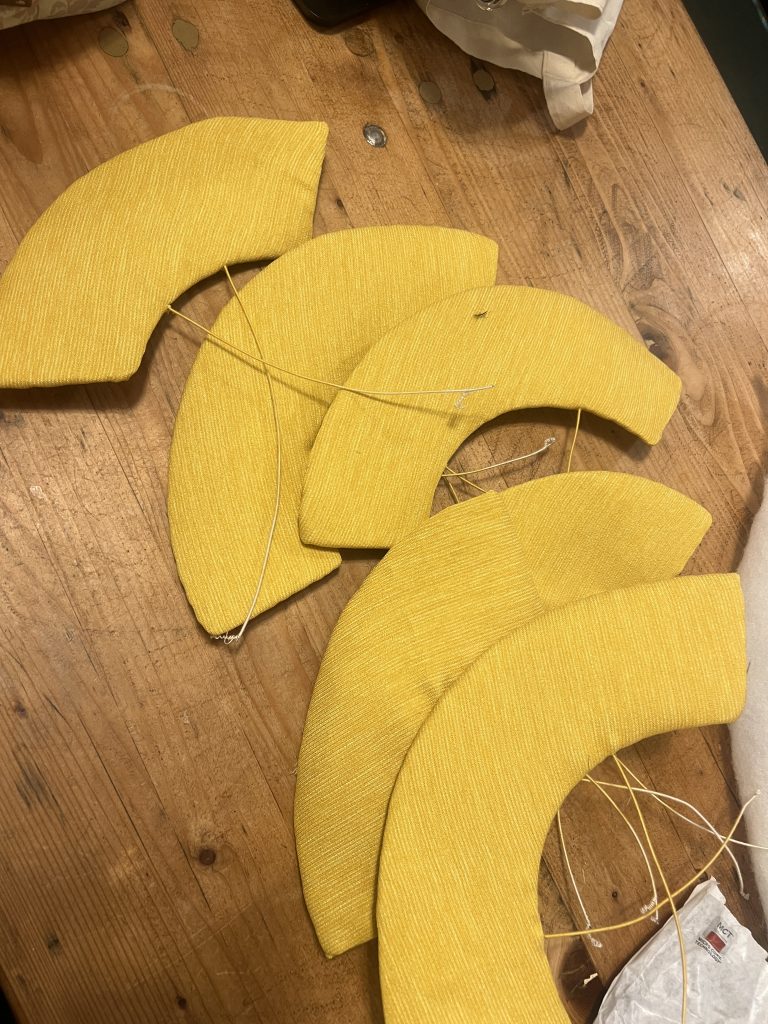
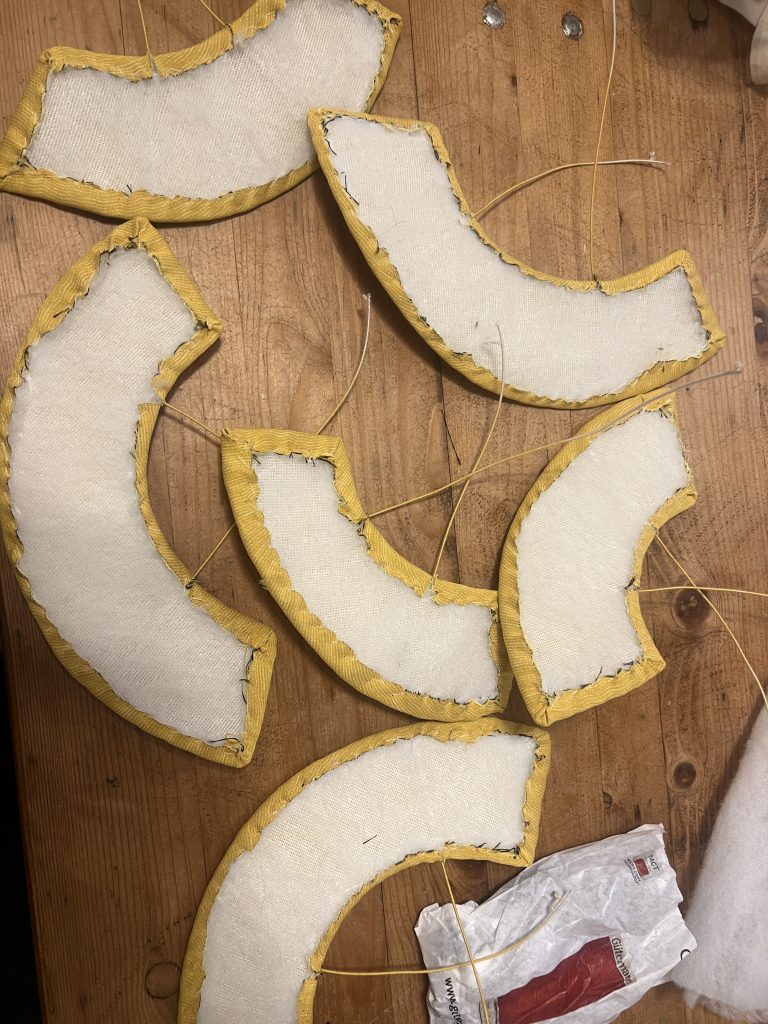
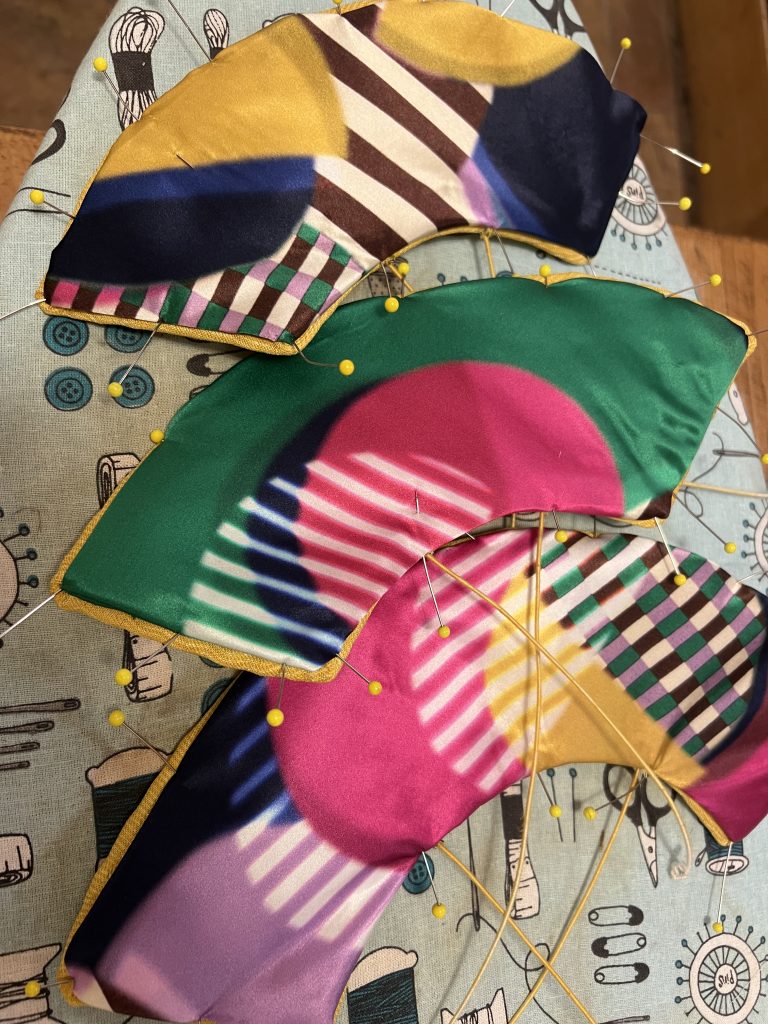
I wanted to be drawn the colours and shapes of the Bauhaus movement but equally create a piece that felt modern and relevant. I took the idea of overlapping circles, as often seen in Kandinsky’s and Delauney’s work, taking the pieces apart and mixing them with colour. I had the off cuts of a curtain for the yellow and some brightly coloured liberty silk, which reminded me of some of the work that came from the Bauhaus, I wanted some geometry, so started with a slanted crown and made the brim from cutting 2 brims into pieces and wiring them with angularity against the crown, its bold and it s strong, some pieces the colour yellow form the curtain is on the top of the brim, sometimes it is the multi coloured silk and vice versa. It has movement and strength in the design. Whilst it cannot be easily suitable for mass production by the design, as per the Bauhaus. It certainly does still have the structure and the colours. The brim could be reflected as fragmented, like society today and like the Bauhaus had struggled to survive and keep its ideals. The colours, by taking colour theory into account, offering joy and hope.
Whilst I think this piece works in images and has a boldness to it. I don’t think the craftmanship is reflective of the level I could achieve. During this master’s I am constantly in a push pull between what is more important, technical skill or concept. To me technical skill would be more important, here is an example where, I have put that aside to create the concept, and although if I made it again, I would make some changes to its structure, which would leave me with a better technical skillset on show. I personally don’t think the concept is strong enough, nor feels true enough to me to bother to remake it. I would probably find it hard in generally to put the time and technical refinery needed into something that I was not fully invested in as a concept. I think it has been great to play around and has given me a chance to experiment from a new angle, but I am unsure that it has really lead me anywhere in the bigger picture, except for perhaps that I do need to feel the work is reflective of me.
Perhaps my downfall here was to focus on an art history moment to create a piece of work than listen to my gut and where my interest and design angles naturally develop from.
Embroidered Half Bowler Hat
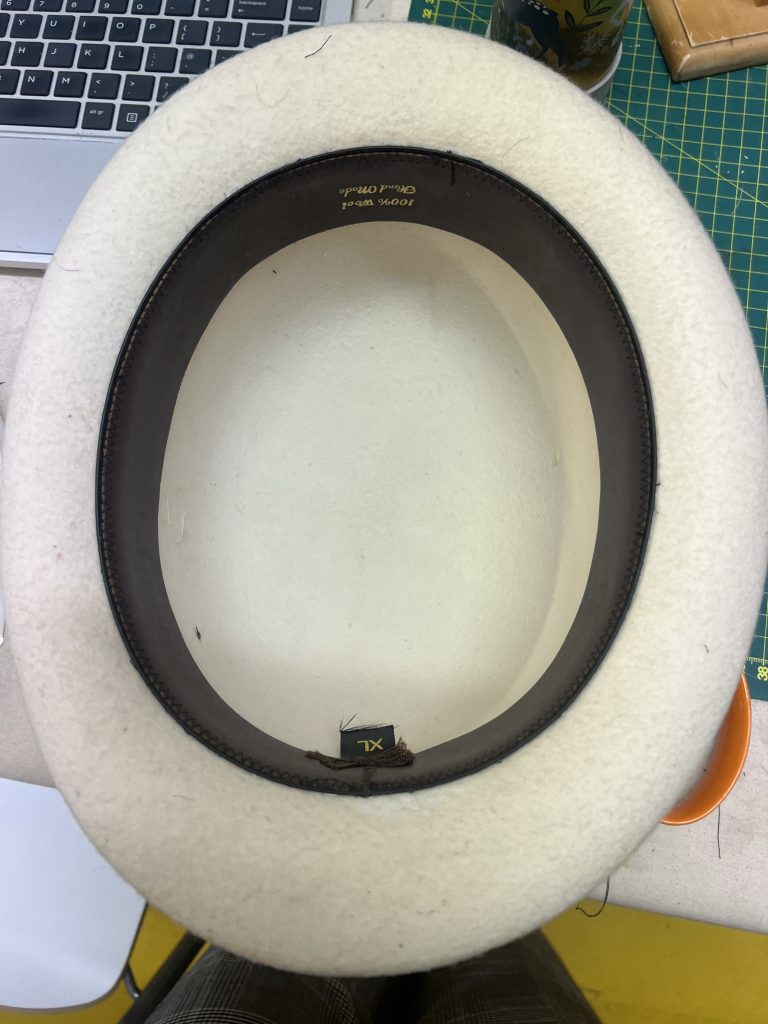
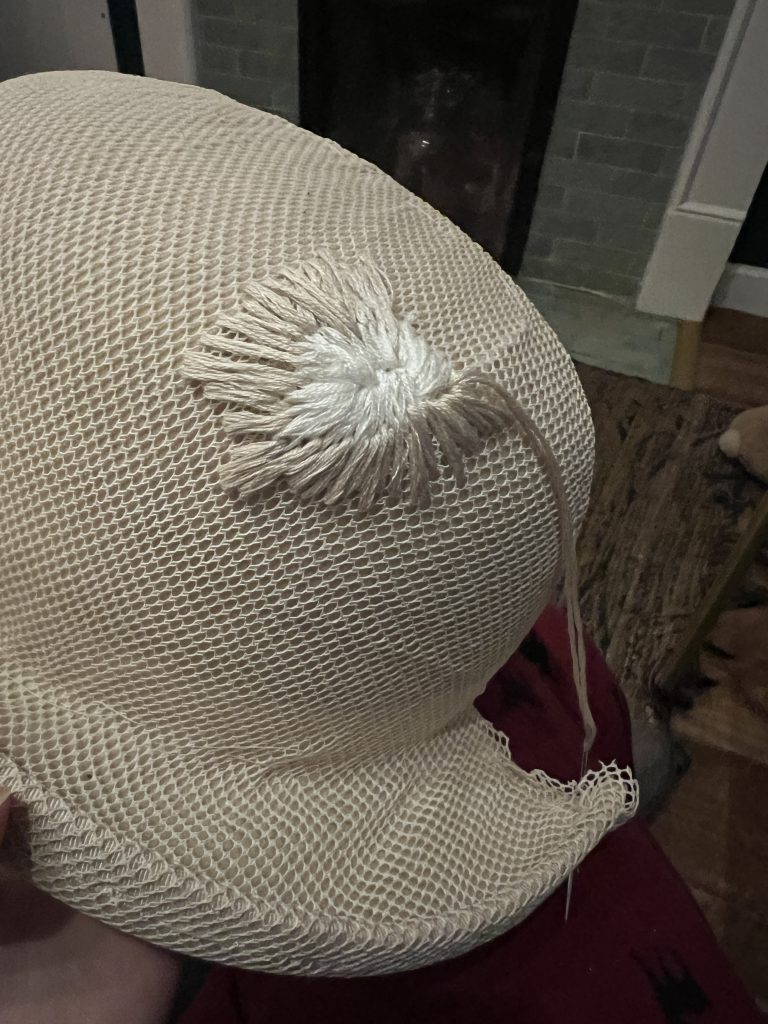
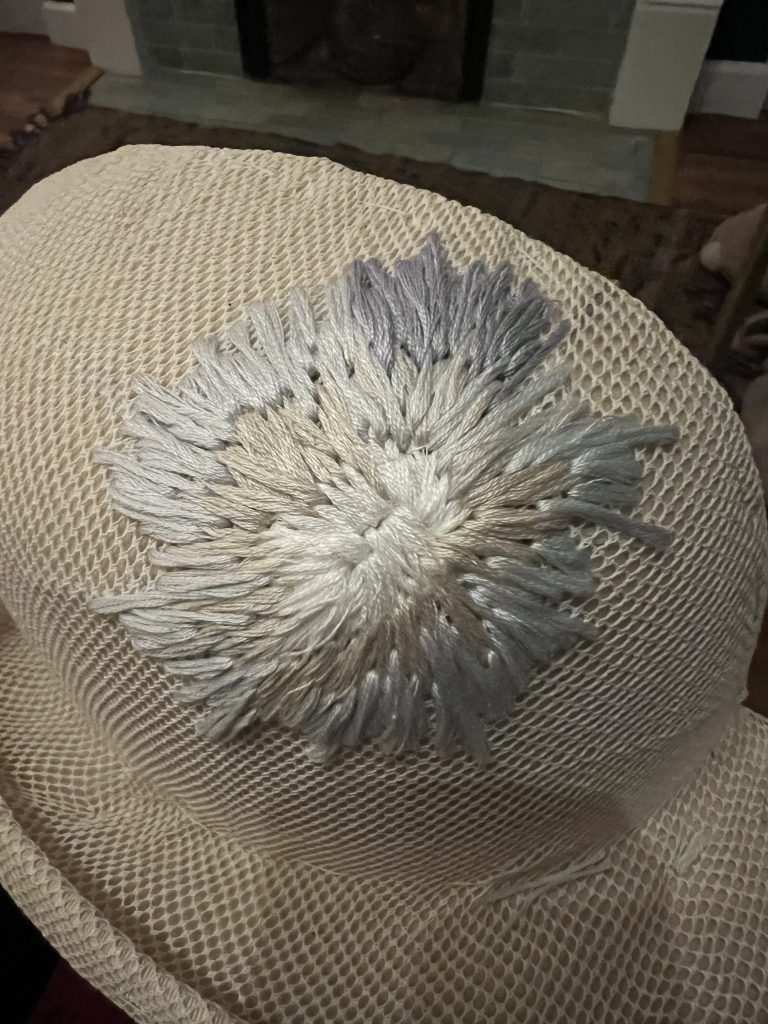
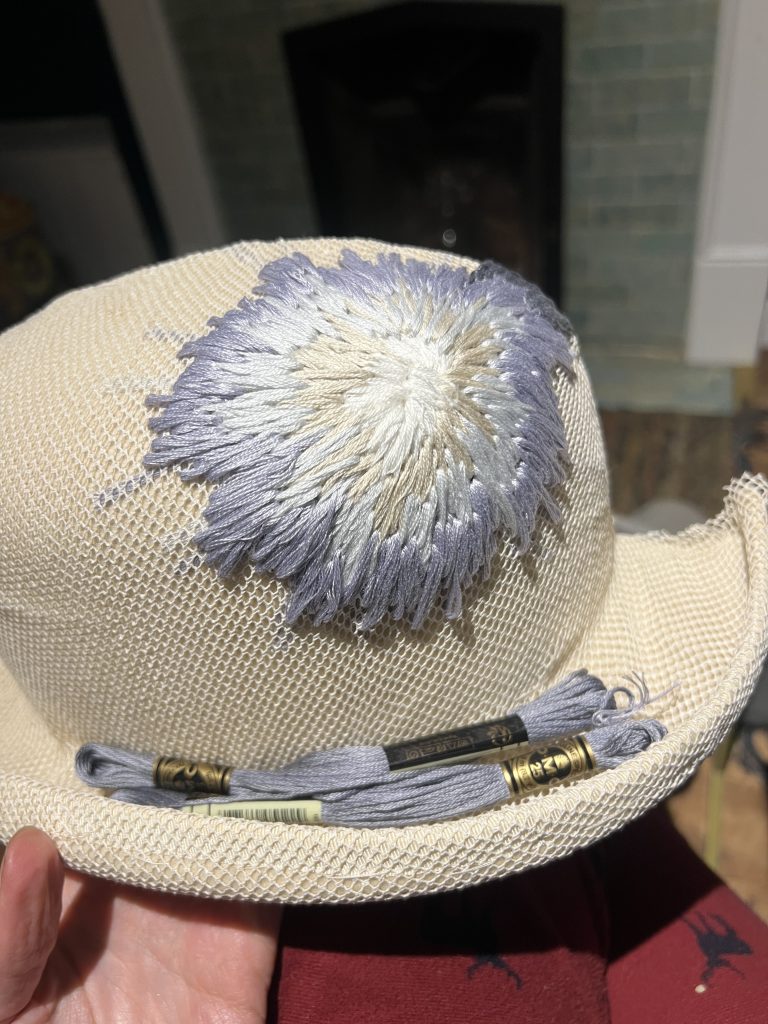
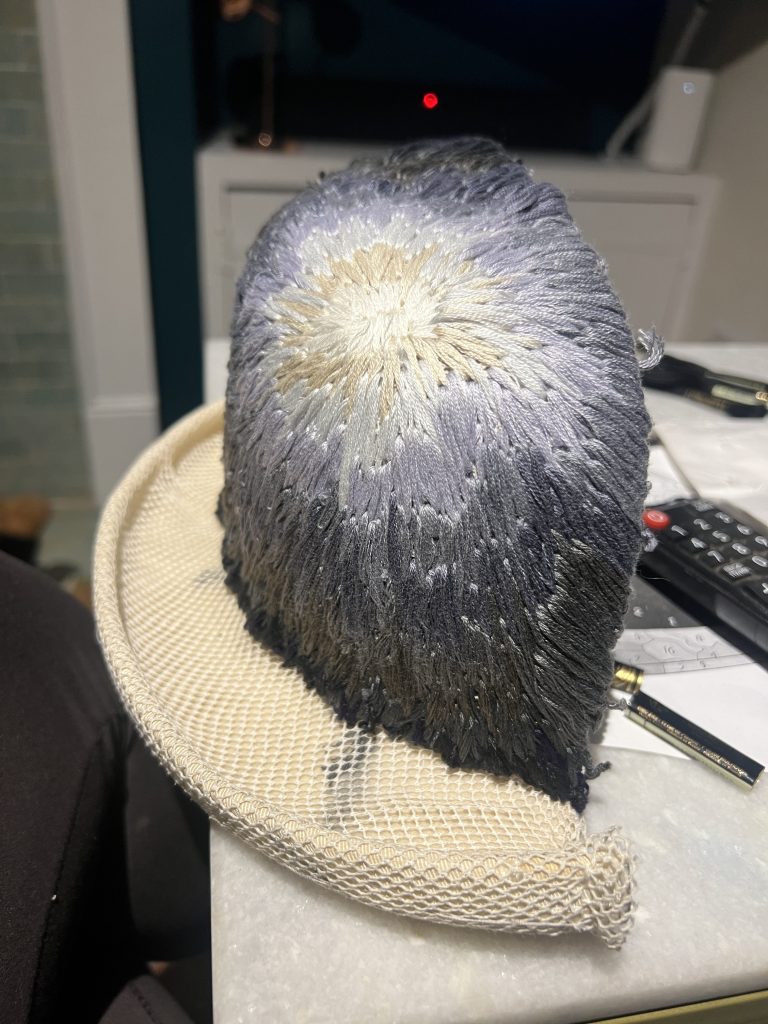
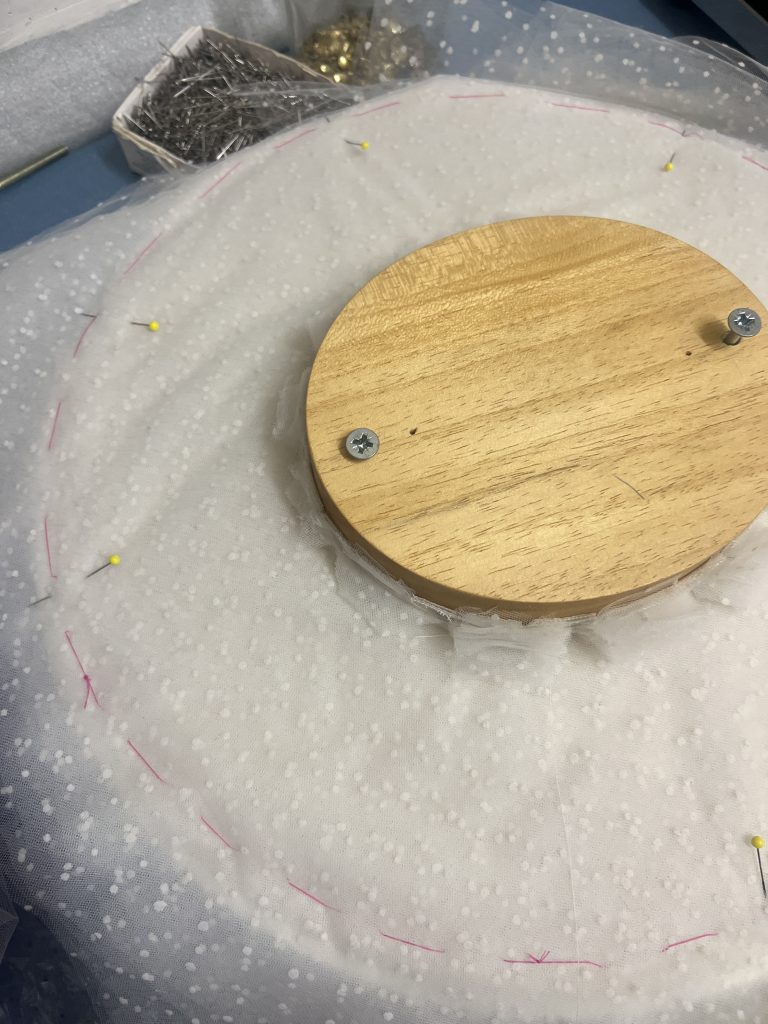
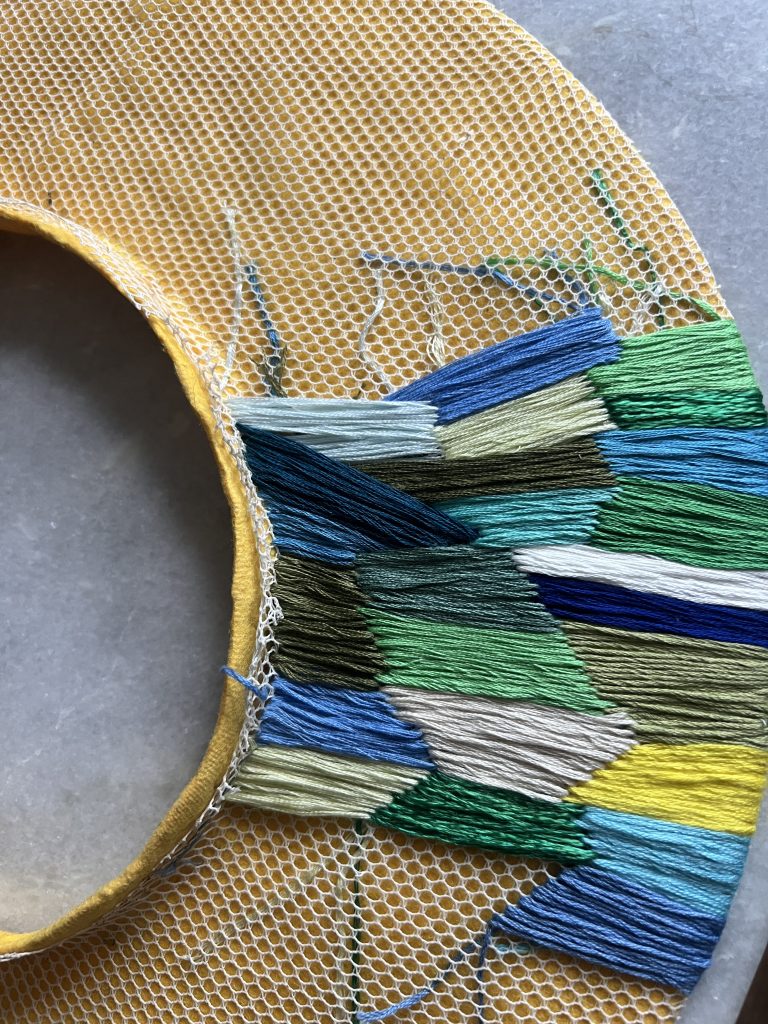
Inspired further by the idea of negative space that I have looked into before, I really wanted to look at what happens if you take away half a hat. I took a cream bowler from a charity shop that was a bit grubby and beyond repair and covered it in paris net, to allow me to stitch into it without going onto the felt inside.
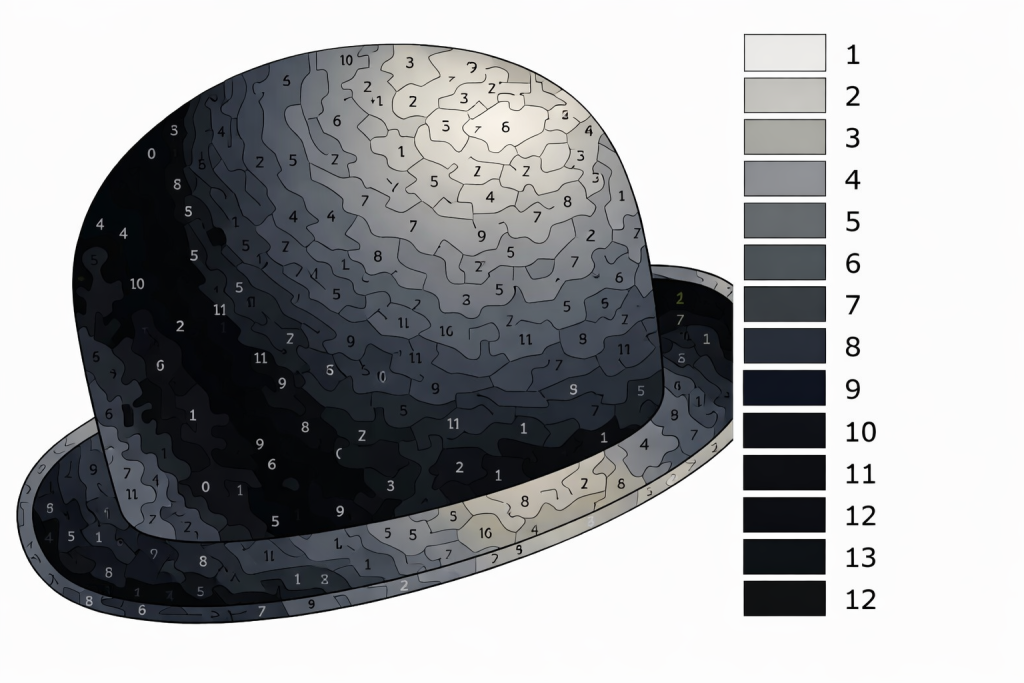
I then found a photo of a bowler hat online that had light and shading in it and put it into ChatGPT and asked it to posterise the image almost like a paint by numbers and then give me a list of DMC embroidery threads to purchase in the right colours.
It was both fun and frustrating using ChatGPT for this, I also tried with Gemini AI, but had similar struggles, whilst it could posterise the image, it could not number the colours and shades correctly, providing shapes that weren’t even numbers and then labelling the lightest colours as numbers that reflected the darkest shades. But I found that the posterised image gave me a visual guide to work from and that the actual list of thread colours to buy and quantity were fairly accurate, so whilst not perfect it gave me enough to go on and copy manually and by my own interpretation.
I liked with the traditional old school city working look of the bowler blended with the modern use of AI as a stark contradiction.
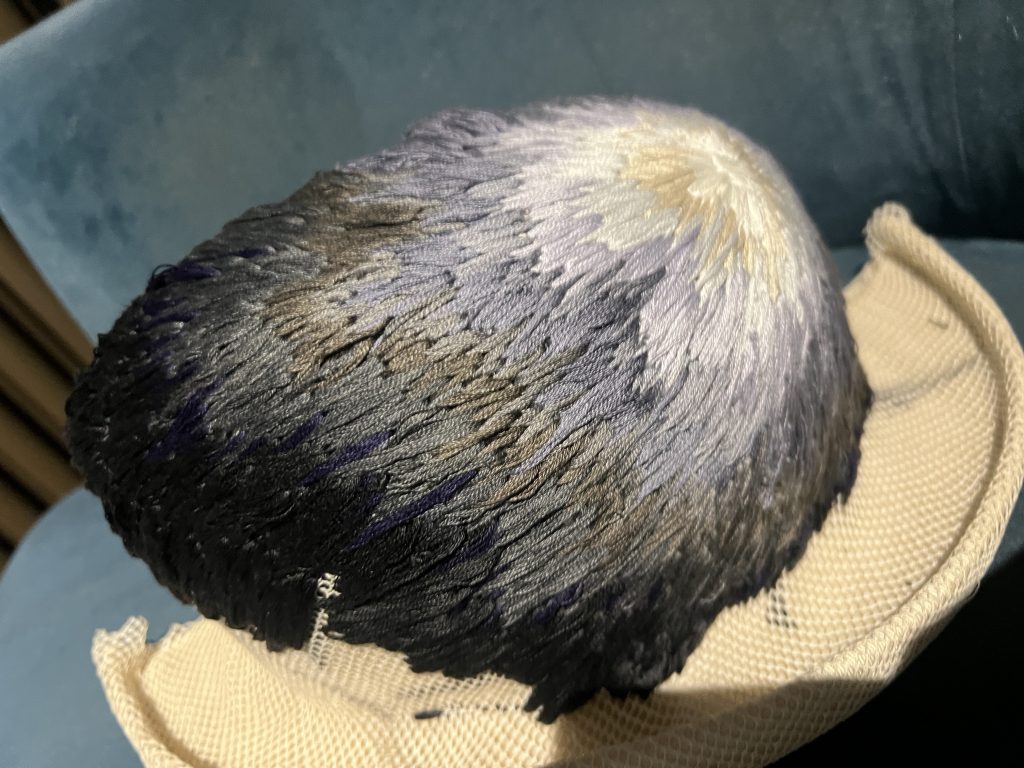
I wanted to embroider the shadows onto the hat using feathering embroidery stitches, I wanted to us this slow method of working to both engage me and my mind, but to also highlight the importance and value of craft and the time that it takes to do these things by hand. I’ve never really done embroidery like this before, but I loved exploring this new to me craft in a millinery setting. And I think the results worked well.
The light and dark reflects both hope and despair, depending on the angle you look at it you see light or dark, the deconstruction by adding the bare bowlers wired shaped from to the other half, speaks to the unravelling of the world, but also to the strength and scaffolding provided by everyday people. I loved this half and half metaphor playing out, a hat and a bare structure and black and white. Using a mass produced bowler hat from a charity shop also allowed me to play with the concept of mass production vs hand crafted in the same piece, how they can be blended together but how the decorative detail can add value.
This is more of an art piece and political statement, a gallery piece, I feel more connected this piece of work than the Bauhaus hat before, as it speaks more to my internal monologue as it is upcycling and craft mixed it not one, commercialism and craft working in paradox with each other. I also think it displays more technical skill and has furthered my skillset in making this piece. Approximately 24 hours of embroidery stitching alone. I am still not sure how it sits within my current practice, but I have enjoyed this exploration and it very much fits into my renewal, transformation and reclamation ethos.
Tulle Slashing
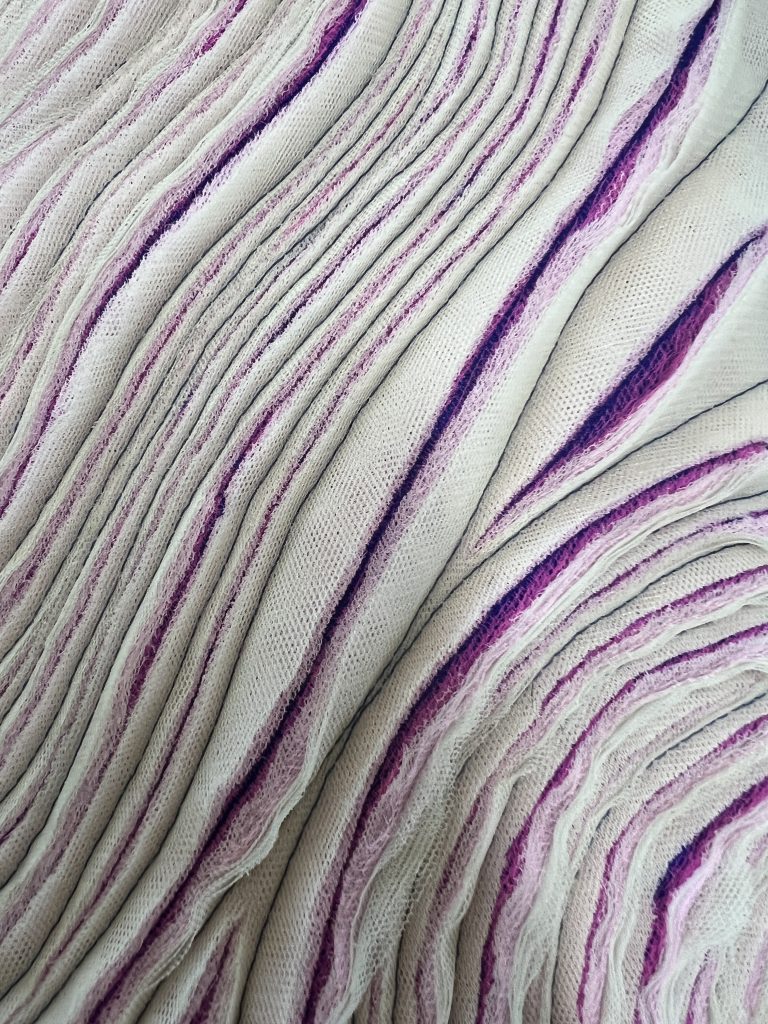
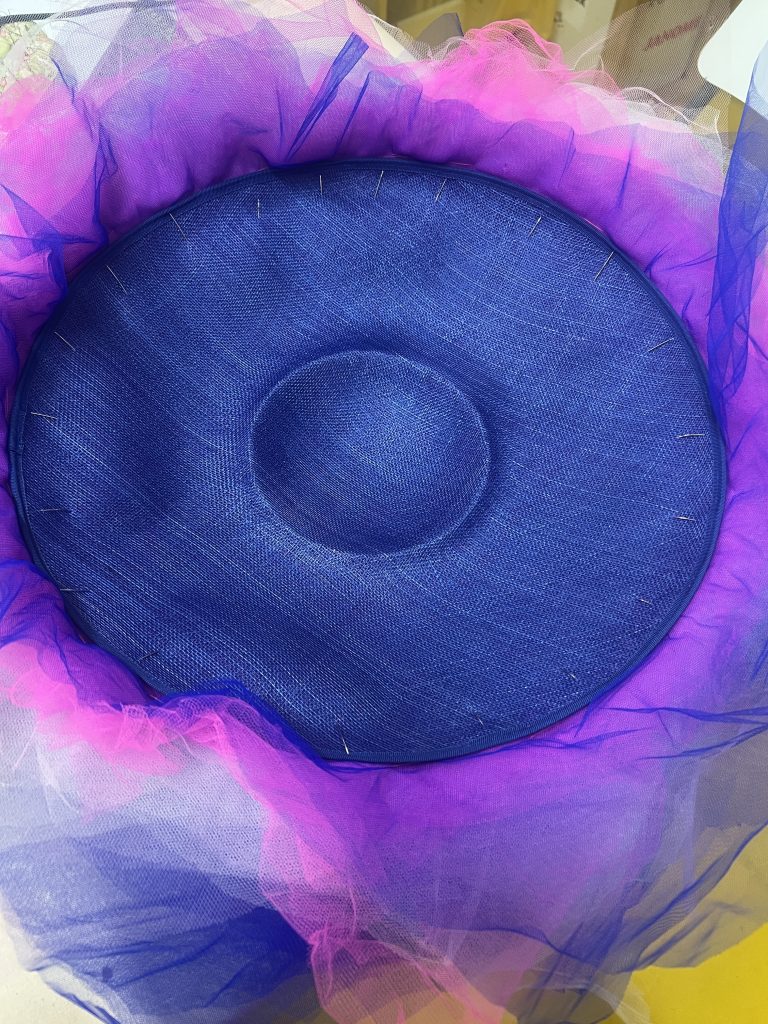
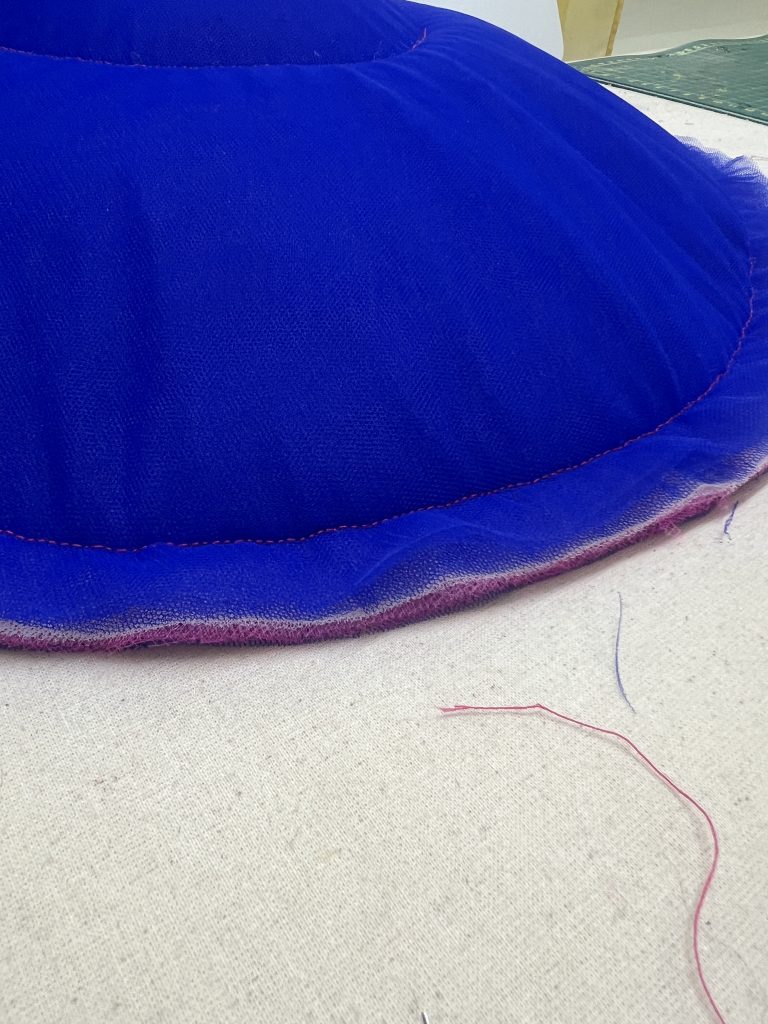
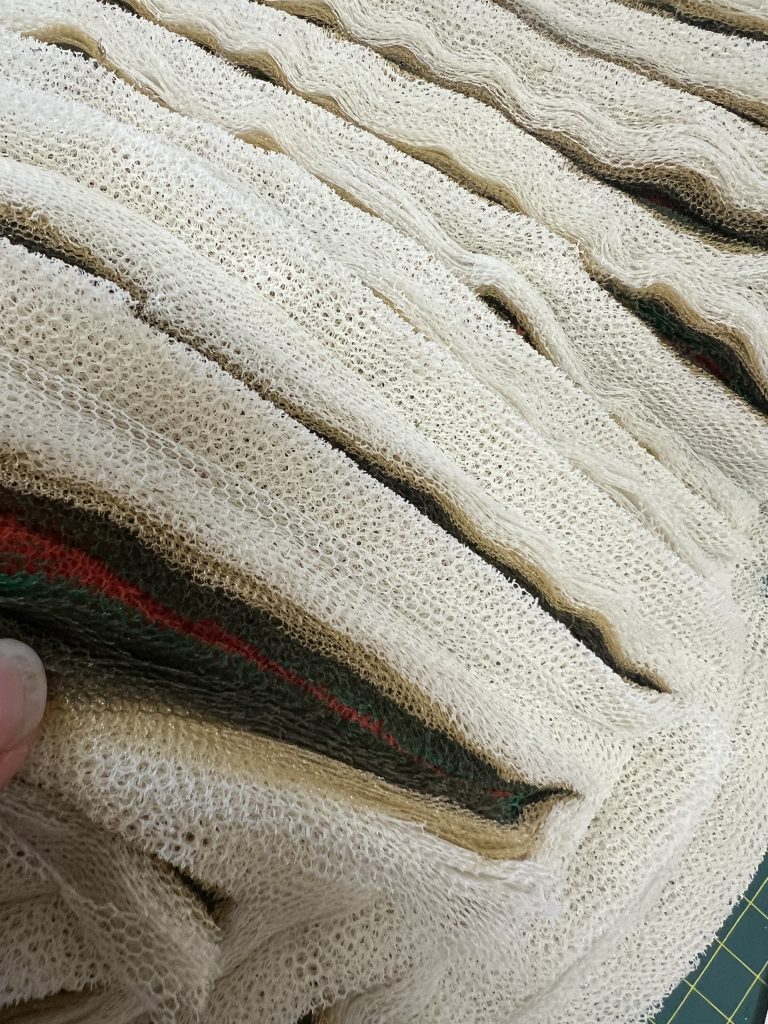
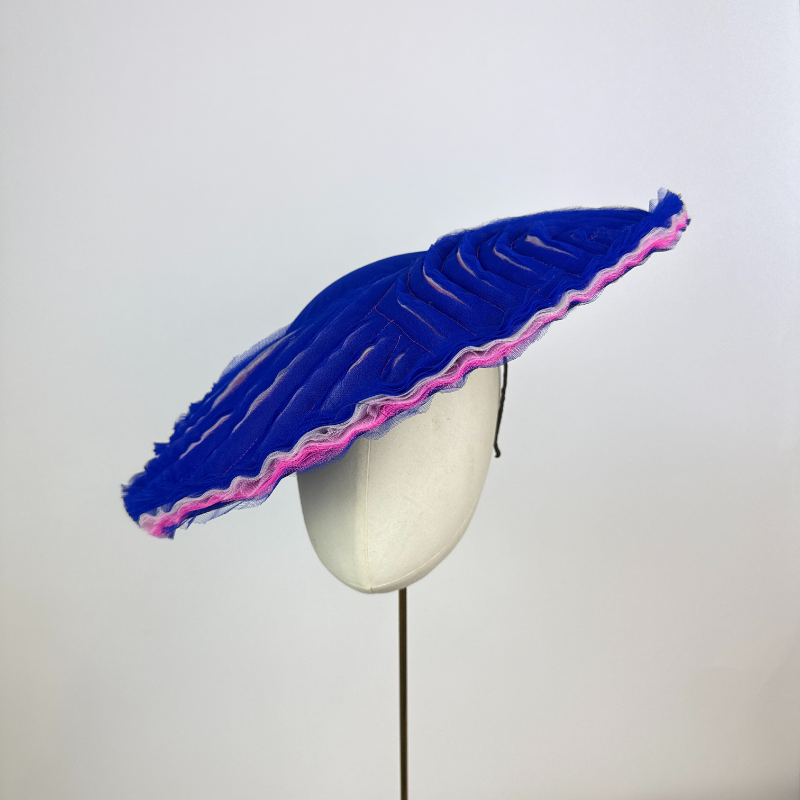
I created a couple of pieces after sampling a small amount, layering multiple layers of tulle on top of sinamay, free machine stitching in lines and curves and then slashing in between allowing the tulle to puff up and split, showing rivulets of the colours underneath. I played around with narrow and wide gaps between stitching. Interestingly I probably prefer my initial sample piece to others. I tried one all in white tulle, which is a fun and lovely texture, but maybe doesn’t make the use of the design as much as varied colours can. The blue saucer with hot pink underneath works well, it feels like a hidden story, it hints at depth and what would happen If you peeled back the layers. I left a longer edge on this one, allowing a ruffle and the full colours to be exposed from the side and I think in this case that is an exciting feature. It feels unusual and unique but also very commercial. I do think I would like to continue playing with this idea more. It is less conceptual but could tell a story. The negative is that tulle (unless pure silk – which also has it s faults in the world of sustainability.) is plastic. I’ve looked at a cotton alternative, but its chunky and heavy and does not have the bounce, I’ve ordered some ‘eco’ tulle which is 100% recycled material and complies with Global recycled standard, but it doesn’t come Iin the colourways so would require dying. So may also not be suitable as a sustainable design, as it is the colour that is really making these pieces come alive, seeing what is buried underneath as a metaphor for not taking things at face value. The tulle I used was just stuff I had left over in boxes that never really had a use. If I would fund a larger supply of deadstock tulle that could be interesting.
One of the pieces failed, firstly the shape I was aiming for was slightly too complicated, secondly, I used a mixture of different weight tulles, and the stiffer thicker ones just didn’t bounce up when slashed or have the lightness required. thirdly, because of the colour choices that I made, and the shape, it ended up looking like an unbaked croissant rather than a refined story tell piece of art or headwear! But trialling several different versions of this technique was helpful to help me find out what works. This technique feels more natural in design and style to me, and maybe there are some alternative fabrics that could be waste from other industries, such as fruit packaging mesh e.t.c that could be used to play on the idea further.
Crochet
In my bid to learn valuable craft skills, I have set up a crochet club, 4 of us meet up fortnightly to learn to crochet, I am currently still only developing the technique of using the needle myself, but I do want to explore how it an be used to trim hats and what materials it could be made from, flowers from vintage or recycled fibres or wire could lend itself very nicely to millinery.
Evo foam
Not a sustainable material, but one that I hadn’t really used before, it would be great for making lightweight headpieces, it is easy to colour with spray paint and can be shaped with a heat gun, and needs no finishing on the edge, it is a clean solid finish, in stark contrast to the natural materials traditionally used in millinery. I can see its appeal for theatre, costume and props and certainly I would use it again, but I don’t feel it fits as a material particularly well to my core values of exploration.
Photoshoot
We had our spring summer 2026 photoshoot, in this shoot it was a chance for us to show off our most interesting pieces and create portraits to use for our marketing. Most of the pieces in the shoot are extravagant and not reflective of what we sell every day, but these images are to be sued as our shop window, to set the tone and be aspirational for how our clients want to feel, they may not buy these pieces, maybe simpler or smaller pieces, but these pieces speak to them as to who they may want to be. We also got to play around with presentation, setting the tone, portioning and story for the brand. I used a team I had used before as I knew we all worked well together, which makes the day run more smoothly and the results more even.
I wanted to play with negative space a bit more so we had some hats which allowed us to play in this space, creating shadows on skin and on walls, allowing the light flow to tell the story over and above the model or the hat. Time limitations of having one day to shoot 35 pieces meant we could not explore negative space in depth, but I do love the idea of what is there may be in the parts we don’t see.
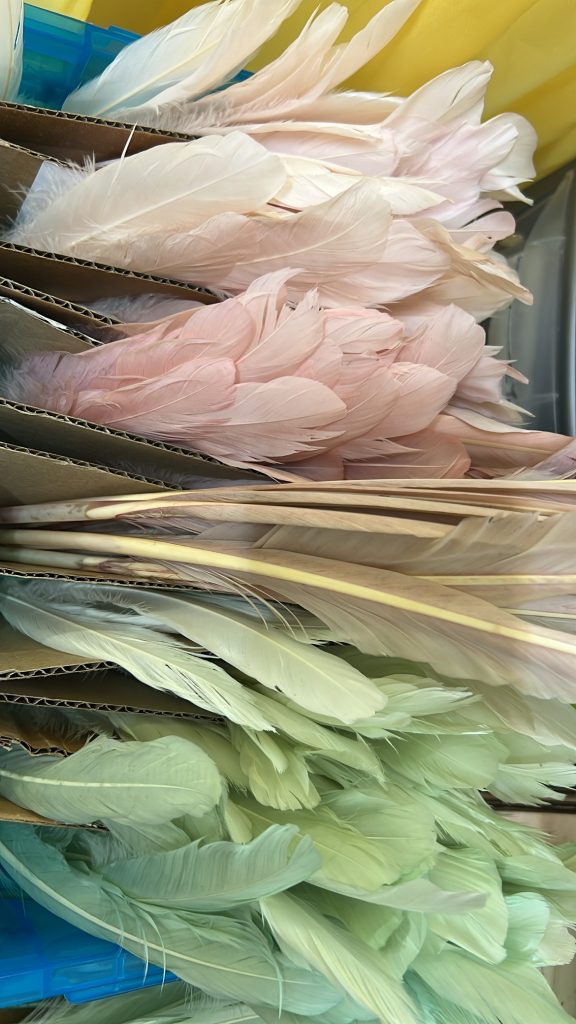
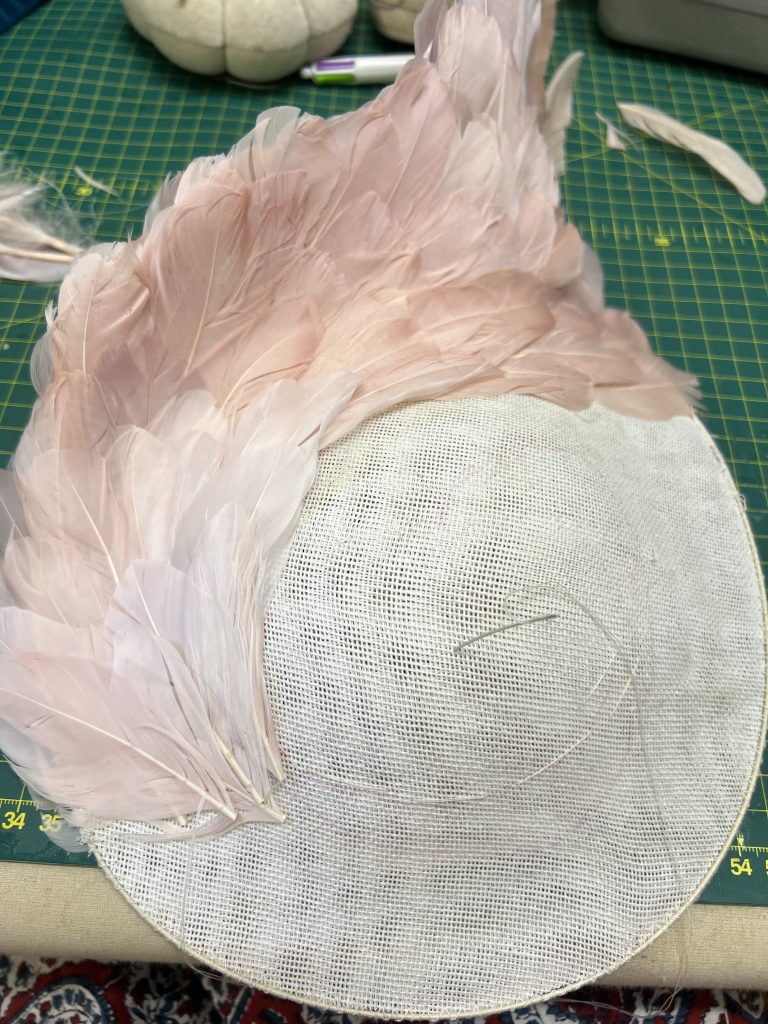
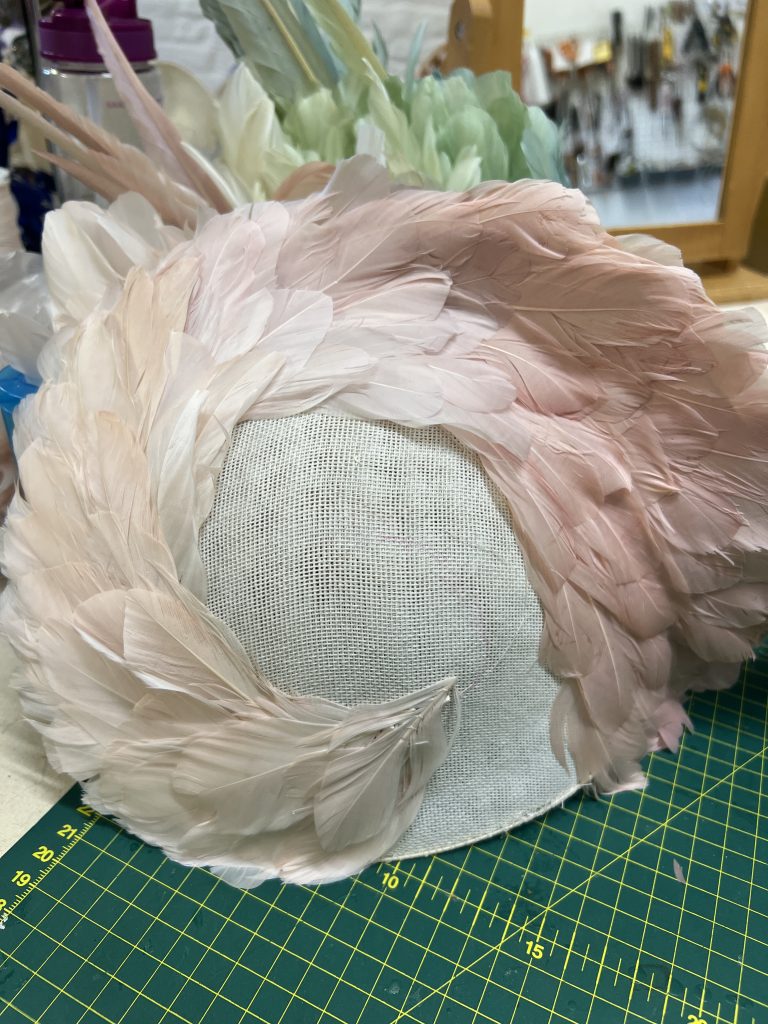
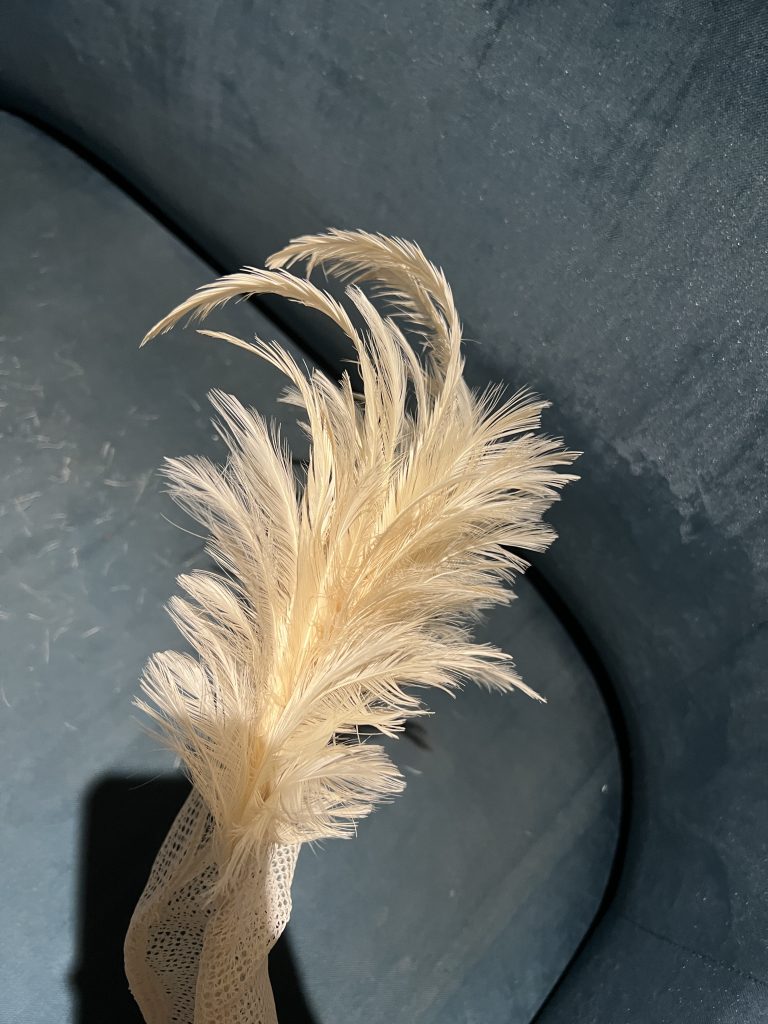
Some other pieces we made we hand dyed ombré twisted brim hat, each feather hand dyed to a gradual tonal shading, stitched meticulously into a swirls as the colours fade out, exploring the craftsmanship and the fact it is all natural feathers and all made by hand, not touched by machine, just nature and human hands. A feel of Schiaparelli and a lot of heritage craft, the renewal of feathers, becoming something new, recognisable to what they once were but changed by human touch.
We have also been experimenting more with scraps and off cuts of sinamay, making ombre and rainbow brims, from tiny scraps, we have used this method before in a more random order with bigger pieces, but we shrunk it down, made a feature of the stitching and it allowed us a much greater control over the design, and allowed for a cleaner and more luxury finish. Whilst lots of the work I have been doing as part of this masters started with the idea of using waste from my own practice, I have been lead slightly away from this idea, perhaps it is too limiting from an art perspective, but I do feel very connected to this way of working and it really makes me feel a lot of pride, creating beautiful things from waste, and it is something I can’t seem to move too far on from. I want to transform and renew and these methods allow me to do that. I love the fact all the shattered pieces have a story, that they came from the creation of something else, that the colours can blend from one to another, not seamlessly, but in a gradual ombre fading, imperfect but joyous.
Certainly, from my continued exploration I want to:
Transform
Renew
Reclaim
Explore heritage crafts and skills
Look at what is in the shadows, or what you don’t see at first glance (negative space / slashing techniques / creating new textures from waste.)
Be sustainable within my practice.
Explore textures in a sensory way
Basketry – horns
Paralysis paradox
Broken wings
Tied in knots
Frozen in time



















Phyliss Tuckwell event
Following up from previous talks about working with Phyliss Tuckwell hospice and their mountain of hats, we have now set a date for an event at there warehouse at the launch of their ‘craft week’
Named the millinery make over. This is the copy for the event:
Ready to give your hat a glow-up? Join us for a friendly craft night raising funds for a fantastic local charity and breathing new life in to hats ahead of the social season’s events!
Join us for a one-of-a-kind upcycling experience where Beverley has teamed up with Phyllis Tuckwell hospice to help you transform your beloved (or forgotten!) hat into a fresh fashion statement.
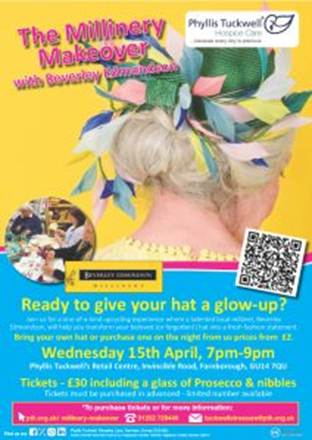
Add trims, reshape the brim, play with textures — and walk away with a reimagined piece that’s uniquely you, ready for a summer wedding, day at the races or fashion refresh!
Bring your own hat or purchase one on the night from Phyllis Tuckwell’s donations – prices from just £2!
DATE – Wednesday 15th April
TIME – 7pm-9pm
LOCATION – Phyllis Tuckwell’s Retail Centre, Invincible Road, Farnborough, GU14 7QU
TICKETS – £30 including a glass of Prosecco, nibbles and ticket for the raffle.
Book your ticket here: https://www.pth.org.uk/news-and-events/events/upcoming-events/millinery-makeover/
Tickets must be purchased in advanced – limited number available, so book now to avoid disappointment! Soft drinks will be on sale, as well as a selection of clothing, plus a raffle for you to win some fantastic prizes.
All Proceeds to Phyllis Tuckwell Hospice
It will be great to get out into the community and do an event with them. Commercially it is a marketing move, it increases my name locally working with such a fantastic charity, it also feeds in and will help form my ideas about what upcycling and sustainably millinery can look like in terms of this master’s degree. As well as hopefully raising some funds for charity.
- Follow up on this: Because we were using Phyliss tuckwells warehouse to host the evening, there would have been quite a lot of set up costs, unfortunately 1 week out from the event, they had only sold 9 tickets out of the 30 available, meaning the time that they had to take out to set uo, costs of nacks, prosecco wouldn’t make it worth it for them for the money back. So the decision was made to cancel it and possibly return to the idea later in the year. It was a real shame as we had both done a lot of social media work for the event and sne tot our mailing lists and it would have been a great event
Here are some fo the commercial issues that I believe may have resulted in,ow ticket sale:
Our client bases are maybe not yet full educated in upcycled fashion
Rather than thinking it was a fun craft evening, they thought ‘but I don’t need a hat’ F\or me the value would be in the evening itself and the experience, but maybe it was too focused on what the end result would be – which wasn’t something that anyone actually wanted.
It perhaps was not clear to an outsider what the event was/ what they would end up with in the end.
Perhaps the brief was too broad, and we should have narrowed it and made a video that actually showed the process of what would happen in the session.
In the meantime, we have the charity auction planned for may of the hat we recreated from the worst millinery donations that they had. So marketing on that will begin soon.
Here is some blurb:
A Second Life
Navy and ivory sinamay fascinator — hand-crafted by Beverley Edmondson and her team
This navy and ivory fascinator began life as a worn and battered and damaged hat from the Phyllis Tuckwell donation pile. Rather than consign it to landfill, Beverley Edmondson and her team saw a different possibility: to take everything the hat had been and make it into something new.
Almost every part of this piece came from the original hat. The brim was cut apart to reveal the blocked shapes within, then wired, bound in navy and twisted into sculptural curls. The stained edging ribbon was un-woven thread by thread into spools of ivory yarn, which were then crocheted by hand into the delicate lace flowers at the heart of the piece. The sinamay ribbons were trimmed and re-looped. The feathers were stripped, reshaped and re-curled. Only a new hairband, pearl trim and a small length of new edging were brought in from outside.
Every part of this hat tells a story, and that story is woven into every stitch, every curl, every hand-crochet flower. It embraces its history while being entirely ready for whatever comes next.
The finished piece meets the Royal Ascot Royal Enclosure dress code requirements for headwear: it is a formal fascinator with a solid base of 4 inches or more, suitable for race day wear or weddings.
All proceeds go directly to Phyllis Tuckwell Hospice, supporting patients and families across the local community.
Maker
Beverley Edmondson and team
beverleyedmondson.co.uk
Materials
Upcycled sinamay, hand-crocheted
flowers
In aid of
Phyllis Tuckwell Hospice
All proceeds donated
Dress code
Royal Ascot Royal Enclosure
compliant headwear
Bio Materials with Jean Ross-Timmes
In this session was a first look at bio materials and how it could be used in my work, I think it could work really nicely in some aspects so an overview of what could be done and some simple ideas that I can follow up on and develop further in my own time.
We looked at mycelium, and how to harvest it from fungus and how mycelium grows in webs that spread across to grow a fabric texture.
It was started by growing the mycelium in an agar and malt jelly in a petri dish. Ensuring that the whole system was kept sterile so that mould wouldn’t grow.
We saw examples from a few weeks later where a white almost spiders web type material had grown and this could then be planted in rye which would then grow into mycelium leather inn a controlled environment. This was a very interesting to see how it grows and how you can grow the mycelium into the shapes, but it did not really excite me in terms of hats.
We then looked at making scoby, which was much more accessible, but also I would see better how the results would work for me.
Method:
Strong black tea – cold 1x tea bag x 1x tablespoon sugar
Koomboocha – lumpy stuff with bits in the bottom
Apple cider vinegar (with bits in the bottom.
Poor ¾ pot full of strong tea, and table spoon of apple cider vinegar to create a reaction. Add 1/3rd komboocha.
Cover with clingfilm, add air holes then cover holes with microfibre tape – leave for ¾ weeks
Lift the ‘skin’ off the top
Dip in a bath of coconut oil and beeswax melted mix and leave to dry
Pick off the wax (the wax acts as a moisturiser)
Then leave to dry over desired shape.
We also made agar bio-plastic (see attached recipes) which was very simple and effective and I can see has many uses.
It was an insightful session and I’m looking forward to playing more and developing it into my work. I think it sits alongside lots of my sustainability goals, my topics of conversations that I am focusing on (the paralysis paradox / transformation e.t.c).
To follow up initial thoughts:
It may be worth me exploring cellulose leather more as apparently this could be blocked which would be useful in a millinery context.
Ideas create a root system in millinery – perhaps grow grass through sinamay and dry out the roots – beathing life into old hats. Using the ideas of rootful but using something cheaper and more accessible.
Ideas – use bio plastics to creates shards/ mask effect for ‘frozen in time’
Ideas create shards for frozen in time from bio plastics / agar – natural dyes
References:

