September 25
Starting of by thinking about how sinamay fabric scraps can be used to create a whole new material.
I started my practical research off by taking ivory sinamay offcuts, cutting them down into small pieces and boiled them in water and bicarbonate of soda.
I added bicarbonate of soda as ‘alkaline solutions have recently be investigated to modify natural fibres, altering their surface (Sanfilippo et al., 2024) I looked at cellulose fibres, as from my knowledge of Sinamay material, it is made from the fibres of an abaca plant and is therefore cellulose based.
After several hours, the pieces were very soft and loose, so using forks I pulled the weave apart to create individual fibres. The fibres were now a dull grey colour instead of ivory.
I took half of the fibres and used a Nutri-bullet blender to make them into a substance that looked like a grey soggy paper. The other half I left to dry without pulping, to see how the fibres had changed from before they were boiled and mixed with bicarbonate of soda.


Sinamay once boiled and shredded
I had only made a small amount of pulp, but it looked like it had the right consistency for making a paper like substance.
At this point I thought that it may be useful to understand how paper is actually made, so I watched a simple You Tube tutorial (NevermindPaper, 2021) on how to make recycled paper at home, to give me a brief overview of how paper is made and therefore how I can apply it to my research.
I then thought as a final product could be very similar to handmade paper, many of which are made out of plant or cellulose based fibres that perhaps I needed to see if paper could be blocked and shaped like traditional millinery materials such as sinamay or felt.
I purchased a sheet of Lokta paper (made in Nepal from the Daphne bush). I choose this paper as it is similarly made from cellulose fibres, so I thought there may be some comparable properties between the fibres, which may give me an understanding of how the pulped sinamay fibres may work in a papermaking form.
I choose a simple curved headband hat block to mould the paper over and wet it lightly with a misting spray, the paper curved really nicely over the block, but on the sharper turns, the moisture made the paper quite week and liable to ripping, so I had to be very delicate, also on the tighter curves, I could not pull out creases, however I could by pulling and stretching minimise them down to quite small, but not to a perfectly smooth finish.
Once dried, it slipped off the block perfectly and has held a crisp shape. it is a bit softer than you would like for millinery, but I would usually add a stiffener to Millinery materials, which I did not do in this instance, but I’m sure would be very possible.
Blocking with the Lokta paper gave me a good understanding of the limitations of what using paper making techniques using cellulose fibres may be. And gave me an idea of what I would need to look out for. i.e. how much stretch is realistic from the fabric and how it would hold together with the requirement to add water in order to block it.

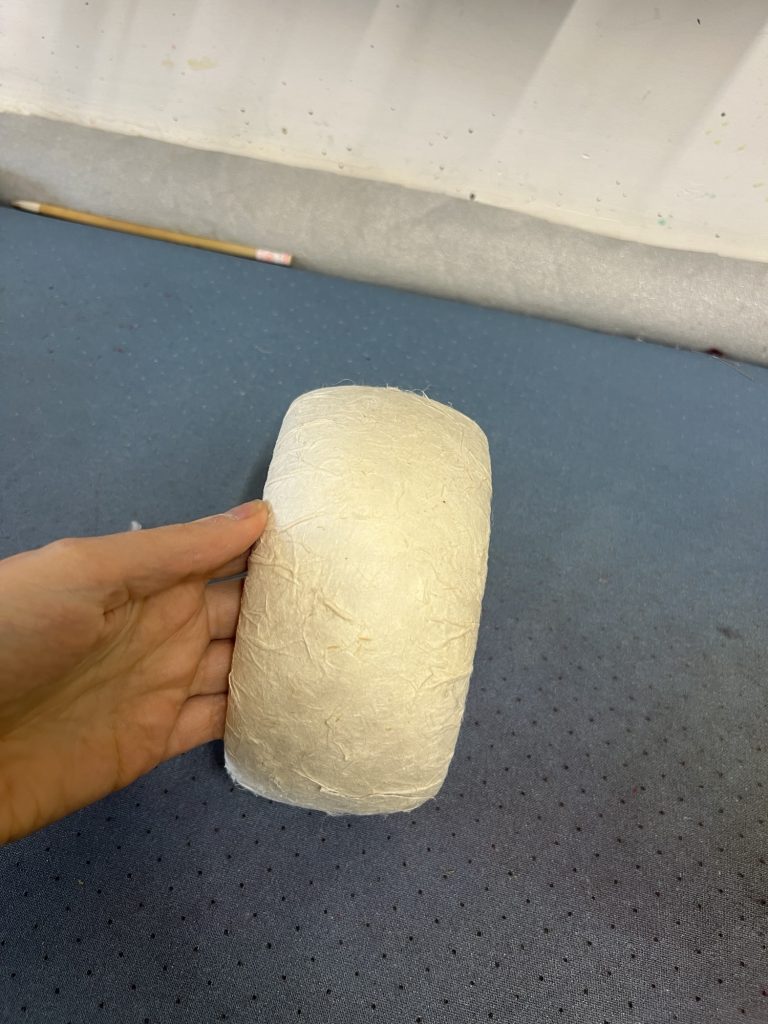


Lokta Paper
As I had only pulped a small amount of sinamay, I did not have enough to assess it in a paper making technique way, so I decided to make another batch. At this point I was more curious on the use of why I was using bicarbonate of soda – so conducted a little more research into this. when I had first viewed this paper (Sanfilippo et al., 2024) I had glanced over it and read that the alkaline of the bicarbonate of soda would breakdown the surface texture, which is great for fibre bonding, one of the requirements I was after, but I had failed to look and see that it could also improve the toughness and strength of the fibres – which are not properties I am looking for. So perhaps I need to, rethink this usage and consider if using the alkaline solution is an aid or a hindrance in this usage – as I believe it may also be having an effect on how the colour of the sinamay and original dyes is affected too.
Locating Creative Practice

2/Oct/2025 1st unit – a taste for everything – feel our way into the course
Making stuff / Developing ideas / Research / Expanding creative vocab / Refining skills / Collaborating
Head topic – Research – includes all above.
Finding a way forward into something – find a direction/ focus / persona.
What do I need to know?
- The umbrella of everything that needs to know.
- Something concrete – deadline – practical instruction
- What are we researching?
- What is knowledge? Within the realm of creative production
- Going to exhibitions – looking outside yourself/ places/spaces/experience
- Inspiration from others – voices of others
- Find an item- go backwards – deconstruct / archaeological approach.
- Feelings / intuition
- Creating unconscious connections vs solid concrete info.
- Get out of comfort zone – new ways of thinking – learn failure.
- Engage with case studies / research.
- Looking and emergence
Always acknowledge sources.
Bad research = basic facts, boring but factual, propositional knowledge our research should include all ways of thinking below:
Research is not just finding out facts – look at other ways of thinking, some of that will be personal.
Include everything for framework, Document everything and integrate research – be more thoughtful and link back.
James Elkin: What is research?
| Type of Knowledge | Definition | How It’s Gained | Main Focus / Domain | Example | Overlap With Others |
| Visual Knowledge | Understanding derived from visual perception—seeing, recognising, or imagining spatial relationships. | Observation, visualisation, perception, or visual data interpretation. | Sensory and spatial understanding. Are we seeing the same thing? Helps us understand relationships between ideas when presented visually. | Reading a chart, recognising a familiar face, imagining a design. | Overlaps with phenomenological (perceptual experience) and practical (visual skills in doing). |
| Practical Knowledge | “Know-how” the ability to perform actions effectively and skilfully. you can do but cannot necessarily explain it. | Requires thinking about a lot before it then happens naturally. Skills acquisition through firsthand learning. Practice, repetition, embodied experience. | Doing, performance, skill application. experienced based, do – fail – feedback -improve. | Playing an instrument, driving, or cooking. | Overlaps with tacit (implicit knowledge) and phenomenological (embodied doing). |
| Tacit Knowledge | Implicit, non-verbalised knowledge that guides judgment and action. Ill-defined, hard to put into words or explain to others | Experience, apprenticeship, intuition. Skills acquired Unconsciously through interaction and observation rather than formal instruction | Unspoken, intuitive mastery. Nuance | Knowing how to balance on a bike or read a room’s mood, or recognising faces | Overlaps with practical and affective (intuition, empathy). |
| Phenomenological Knowledge | Knowledge from lived experience—understanding how the world appears. hard to capture in writing – the ‘being embodied’ is what it is. | Reflection on your own experience and perception. not objective facts but individual and contextual understanding of what it means to have experience. | Awareness, presence, embodiment. | Knowing the feeling of fear, fatigue, or joy. sense of what is to be human, climbing a mountain. | Overlaps with visual (perception), affective (felt sense), and tacit (lived action). |
| Affective Knowledge | Knowledge grounded in emotions, moods, and empathy. a feeling about something or emotional connection. | Emotional experience, empathy, Holistic process, attitudes | Feeling, emotion, interpersonal understanding. Impacting someone emotionally (music can do this at its core) | Knowing someone is upset without words; responding compassionately. | Overlaps with phenomenological (felt experience) and tacit (emotional intuition). |
| Propositional Knowledge | “Knowing that” something is true factual, conceptual, or theoretical understanding. Binary understanding. | Learning, reasoning, studying, logical inference. good evidence or rational justification. | Truth statements, facts, theory, language. | Knowing that London is the capital of England, 2+2=4 | Overlaps with practical (when theory informs action) and visual (in conceptual representation). |
In art can research be defined?
Is it about Interaction with art or research in art (by ‘doing’ rather than talking about art)
Not academic, scientific, or creative.
Research models cannot meet both scientific and creative models.
Hypothetical deductive research / Interpretive research / Constructive research
Keep creativity flexible and non-institutional but be specific with precision where possible.
Can be seen as rhetorical information against the quantification being imposed on it.
The word knowledge is not well formed in visual arts.
Knowledge either is the visual object, or knowledge is embodied by it- to be extracted from it – knowledge interpreted within the object.
How is knowledge related to the artwork?
Do you need to describe artwork because either…it is knowledge or your write about whet it embodies which defeats object of having the object as you need extract knowledge from it?
Articulate your work, self-reflection.
Problematic History of artists- full of artist who could not articulate their art.
Does self-reflection create better art? Is a tacit assumption that it does?
I found this tutorial a very interesting tutorial, however it took me a little time to really place each of the 6 research methods, whilst some were obvious, some needed more clarification, so I created the grid above in order to better understanding of each element and how they interact with each other. This has given me a much-cleared insight. I then watched the research methods video with James Elkin. which explained the problems about trying to nail down research methods in the creative world, how it can be impossible to articulate some things, how it is impossible to quantify certain other things and how it really cannot be defined.
October 25
For this batch I took any sinamay scraps in any colours or grades, chopped them into small pieces and added them all to a boiler with a little bicarbonate of soda. I left them in the water for 48 hours to soften and become loose. This time instead of using the forks to pull the fabric apart, I put the pieces in a food processor…I would hoping this would go straight to pulp, but it turns out a food processor is not the same as a blender, so all it did was shred the sinamay. I am also thinking that next time this step could be skipped and go straight to a blender.
I then bought a cheap blender to blend the shredded sinamay, unfortunately shredding the sinamay was too much for the new blender and it burnt out the motor on the first go.
I then went back to my Nutri bullet blender but found this time I did not get a paper pulp type texture, it was much more fibrous with long fibres still within it and not the texture I expected. This is because mixed loads of different grades and colours together in this batch, unlike how I was selective on the first batch. from a visual inspection it appears that the stronger colour sinamay fibres have remained the most intact…..I wonder if this is something to do with the amount of dye they contain to get the strong dark colours, or if it is down to using a mixture of varying grades of sinamay. Also, the overall colour is a much darker grey than when I just used ivory sinamay.


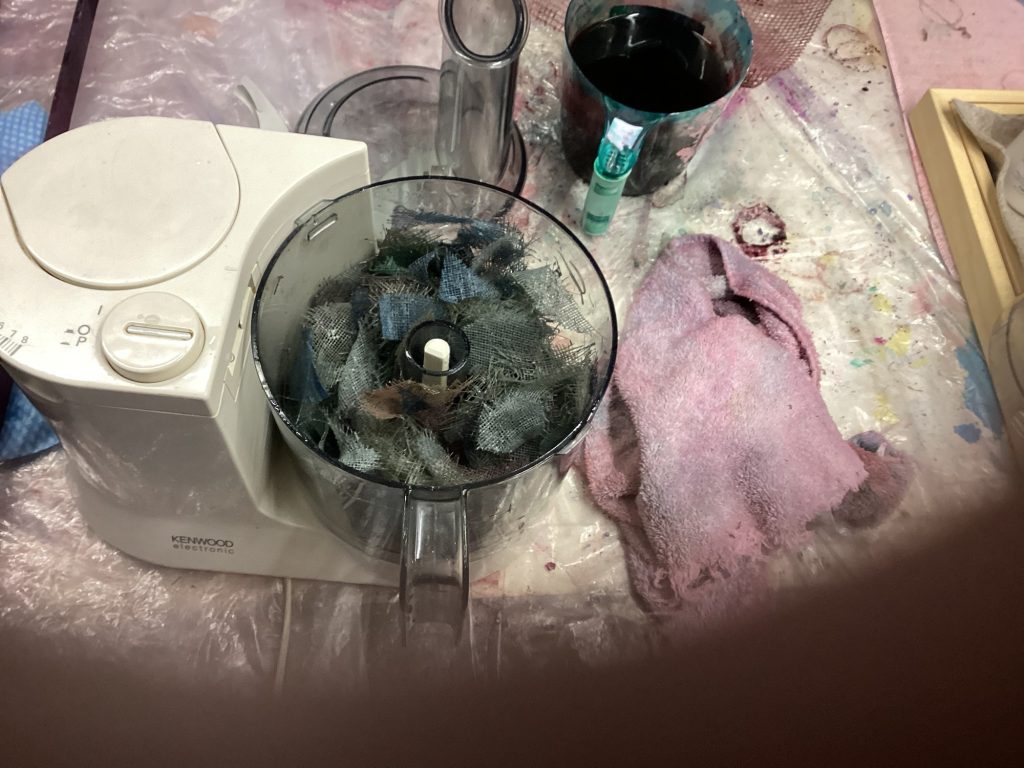


Looking at the structure of the fibres and the openness of them I wonder if now they are split, more broken down as fibres and rougher if wet felting maybe a technique that could work if the fibres are in this condition? (Hearle, 2000)
I decided to try paper making so added the pulp into a large vat of water and used a mould and deckle to spread and drain the fibres, creating a sheet and then left this to dry with a weight on it as seen on https://www.ghanapaperproject.com/ social media.


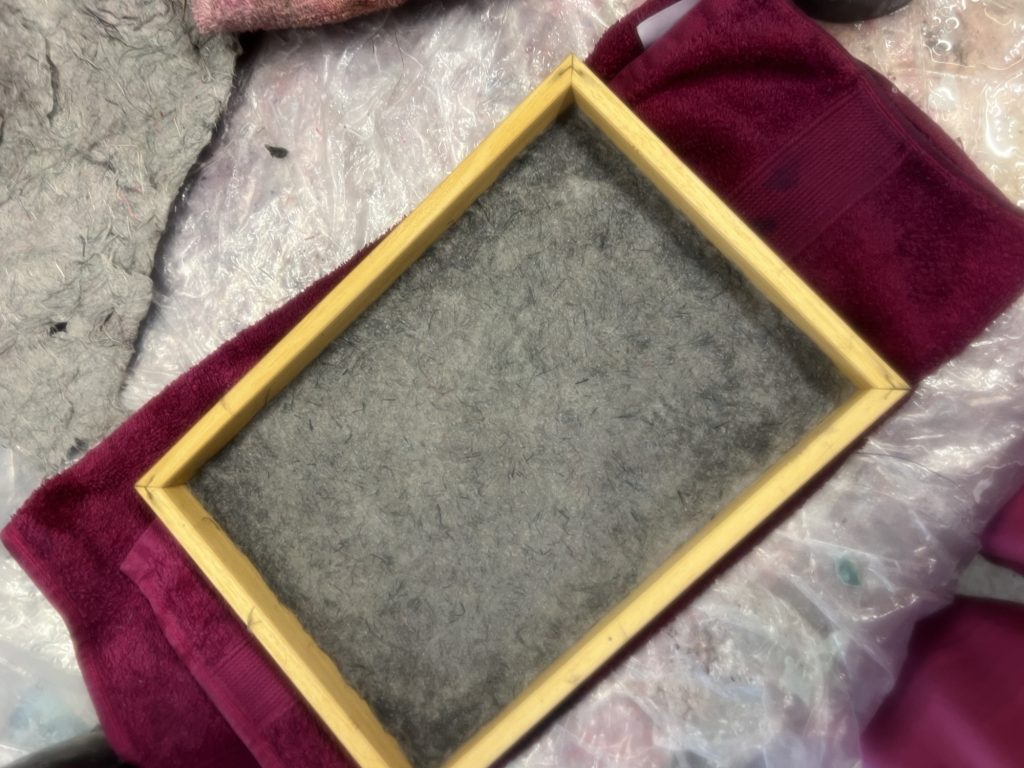
9/10/25
Ny notes from a lecture about how to research and tools we can use to assist.
Research = good stuff to find out about
look up Critical theory reading list – Reddit https://www.reddit.com/r/CriticalTheory/comments/1ljxft/critical_theory_reading_list/
Creative subjects – essentially you know everything about everything.
Find balance how much to engage with critical theory, Critical theorists can back up your work can help you explain what you’re trying to explain. Find who you like and interpret.
Look at subject research list and watch take notes etc.
https://www.jstor.org/ – access to academic journals
The internets own boy documentary. https://www.imdb.com/title/tt3268458/ activist for freedom of information on the internet
there exists a search engine library for millions of books and papers, aiming to preserve and provide access to cultural knowledge. (grey area legally)
library app – calibre eBooks management – for organising e-books or making into required formats.
Correct referencing – we are assessed on Harvard style referencing format.
Reference an idea, quote, or paraphrase outside of own knowledge
Keir Starmer talked about the need for ‘cutting the red tape.’
Whoever wrote it (Comerford 2025)
In text citation = Surname and year
THEN Bibliography – a separate page at the end
Use www.mybib.com
Download as you go create a bibliography – if it is a book – reference page number.
Green, R., Trott, F. and Georgieva, G. (2025). Children as young as four taking knives into school, BBC finds. BBC News. [online] 9 Oct. Available at: https://www.bbc.co.uk/news/articles/c77d06vde4po.
Pernecky, T. (2019). Post disciplinary Knowledge. Routledge.
Notebook LM
Upload books or couple of books – will only give info from that book – so can extract info from it. AI. Tell me what I need to know – ask direct questions such as:
‘I’m doing an MA in creative practice, what is going to help with my creative practice? Show me this focus from this book.’
Can critique your own work.
Summarises information and extracts useful information.
Audio overview
Free tool…….
Compare multiple sources – debate different perspectives.
So much info out there – helps you get into information that is of interest and of use to you. Use this as a way to get in.
Need to able to extract quotes to be able to reference.
Ethical view of AI – we are not cutting away creative voice but enhancing our access to knowledge.
It is a summary machine.
Copilot/ ChatGPT try to train you…and can provide false info.
Think about Ethical research methods – Text generation can provide false info.
Maybe say to ChatGPT: Strictly as a sub editor – can you help how I am expressing my ideas without changing content.
Write a statement for how I used AI.
It was really interesting to see how AI can be used to help us work, how we can summarise texts where maybe most of it would not be of relevance, so it will quickly cut out the work involved in finding the relevant texts and summarising for us. I am surprised by the amount of AI that would be allowed, but this is probably just a lack of understanding on how modern education works and how it has no choice but to function alongside the evolution of AI in this day and age.
10th Oct 2025
Initial ‘paper’ experiment is nearly dry; colour has lighted a lot – which has encouraged me as I thought it may be too dull and dark to be able to dye over. If next time I was to be more selective over colours in batches of pulped sinamay, I think this could be controlled even more.
The texture is quite thick and as I bent it holes and chunks appeared. I wonder if I need to pulp it further, or perhaps almost roll it together like you would with wet felting? I also wonder if it will ever look ‘smart’ enough for the applications that I plan to use it on. I need to think om this idea and concept a little more, research a little bit more into papermaking with fibres, look at if I need to add any glues or stiffeners to it as well.


14/10/25
I used my Nutri-bullet blender on the remaining pulp that I had created for the first attempt at making paper as this worked excellently on my first attempt, however this time it still didn’t get it to quite as fine as previously when I did it with the initial small test batch, which was disappointing. Looking at other blenders available and unless I want to spend a lot of money on something that may not work, I cannot see a blending tool that would be more powerful and affordable.
the second attempt once dried was still much more lumpy than I wanted it to be, so I tried blending it again…this is when my Nutri-bullet blender had enough….so 3 blending tools in and 1 completely unsuitable, and 2 which the motor gave out…If the point of this project is to be sustainable, then getting through 3 blenders in the same number of weeks, does not make this a sustainable method of working.
I took scissors to chunks of the pulp to cut it up finer by hand, very time consuming, but did make the longer fibres shorter, the pulp in water was a lot looser and when I used the mould and deckle to create the paper material, it was much finer and thinner than I had previously achieved.
Whilst waiting for this sheet to dry and see if the texture works for the required applications I need to look at other ways of shredding/ pulping the material which will be sustainable. luckily, I have enough of this pulp to start trying it with sizing’s and glue too, to see if that make any differences to the uses.


Second attempt, dried
Exhibition visits 16/10/25
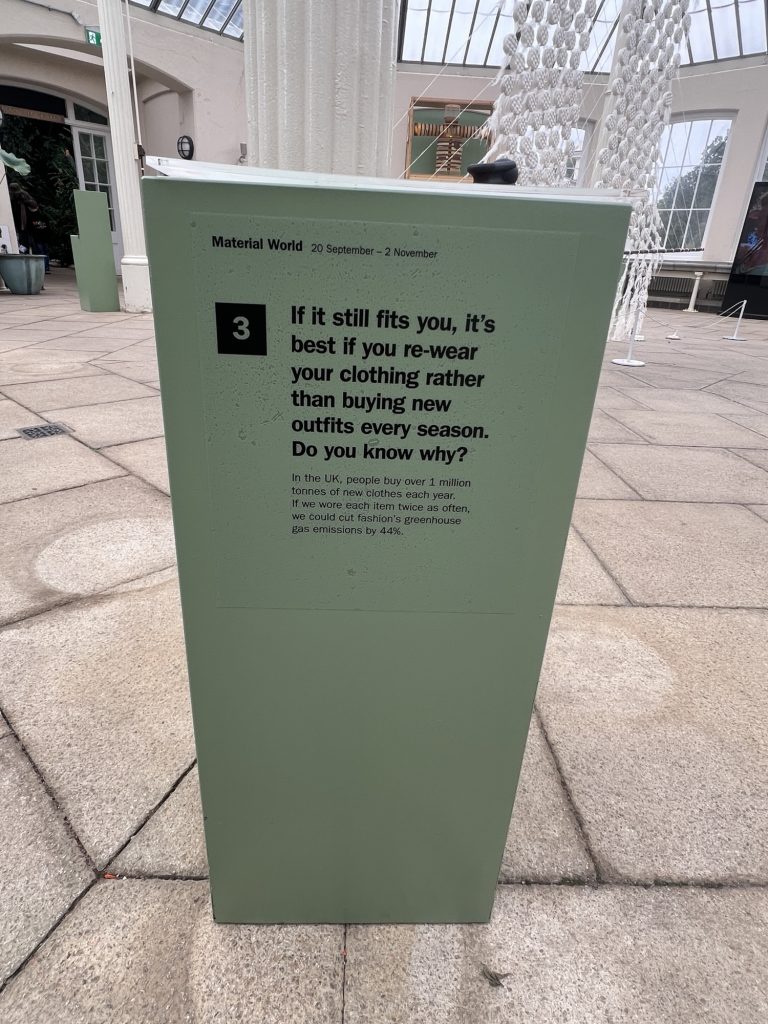
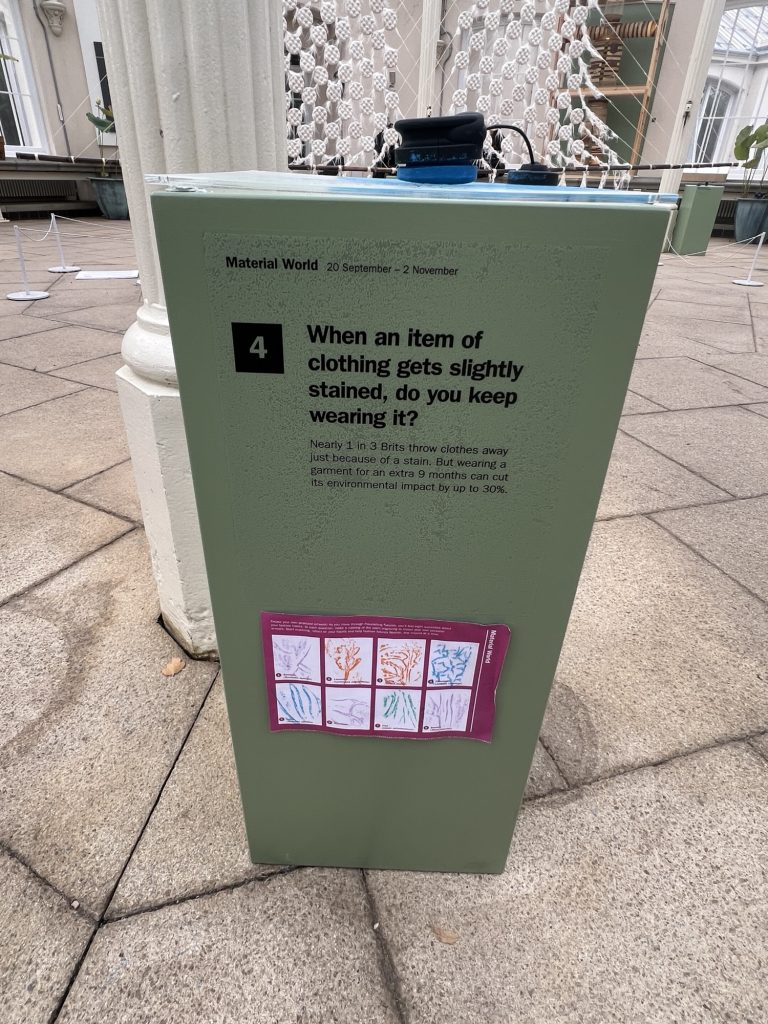
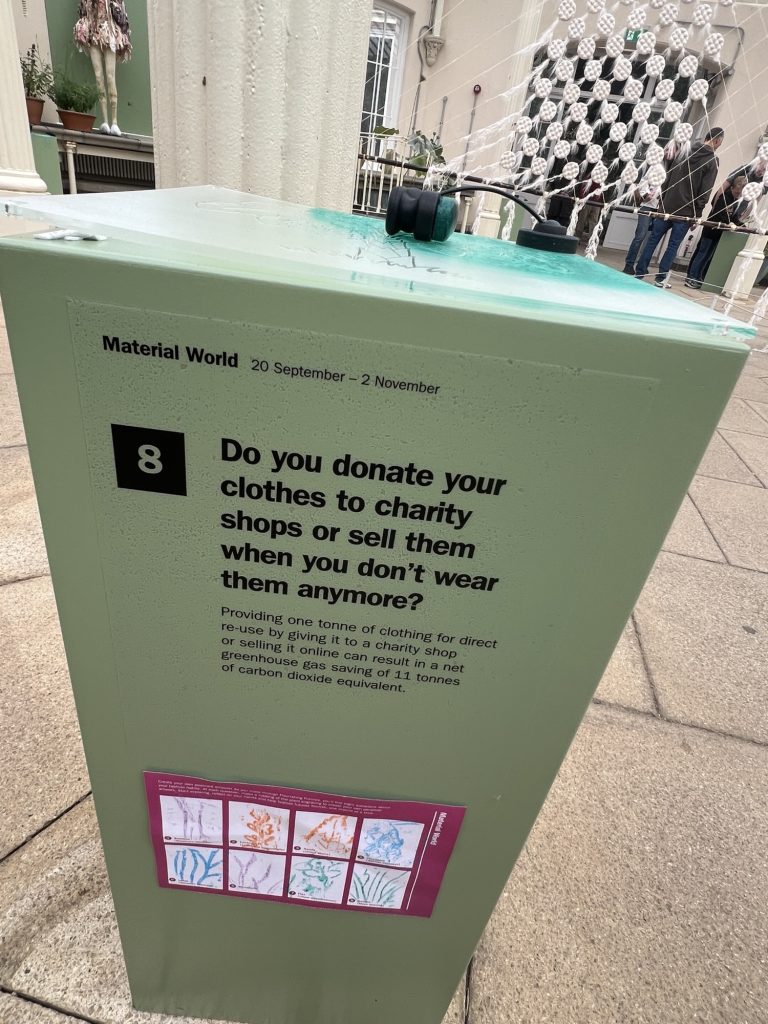
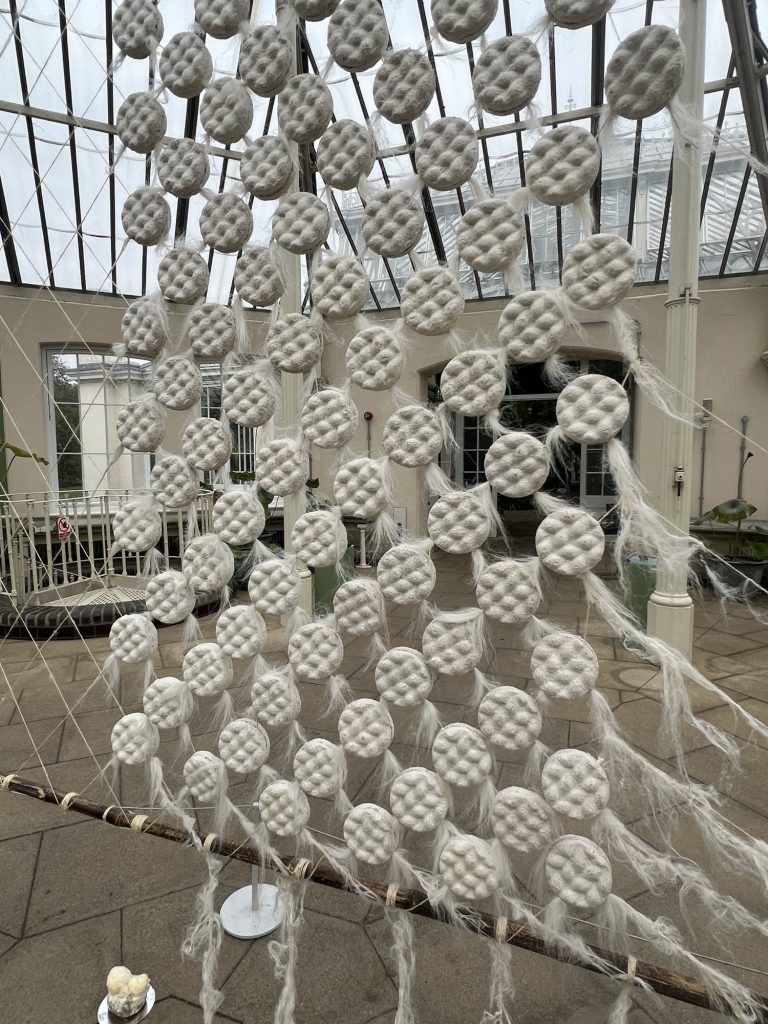
Material World Exhibition – Kew Gardens
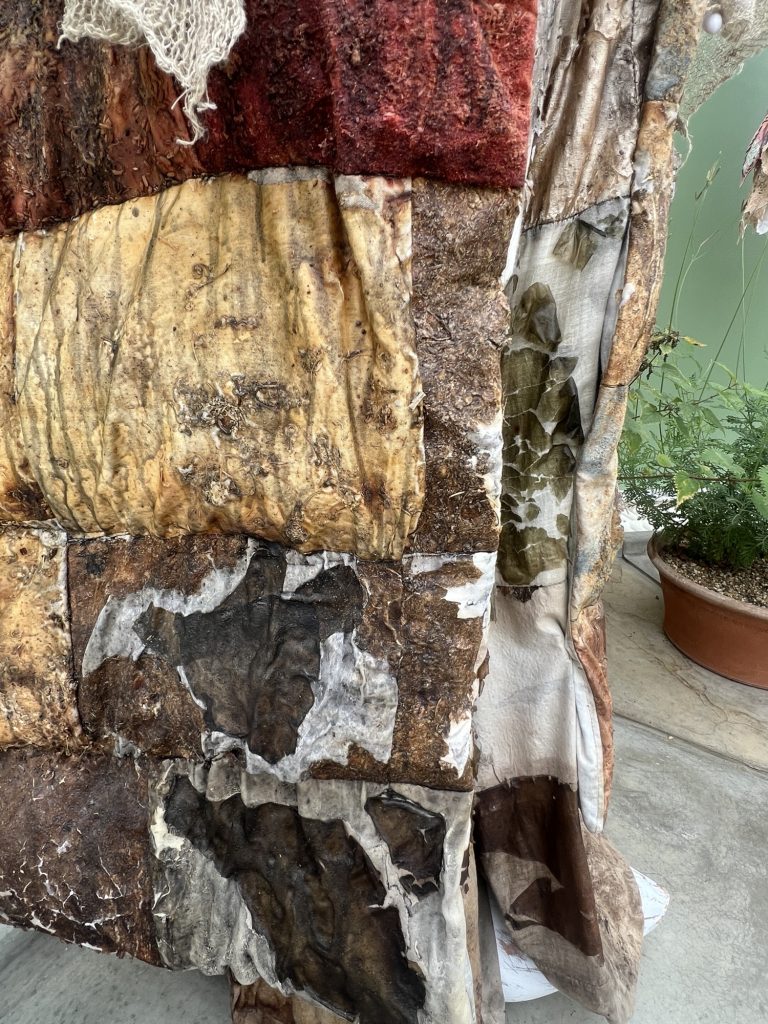
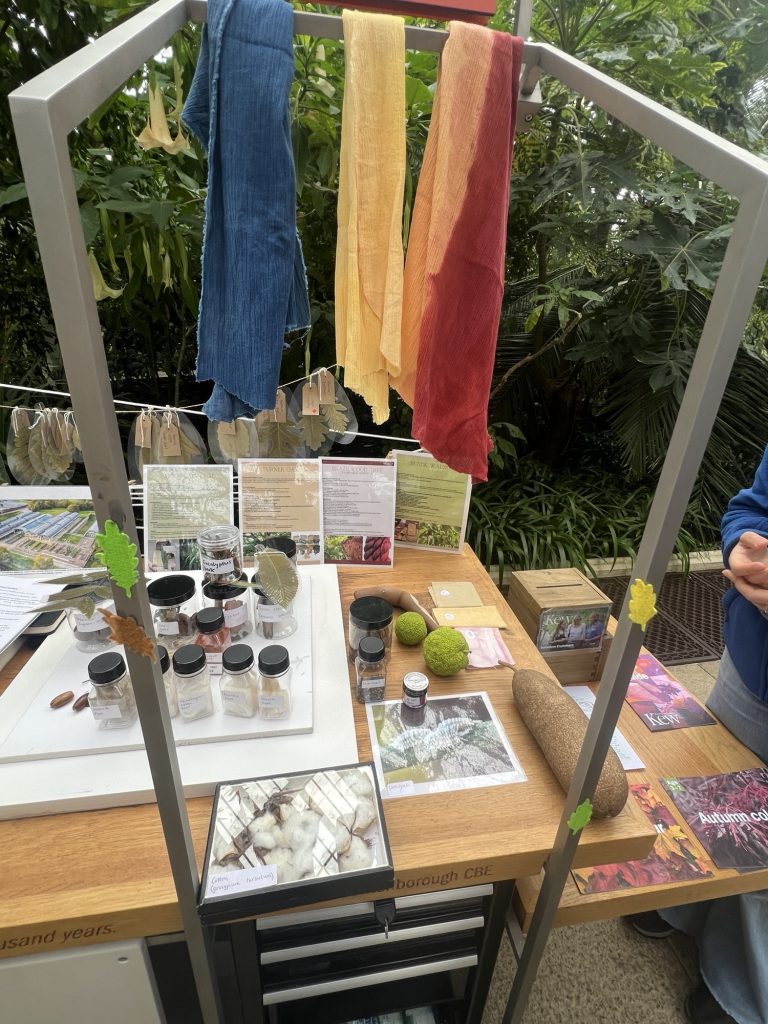
Nestled in the temperate house at Kew I visited the material world exhibition, showing how fabric, fashion and textiles came from the natural would, but also demonstrating how somewhere along the line, we have lost this connection and to be more sustainable in the fashion industry, we need to return to nature.
I found it very inspiring to be in a place of nature with fashion dotted around, showing how plants become clothes.
I was specifically inspired by the crochet wedding dress made from nettle fibres by Silvia Acien, as the colour was clean, and although the fibre finished was maybe a little rougher than you would expect from a wedding dress, it did show, beauty, and delicateness that can sometimes be lost in sustainable clothing.
There was a puffer jacket made from mushroom and mycelium leathers by Eirrin Hayhow stuffed with bio matter. Unfortunately for me, as clever as the innovation and use of nature was, the execution looked and felt like a forest floor, this look could never be classes as hight polished style.
The exhibition brought up some questions about how ‘we’ the general public consume and dispose of clothing and how all of us by making small steps can make the big differences to carbon footprints, pollution and the mountains of non- biodegrade waste that are produced which was thought provoking, and although I try to live by these sustainable fashion thoughts, it is not always as easy as it sounds, so to have the reminder was handy.
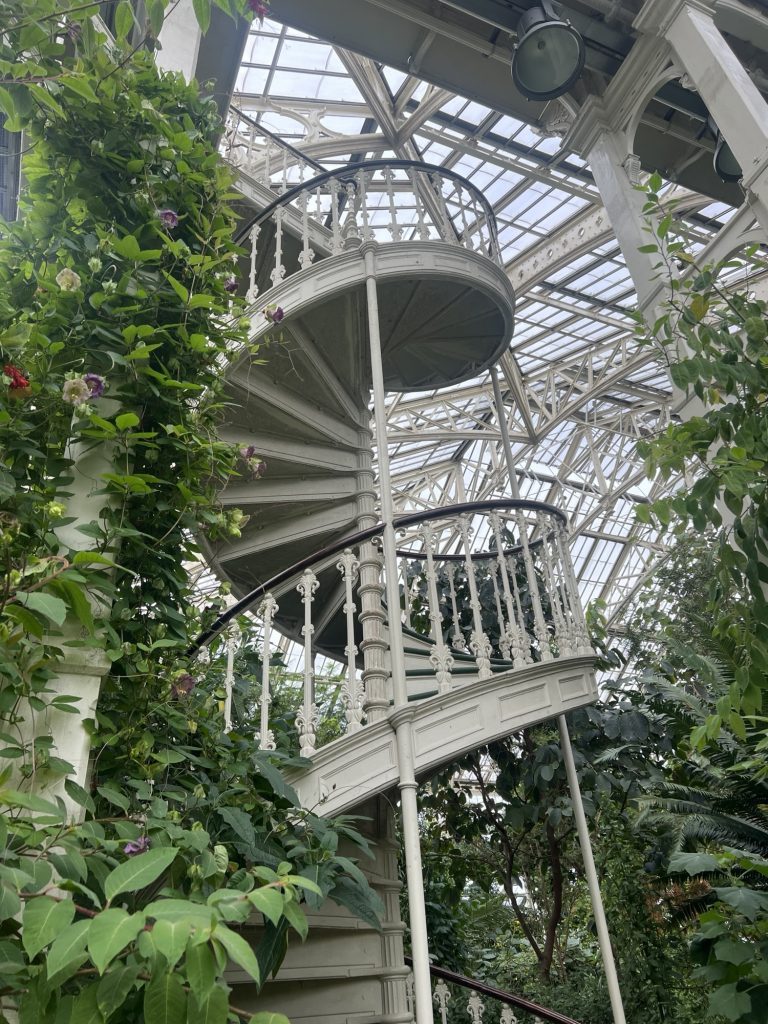
Visually I was inspired by beautiful plants and seed heeds, the architecture of the temperate house was stunning with the Victorian spiral staircases in wrought iron nestled and winding up between the trees.
I spend some time looking at dyes from natural and picked up a leaflet on making dyes from kitchen waste, this is something that I will look at and try to do myself at home at some point.
The Global threads exhibit by Lottie Delmain clearly showed the juxtaposition between textile waste in landfill and nature and how many of the colours we create through synthetic dyes, can be created through nature. And what compromises in colour may need to be made once we take away synthetic fabrics and dyes.
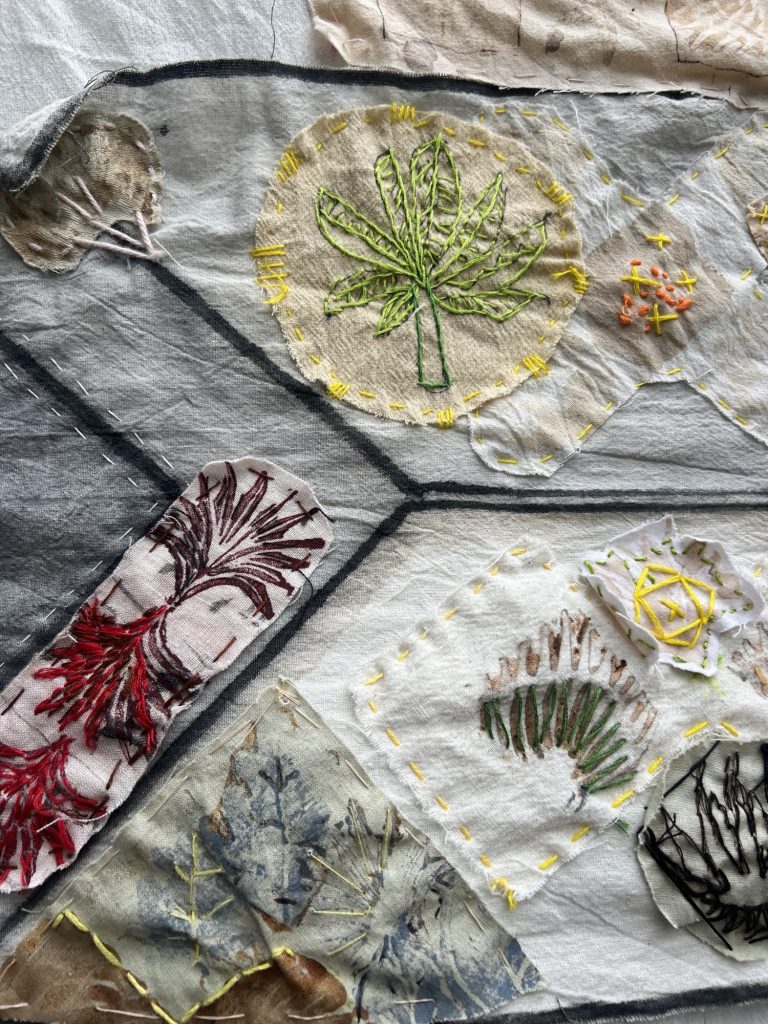
One exhibit was a piece of textile artwork made entirely from materials, plants, dyes, and textiles harvested from Kew itself, I loved the concept of brining place into the artwork and having everything around you from nature to make incredible pieces of art. However, I did think that the clothing that was on show didn’t offer practical solutions to everyday dress. Yes, they provoked thought and conversation as art pieces and made you aware of the issues with fast fashion but didn’t really engage or show what dress in the real world looks like when made for the natural earth.









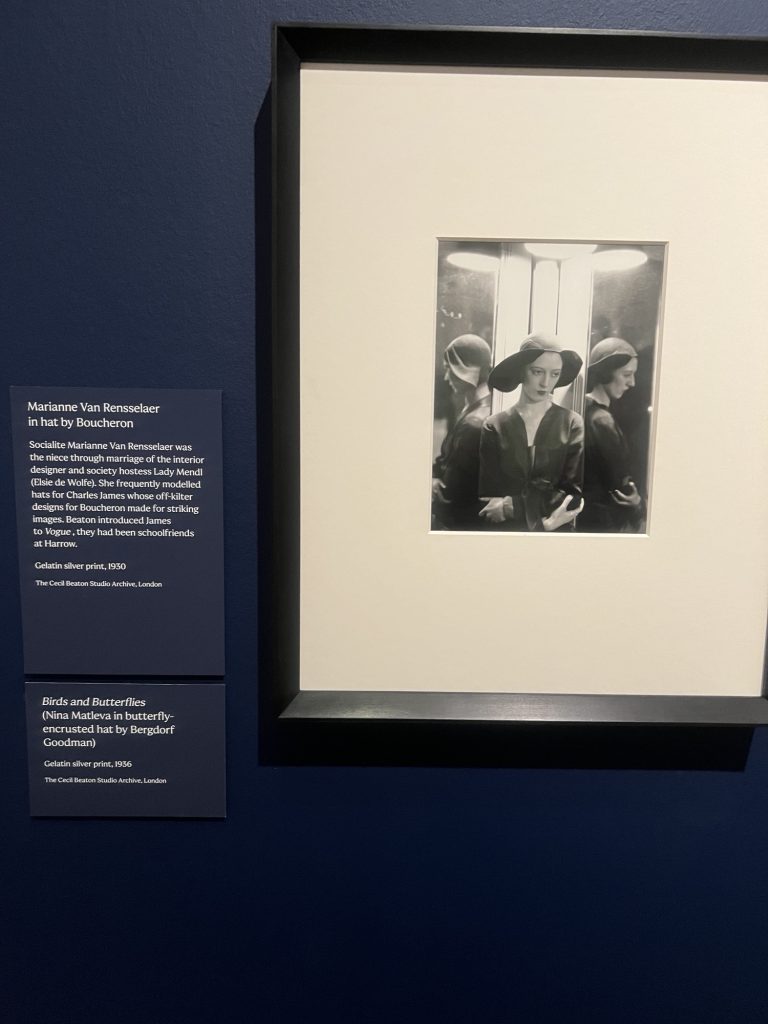
Cecil Beaton’ Fashionable World – National Portrait Gallery
‘I have wonderful plans and I’m going to do marvellous things.
A great quote, which I think we should all pay more attention too! And air of confidence, even if it has nothing to back it up, a sense of belief in oneself is the only thing that holds us back from our dreams. Cecil Beaton started his photography by sitting for himself, practicing on himself and family, didn’t let lack of sitters stop him from practicing and realising his dreams -which I think is powerful.
His work captures the elegance of womanhood and a softness in men. The human side seen despite theatrical displays depth is seen in the person.
His work was theatrical front he starts blurring boundaries of gender fashion at a time where it wasn’t commonplace, his home and fashion and work were essentially and extension of his personality. He lived his art.
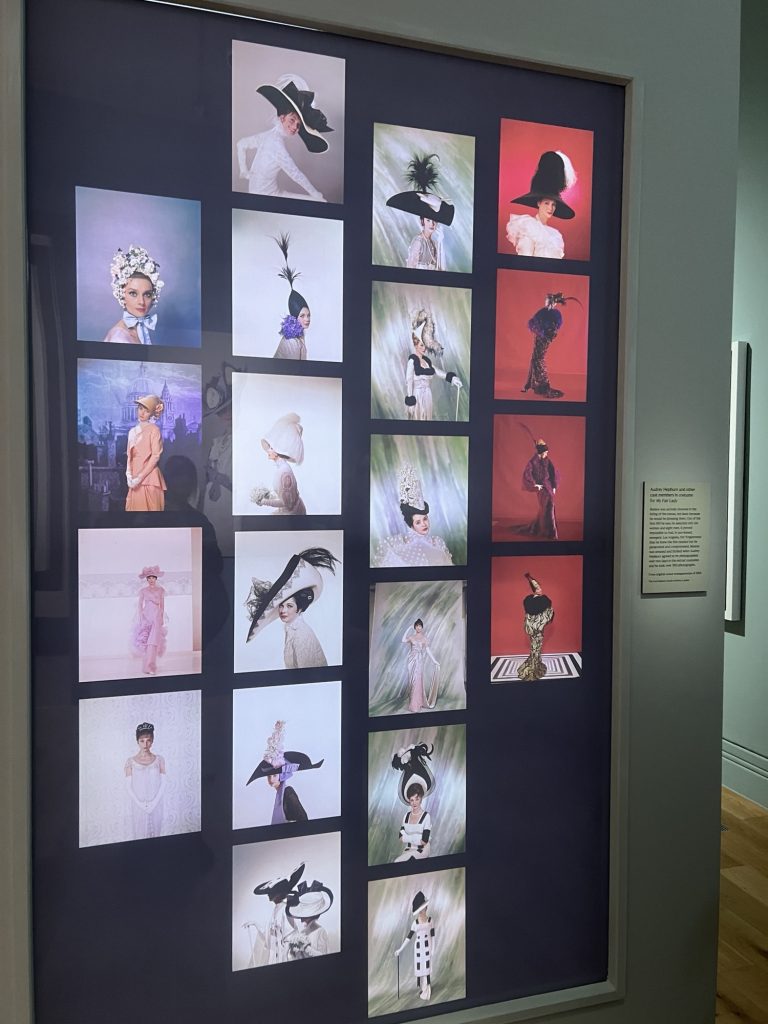
As a milliner of course I know Cecils work from the Royal Ascot scenes in my Fair lady. But even without being into millinery, the scene is so iconic, I am that sure most within a moment most can recollect the scene. Which is quite an incredible stylistic feat.
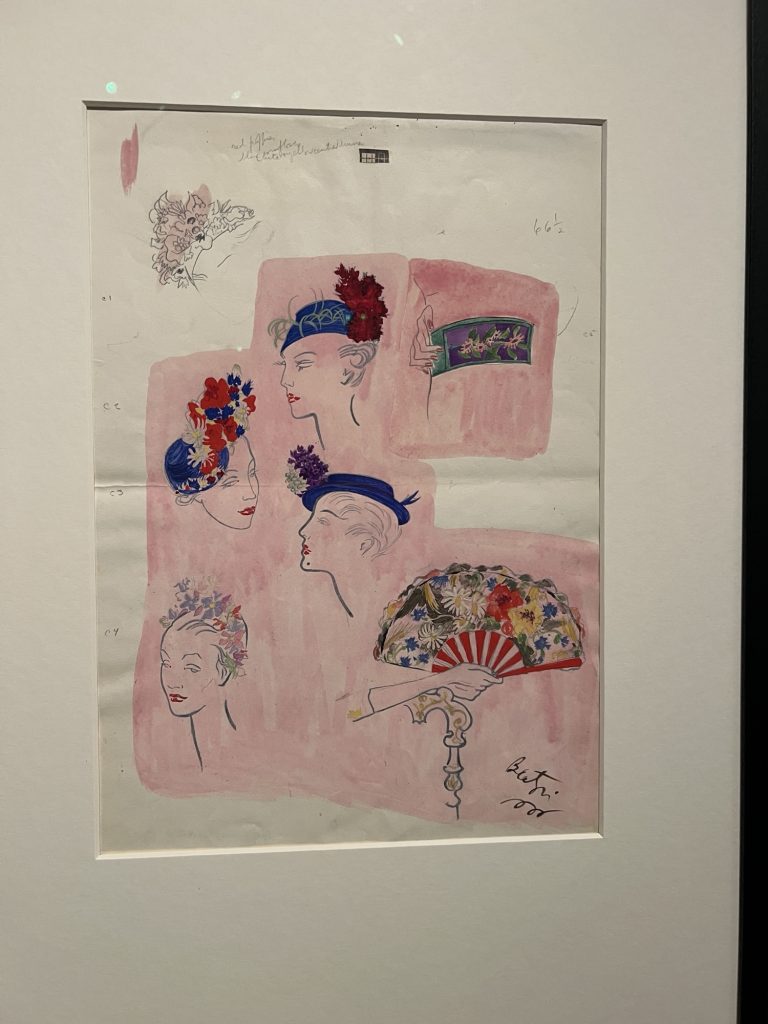
Hats express personality, you can become who you wish under a hat and develop a new personality. Maybe this was what Cecil was always doing, using theatricals and costume to speak for him. To tell the story without words.
Hats are wild and over the top in my fair lady, the hats in full focus but not losing any of the character of Audrey Hepburn. My fair lady was inspired by ‘black Ascot of 1910 racehorse dresses in mourning for the late king. Looking closer at the hats, the hats are not all masterpieces of millinery skill, rather masterpieces of theatre.
Everyone always says in my business ‘I want an Audrey Hepburn style hat.’ However just in this exhibition alone there are images of Audrey in 10’s of different hats all completely varied and of no style. It is interesting how in the consciousness of the public that only the ‘breakfast at Tiffany’s’ hat is remembered. For me Cecil Beaton captured her in far more iconic hats! – and certainly far more wearable hats!
I loved the term ‘he created visual essays’ written on one of the information boards, This phrase sums up what I would love to be able to express through the wearing of a hat, not just the hat as an object but how it interacts with the wearer.
From a fashion perspective it was interesting to see a photo’s of princess Elizabeth in 1942 wearing a dress with sparkling bows down the front- the information provided mentioned that it was her mother’s pre-war dress and was worn in the spirit of ‘make-do-and-mend. I love the spirit of this and feel that this is something we need to return to more. But also, how the dress really reminded me of a modern design from the designer brand Saloni…. showing that no ideas in fashion are new, just a new iteration inspired by something that has happened before. Perhaps an angle to look at could be make do and mend?
Cecils work from the 1950’s still seems very contemporary he manages to capture texture and colour effortlessly but almost in high definition.
I feel like in his photos women and fashion were celebrated equally and made up the story, not as an object for the male gaze but as owning their space. I see it as he photographed that which gave him visual pleasure, but with no aspect of a sexual nature just elegance and class. This really resonates with the way that I see fashion and glamour, we perhaps have a similar view of what we define as ‘beauty’ and what attracts us in art and fashion.






60 Years of Cosprop – Fashion and Textiles Museum
I didn’t have very long here as it was only 45 minutes before closing, however there was a private event happening that evening, and the exhibition curator was doing a personal tour of the exhibition for some of the delegates…which happened to start at the exact time I arrived…as a small exhibition, I had no choice but to listen in and essentially get a guided tour – which was an extra special bonus!
There were so many costumes that were instantly recognisable from Poirot to Downtown Abbey and the Jack Sparrow pirates of the Caribbean costume. It was predominantly historical costume design, prior to the 20th century, so full of silks and embroideries. I was in some ways blow away by some of the detailing; in others you could see how they were made a costume rather than as couture. The production techniques would very much depend on the end use and how close up scenes would be. The exhibition led you to understand how costumes are kept- kept safe until production releases, after release if big hit or won major award for acting or design it is kept for exhibition pieces, others returned to hire stock.
I’ve just selected a few pieces of millinery that stood out to me.
A room with a view 1806 ensemble worn by Helena Bonham Carter – a small ivory straw braid boated hat- hat is sewn with a poly braid- material would not have been available at the time, and you would never get a straw braid that clean colour unless it was synthetic.
1900 Bejewelled headpiece worn by Uma Thurman in the golden bowl, whilst made from fabric with diamanté strips stitched on, it looked like a piece of metal jewellery, these techniques would have made it lighter flexible and more comfortable (and cheaper in production. Embroidery samples show depth of research for the rest of the costumer.
An 1840’s bonnet from Jane Eyre worn by Mia Wasikowska looked like it was made from incredible fine work straw, on closer inspection it was made from narrow twisted cotton or poly braid which was braid knotted and crochet looks incredibly delicate, with maybe the odd row of straw but not entirely, it was so delicate and I loved the look this technique brought to the outfit. It may be an idea that could be recreated in a more contemporary manor.
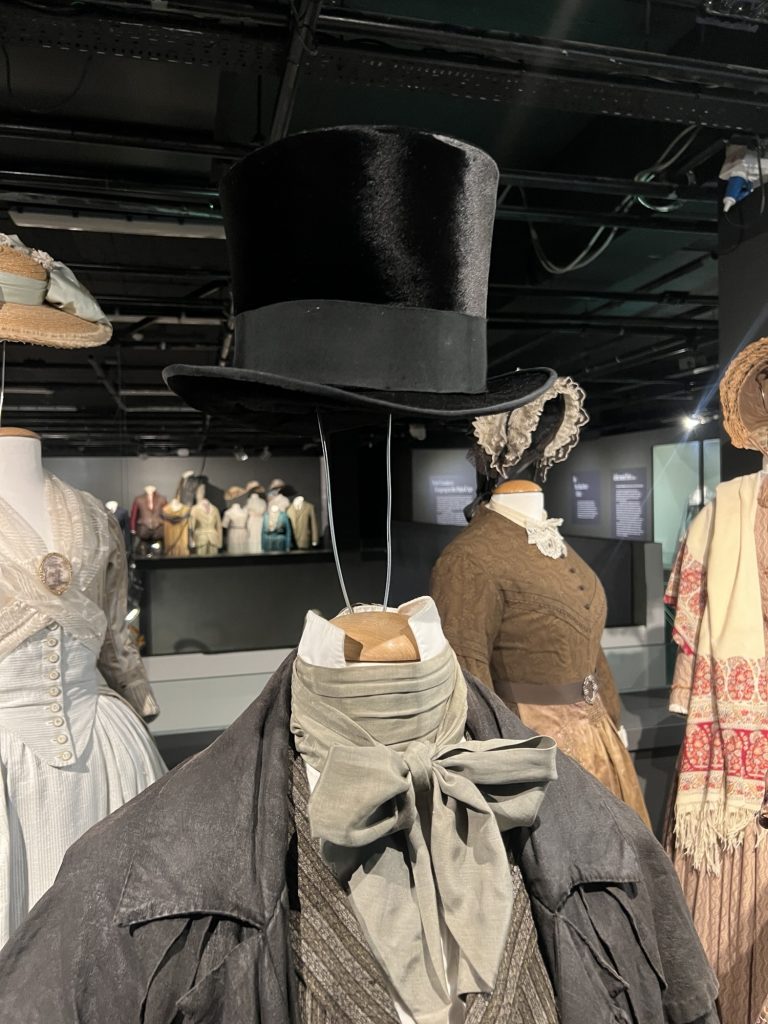
The top hat worn by Suranne Jones in Gentleman Jack. A beautiful handmade top hat, but not made out of silk or cotton velvet, rather a poly velvet, with a seam on the top edge, from a distance a clean crisp line and shape to the hat, close up you can see the quality of materials is not super high – I’m sure unnoticeable on screen and much cheaper than other fabric alternatives.
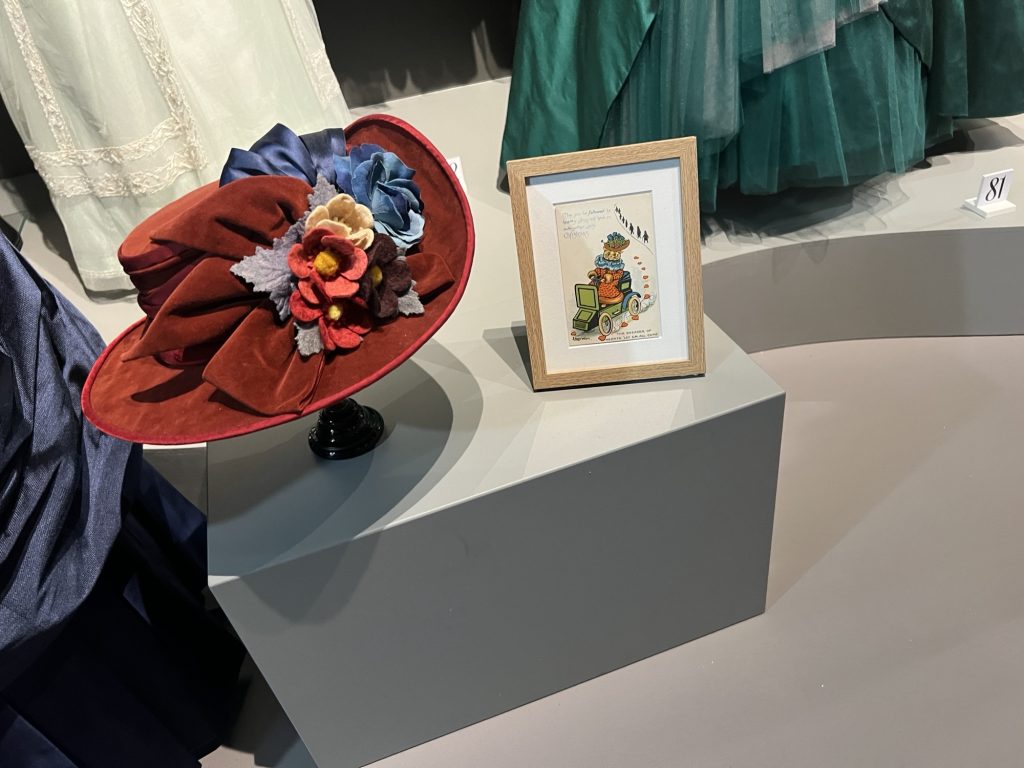
A fun wool felt burgundy hat worn by Claire Foy in The Electrical Life of Louis Wain a film that brought to life his whimsical hat paintings. The hat against the original illustration, really did take inspiration but make it real. It had a slightly rustic feeling with cheap felt flowers on it, but somehow totally encompassed the feel of the original drawing which did not show details clearly.


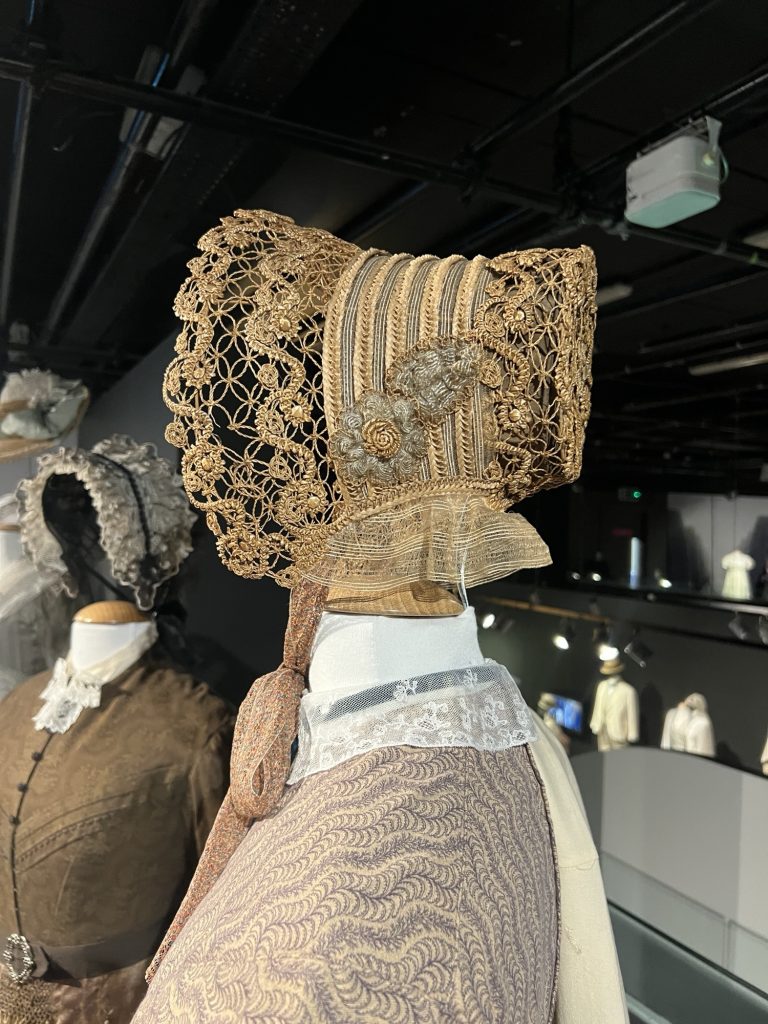

Key Take aways from each exhibition
Fashion and textiles should not contribute more harm to the planet. Using or reusing what we already have will have huge effects on the planet.
For style to speak the wearer needs to be happy and confident. A hat should complement a woman and bring out her best but not overpower her – a had should just add to the expression of herself and allow her to be all the things she wants to be.
Looking back at historical design, does not mean being stuck in the past. Techniques can be modernised to create modern headwear whilst honouring the past.
18/10/25
My third attempt at making the paper sheet, created a much finer finish, which is much nicer, but it was incredibly fragile, so I tried again, but this time soaking the pulp in a 3 part water/ 1 part PVA glue mix before making the paper in the mould.

With my current thinnest piece of paper, I looked at separate ways of stiffening the paper, so I cut it into 4 and used a different technique on each.
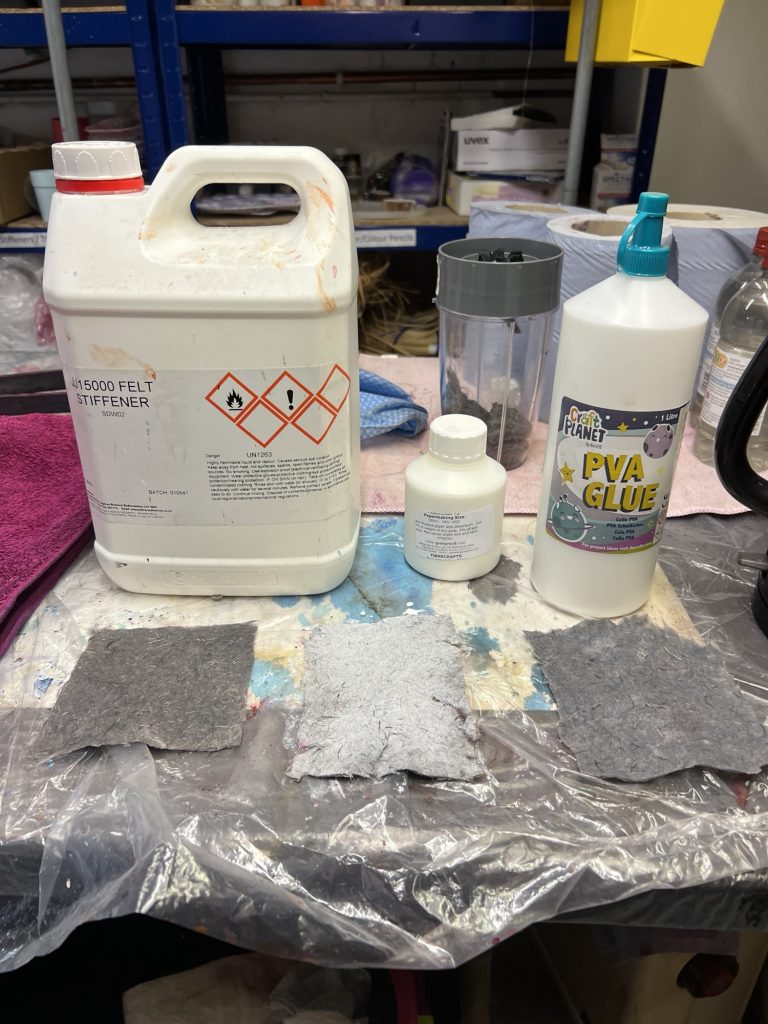
- Felt stiffener painted on
- PVA glue painted on
- Paper size painted on
- Free machine stitching
The felt stiffener certainly worked well and made the fabric feel strong. The free machine stitching also added a great level or reinforcement holding the fabric together and allowing you to pull it in all directions.


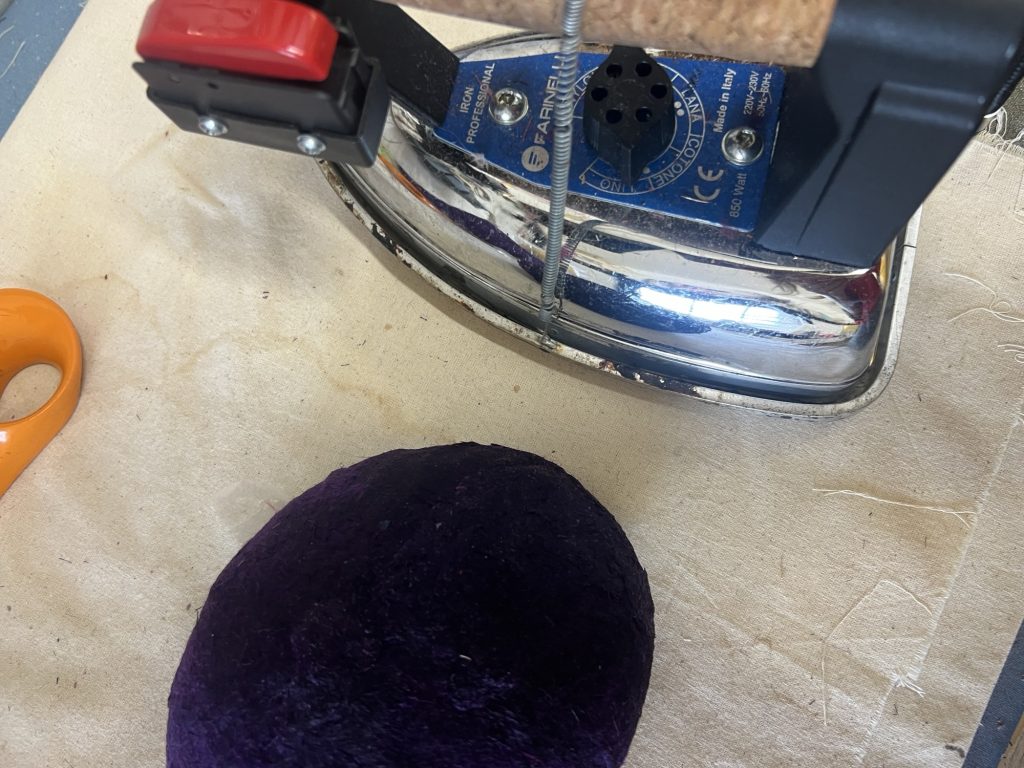
Once the PVA infused pulp sheet was dry it did feel much firmer, so I decided to see how it would block. It had similar properties as the Lokta paper had. It ironed well and steam made it flex in order to get to the fabric around the block, small creased did appear on the more dramatic curves, but overall, I was quite impressed at how much this could be minimised. The main problem was that pulling it, it was still far too delicate, and it did rip in places. However, I do feel with maybe using some additional stiffening or reinforcement techniques above it may be successful.
One of the main problems with the fabric is the colour looks like carpet underlay. So, I looked at dying the fabric. Obviously, we will struggle getting lighter colours, from this, but perhaps we could try bleaching it?
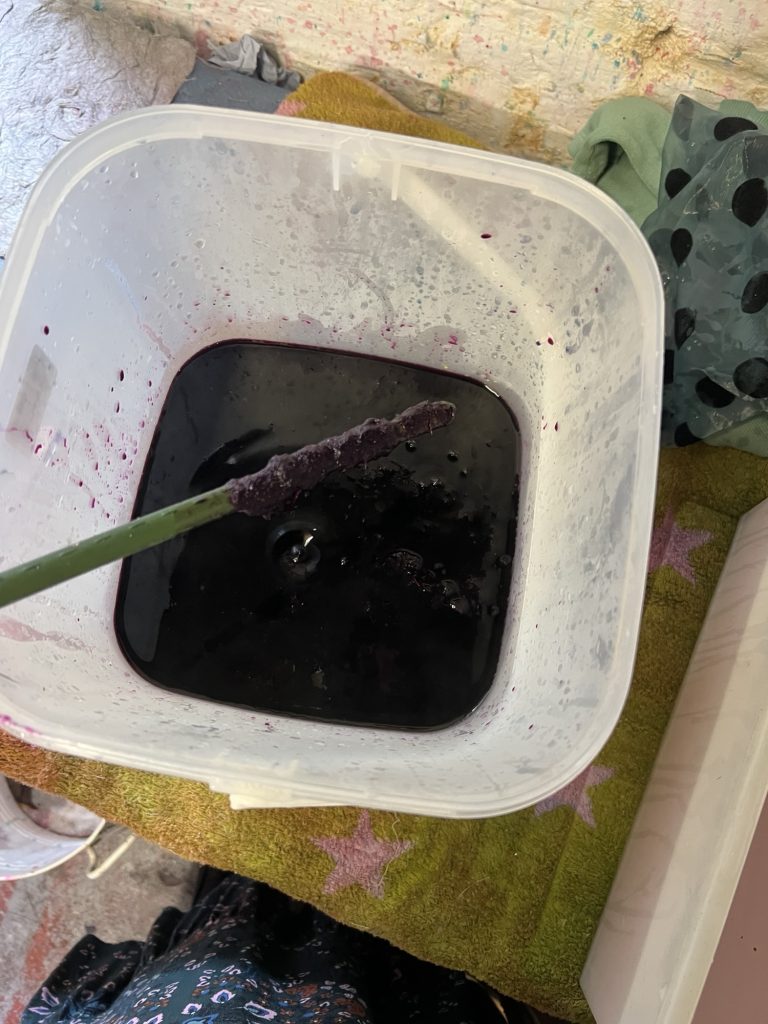
I started by looking at dying the pulp, I had some procion dye already made up for another job, so I soaked the pulp in it overnight. I then rinsed the dye through until water ran clear and was impressed at how much pigment remained on the fibres. I then made 4 sheets all with added PVA glue.
19/10/25
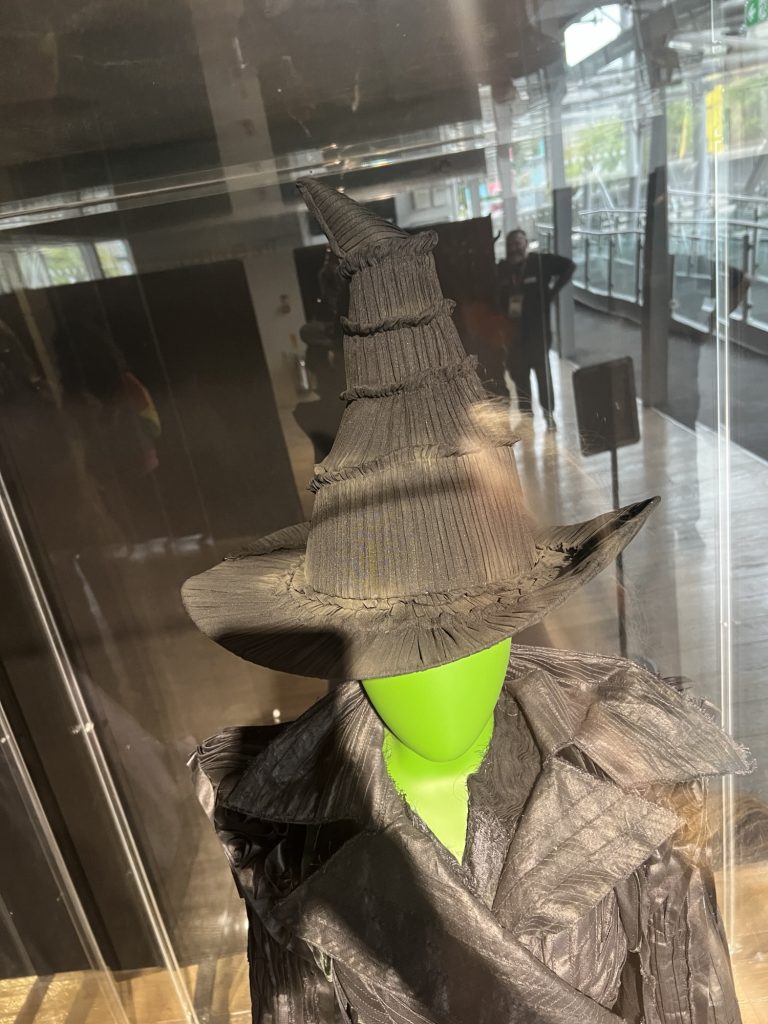
A Wicked Celebration – British Film Institute Bankside
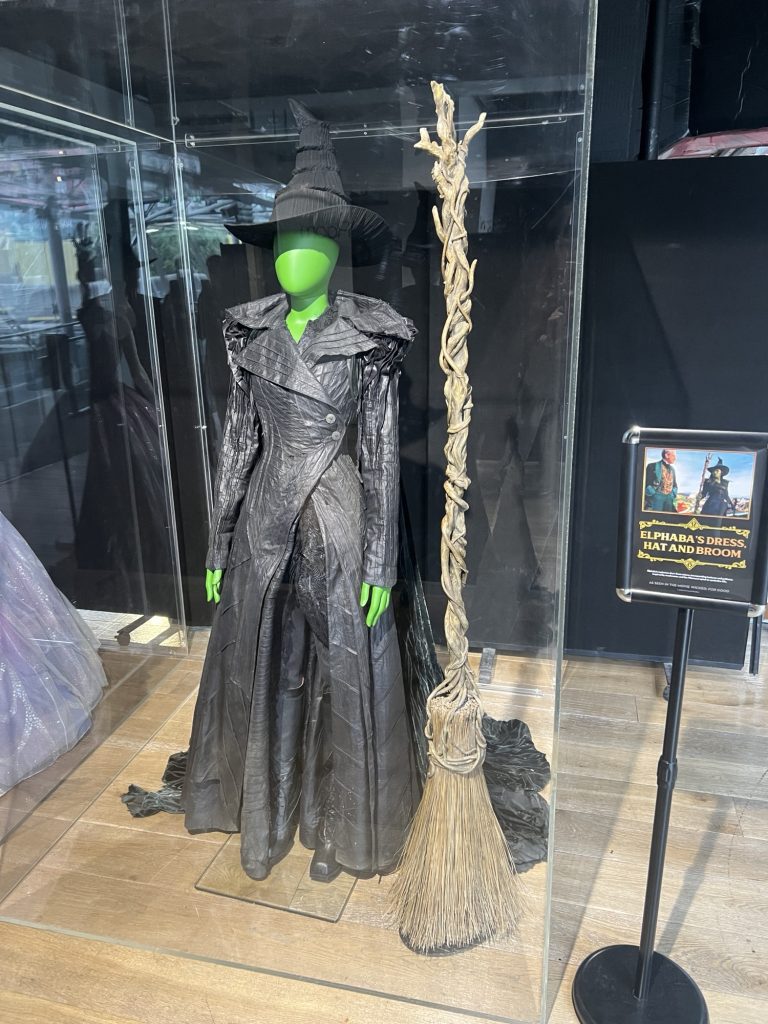
A showcase of props and Costumes from the Wicked Film, just a small exhibition and I mainly focused on the costumes of. I was mainly surprised by the amount of plastic used in the costumes, specifically Glindas’ wand, made entirely from laser cut Perspex ‘shards,’ scattered with diamanté then clipped into a ball. It was highly effective, from a distance it certainly looked like glittering glass, and a lot heavier and complex, ultimately its construction and finish were quite simple. I would have loved to have seen this made from beautifully hand blown or mounded glass, but I assume this would not have been light enough nor practical enough on set.
I do admire Paul Tazwell’s (costume designer) commitment to detail throughout the films, using elements from the Fibonacci sequences and for Elphaba’s costumes the textures from mushrooms. Sometimes perhaps the ideas and the execution appear deeper than they would need to be, but costume design is all about encasing a whole personality and story into just a few outfits, so that the viewer gets to completely understand that character. So, whilst some elements may seem innocuous, in reality they all have a purpose in building up the story of the character subtly.



20/10/25
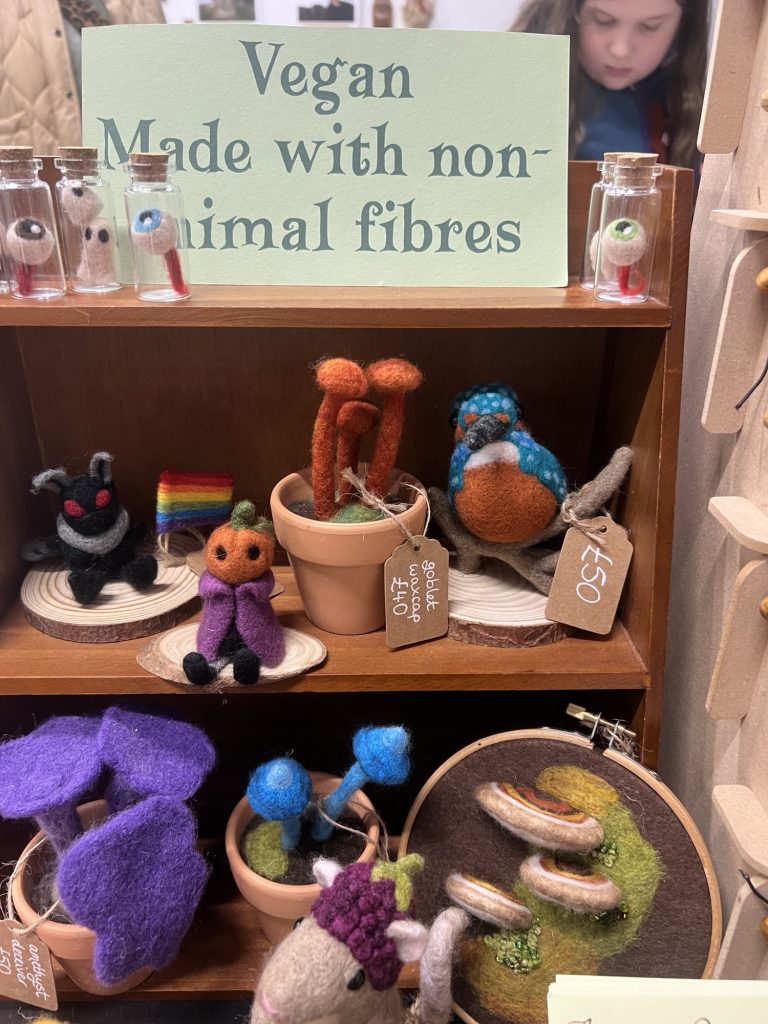
Farnham Folklore Society Exhibition Launch.
I was inspired by the Cosy Witch (www.instagram.com/cosy.witch) from a sign that showed vegan needle felting. I always thought that needle felting had to be done using animal fibres. I had the opportunity to speak with the artist and found out that she takes synthetic balls of yarn and essentially un-spins it and then uses carding combs to create individual fine but textured fibres before felting. She also said that she was experimenting with bamboo fibres currently, and that any fibres that looked rough under a microscope would work. I was disappointed with realising that the vegan needle felting was made from synthetics but loved the creativity to try and so something with alterative materials than the usual. Needle felting the sinamay fibres could be an option as the bicarbonate of soda did give the fibres a rougher edge.

I also had the chance to speak with Ginny www.instagram.com/myrtle_sweet at the event who specialises in natural dying and making clothes from the ground up, from flax seeds, to retting, spinning, weaving, and sewing. She asked me a question to think about. How can you change your consumers point of view on sustainability within millinery? Is the end product more important or the sustainability credentials to your customer and how do you balance the two? I believe from 17 years’ experience that whilst the consumer loves the idea of sustainability in theory. They still want what they want when they want it. Hence why I am asking how do you make high fashion millinery that doesn’t look like it’s sustainable? Is my question whether to make items that are sustainable AND meet my client’s needs, or is it shifting the client’s mindset towards shopping sustainably that I should be focused on?

23/10/25
Dialectical Thinking and Contradiction
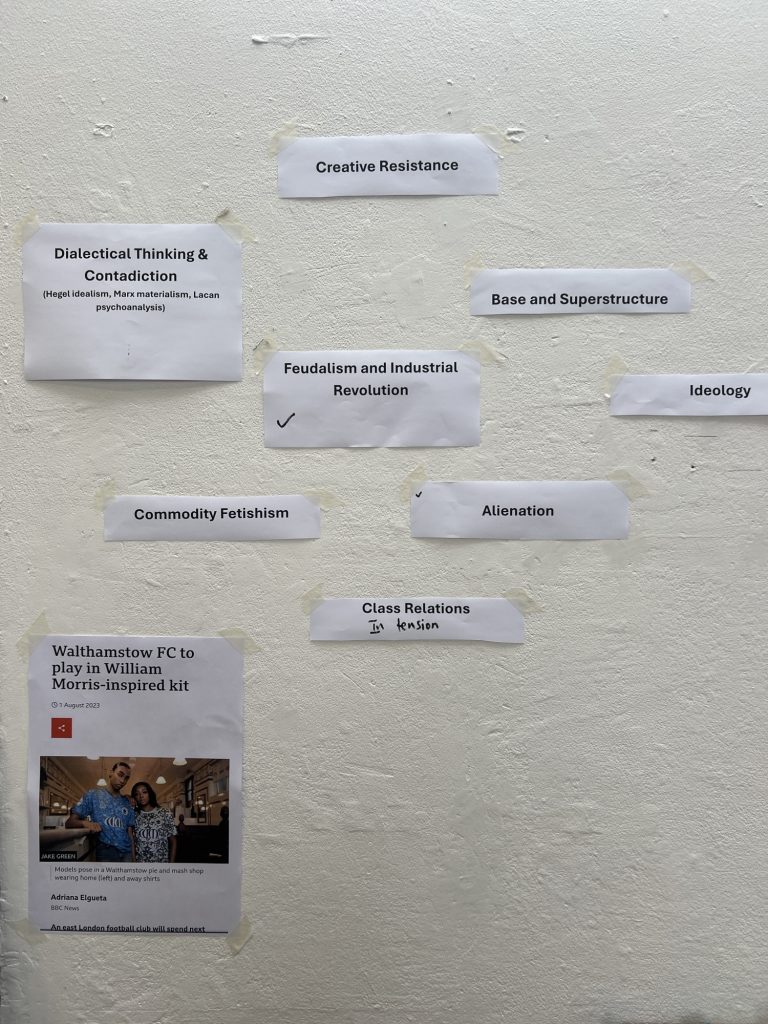
We looked into the concept of Marxism my notes on Marxism as an introduction are below:
Spectre – a feared occurrence – haunting Europe 1848
All history is history of class struggles.
Oppressor and oppressed, formerly enslaved person and slave. Owners and means of production (bourgeoise) vs Wage labourers (proletariat)
No means of production alone – require work to fund – sell labour power to live – can only find work if labour increases capital for the owners – essentially becoming commodities themselves. – vulnerable– supply and demand not skill.
Centralising labour means there is no jobs outside of large labour in cities.
An appendage to the machine – machines de-skills workers which then limits workers potential. Workers are cheaper if have no skill, so wage decreases for worse work.
Lawyers/doctors etc end up in the lower classes as bigger business takes over – middle class become lower class.
Individuals may protest machinery – de-skilled – regain their status. Modern industry – i.e. trains mean the workers can interact and grow movements and realise similar struggles with others. Unions formed to maintain wage levels. The fight becomes more organised for revolution. Improved communication means the movement can be centralised for revolt becomes a national struggle therefore a political struggle.
Economic rise from steam and industry means there is a huge rise in wealth in some areas.
Bourgeoisies need help from workers- which gives them an education and tools to be able to uprise against the owners.
Power of owners relies on cresting and increasing capital= which needs wage labour. If workers stop competing for work but combining, then the owners cannot take advantage. Owners – unfit to rule. Poverty grows faster than population and wealth.
Bourgeoise create material weapons for its that threaten its existence.
How might a dominant class create thinkers and speakers that ague for its own destruction.
We discussed a case which encompassed many of these ideas.
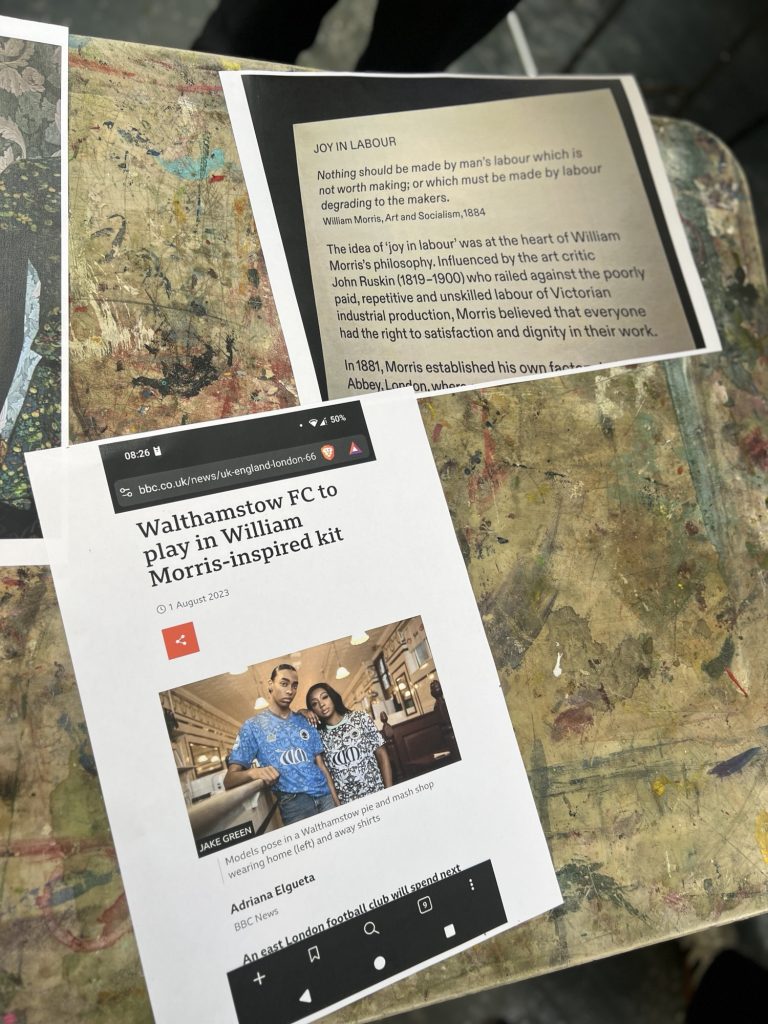
We started by looking at a William Morris designed football kit, sponsored by the William Morris museum in Walthamstow and how Hegel idealism, Marx materialism and Lacan psychoanalysis plays into how these T-shirts came about.
The Story of capitalism
We used to within the community/ very local grow, pick, weave in one space. locality at each stage of production.
-Feudalism to The Industrial Revolution
The enclosure act- owning /renting your land.
Mechanisation of skills takes people away from land into centralised production. So, you are chained to a machine just doing repetitive work. Taken away from land and skill. Disempower the worker. No longer know the whole processes ‘ford’ theory.
-Alienation
Disconnecting from means of production.
No investment in item just doing repeated tasks.
Paid with food / bare minimum to survive on
Cog in the machine
Housing provided- morality different to business life. But still importing people to be close to factory.
Disconnecting people from means of production and bonds with people and therefore community.
-Base and superstructure
How do you get a job and earn a living?
Material relations of how we live -physical thing- material relationships.
Law -philosophy -culture- ideas on how comes out of where and how we must live.
Take out the romanticism- open your eyes and understand the basics of what is happening.
Everything is connected – mental health related to cost.
Your basic lived experience is alienated so affects your mental health.
-Class relations
Haves and have nots.
Mutual need- power imbalance
Making art helps us negotiate the alienation and class tensions within.
Art is in contradiction.
3rd class le petit bourgeoise – mini businesses, not worker, not factory owner. But operate within. Plumber, small shop owner -some autonomy but not owners of capital.
Resolution within Marxism
Dialectical thinking- think about the world- that’s weird- conversation between something in contradiction.
Hegelian-These ideas take you to what is means to be human.
Marxism- in tension over material things, class conflict- describes world as he sees it.
Lacan- 2-way street everything informs each other- does not get a resolution – culture informs how we live our lives; our lives inform our culture. (Perverts guide to ideology)
People are disempowered apart from those at the top.
Yanis Varufakis- today theory (Greek minister) – research further
-Ideology
Zizek – look up.
Set of political principles
How are you going to do it- manifesto?
Action
Unspoken stuff that supports base superstructure
Not even sure you know, you believe not.
Believe there is a better option to aspire towards
The way we assume the way the world works.
Something you have never questioned- it’s the way it is.
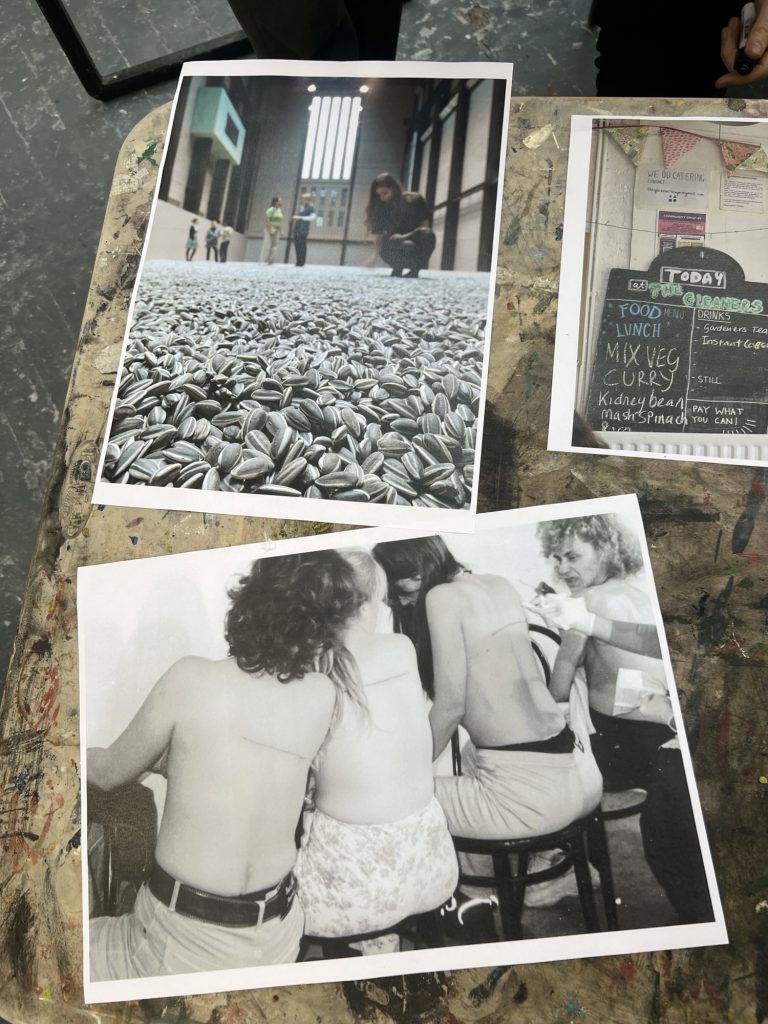
We looked at case where Food waste cafe- ideology from customers who don’t get it. No amount of money to pay…how do you know how much to pay.
I want to eat this- I’m used to getting what I want by giving money and get what I want. I want to make that choice with my money. Your freedom is to be able to choose what we consume. (That’s capitalism) all our other choices have been taken away.
You must participate and feel guilt- not a simple monetary exchange.
Create art- but then someone needs to buy it…the problem is price…. everything is handcrafted…so expensive, only rich can purchases- enhances class divide.
-Commodity fetishism
Factory costs a certain amount, workers need to be paid, cost of goods, cost of factory.
Whole purpose is not to make but to make profit.
Owners don’t do work but make the money (surplus profit)
Profit chances how objects live in the world.
Commodity fetishism- desire / mystery
We don’t see all the parts that make a product. We only sell the actual item.
But we are marketed the lifestyle it will bring, not the item itself.
The only thing you see is one thing item…. It all the stories of how was created.
Disconnected from creation.
shows how much inflated prices are against workers payment.
We choose to ignore the ‘how’ creation.
Is good business simply good marketing. Irrespective of the quality and artisanry.
Buying William Morris notebook is not connecting you to the craft is just a visual cultural symbol that I am an evolved cultured person of this taste.
William Morris wallpaper is printed in restoration of house- take easy from the craft- just a visual representation.
Pie and mash shop local Walthamstow black models’ authenticity
Trying to be connected to local Walthamstow. All tokenisms! Where were the food all shirts made?
The importance is not the object it is the brand being sold.
Big contradiction
-creative resistance
How does what I want to do sit within this structure.
Am I connected to what I make?
How much is the value of your connection to meaning.
How much to how its value socially
How does it sit making a product to be sold?
Does it want to be sold?
Question these relationships.
Teaching- bringing people into the craft.
The crafts are dying out and if modernise too minor down teach then you are also part of being responsible for the craft dying out.
The sunflower seed art
How or where you make a million handmade seeds? Labour? Reinforce capitalism.
If all stolen so it is shut. Gave jobs but how does artist get funding? Boring making millions- not expressive becoming the worker again.
Lines on the back of street workers (possible drug users)
Paid cost of a ‘hit’
Sex worker has a value in their body (autonomy) so its ultimate consumer transaction. Don’t Take away autonomy by saying that is immoral.
Marx (flesh attached to the machine)
Sell time in order to be paid.
Is it an honest description of capitalism exchange?
Show uncomfortable to evoke a reaction.
Marxism = We are ALL reduced to commodities

My Thoughts on how this relates to my practice.
I found the lectures from the notes above interesting. As someone who is creative, yet also pretty conformist (i.e. I will generally fit in the box of what society wants from me – that is the society, where we are all a cog in the machine, essentially just surviving). I live in what would have been a Victorian farm workers cottage, a cottage that would have been provided to the workers by the owners of the land whilst they worked on the farm to have the skills on site and to ensure the staff were loyal and tied to the job. They would have earnt little money and the cottage value would have been for a lower farm hand position. Now my property is in a very desirable ‘commutable’ area with high house prices, I now work hard to pay the banks who actually own my house, yet the house it itself now holds value, where as previously when owned by a landowner on the farm, the home was not built to be a desirable place, rather a functional place. Now it is seen as desirable and very middle class, if I were a lowly farm worker now, I would not be able to afford to live in this house. However, my partner and I both work with our hands in roles that exchange labour hours for money for a living where our time has been commodified, in the area we live we are very lucky to both work in very niche (and endangered) skilled areas where our skillsets are sought after. Because of our rare skills we can command a reasonable fee for our time, but this also means we need well off clients who can afford to pay for our services. I am very aware that whilst we live in a very expensive area and earn far below the mean average of where we live, our skills and businesses could not survive and pay our way in other areas of the country as there would not be the clients around who could afford our services. So, we are stuck in a cycle of paying inflated housing costs, in order that we can both work within our passions and skills sets. It reminds me of Marx’s comments on bringing people inwards from countries into cities as that was where the labour was, when in turn killed the communities and lost the skillsets. If the economy changes and the wealthier middle class suffer, our businesses will both suffer so will our ability to live in this area which reflects Marx’s idea that capitalism constantly reshapes labour and how we live, even creative or skilled work becomes trapped within cycles of dependence, value inflation, and classism.
In terms of my creative work, I am very much of the opinion that if the world works the way that it works and that I am tied into a system that needs my labour commodified in order to survive in the capitalist system, I cannot make art for the joy of making art, because I have pressure of earning a living to be able to pay my bills and live in my overpriced home, therefore my art becomes commodified.
What is the point in making art if it cannot be commodified. Time in modern day is always taken away from us, we need to ‘hustle’ harder to pay the bills, to compete in business etc. If I place value on creation, surely by having a reason for creating i.e. monetary gain, so that I can survive in the world, commodifying my art allows me to do that. Whilst of course this takes some joy from the art as there is always a deadline /cost measures to meet, my other choice is to not be creative, do a soulless job which brings me no joy or wellbeing and have no time to experience creativity at all. It feels far more comfortable to me to create art that someone is willing to spend money on and that gives them joy over creating art for the sake of creating art. My skills are not highly valued by most of society; you can buy similar products from Temu and Shien for a few pounds. Many people do not value my skill and time, because of how disconnected society is from the manufacturing labour. I have hundreds of examples of clients saying my work isn’t worth the money, that they could make it themselves, that whilst they apricate my time, they would NEVER spend that amount of money on a hat etc. and sadly less from those who would sing from the rooftops of my skills and the value I offer. This is because generally society have no understanding of artisanal craft anymore, cheap labour halfway across the world and poor manufacturing techniques and materials have become the norm. Most exchanges with customers is about educating them into what they are buying, it isn’t just a product, it’s something personal, made for them, a future sentimental item passed down through generations, or at least remaining in Photographs in the last type of family albums still printed (wedding albums) for years to come. They are not just buying a product; they have to buy into the whole story and experience that surrounds that product. The neatness of the entrance hall when clients come to visit all has value to gain the value that my art needs to sell for, I need to justify my worth through my surroundings and ability to sell the items, even my ability to sell myself rather than just the item itself.
Other aspects of the value of my craft is that as many crafts are dying out and if we continue down this trajectory then there will no longer be the skills, so some of my skill must be passed on to teach the next generation, otherwise I could be playing a part in the extinction in my craft. However maybe the craft needs to modernise, maybe updated to reflect modern society also to survive. My skills cannot be replaced by AI so maybe in the future we will go full circle, and creative practical skills will be the most sought-after skillset. By focusing on the sustainable aspects of the craft, hopefully not only am I helping to preserve the earth’s resources but also looking at a traditional craft but bringing in a modern approach. Whilst right now selling my art at its true cost can be difficult to compete against the likes of Temu and Shien, will there be a monumental shift in views toward the environment and brands that are offering sustainable approaches that are not causing further damage to the planet.
The millinery industry is completely related and tied to class, so the class structure is particularly important for the trade to survive, the reason people wear hats is because of the capitalist structure of the Bourgeoise and le petit Bourgeoise. Because millinery has no practical function, its only purpose is that of a way of social standing, it is pure frivolity. Within Marxist views, millinery seems to sit quite nicely, maybe one of the reasons that I state at the beginning that I am in general a conformist as a cog in the machine of the structure of society, is because my livelihood relies fully on the class structure to exist.
Millinery only exists to display social classes. Fashion only exists due to the class system and millinery is literally the antithesis of this. As the bourgeoises and le petit bourgeoises increase their social standing the aristocrats want to stand out and make a note of difference in how they dress and ensure their status is not lost. Then as the lower classes rise up the ranks they then also adopt these new styles of dress, meaning the aristocrats need to re-invent again, becoming more frivolous, more seasonal, more stylish in order to stand out above the rest and really cement in a visual instance there social standing, hence the birth of fashion trends (Grose, 2023).
Millinery is status and class. The styles of the upper ranks in society set the trends in millinery, the lower classes have cheaper knock offs and less refined styles, but always copied from what the Royals and upper society sets as the trends and not seen amongst the public until a few years later when the styles have trickled down the ranks.
Royal Ascot still sperate out racegoers by social standing and the styles of fashion as you go through the different enclosures is literally a modern-day representation of how this class system works from a fashion point of view.
Are people even buying millinery because of the creative and artisanal skill or are they buying it purely to show social status? Without having, or giving the impression of having status, is there any need for millinery at all? Therefore, does the craft of millinery even play into the purchasing decision? Is a hat purely to create an air of status and to show this to others. Purchasing from a ‘bespoke milliner’ is surely just another way of saying ‘I have more status’ because they went to a milliner rather than buying a factory-made piece’? By adding in a sustainable design to millinery, does that purchase perhaps just another bragging status point for the upper classes? One that is only afforded to the luxury of the upper classes (for now)? Perhaps to be able to introduce sustainable design into general society, we need to start small, at the top of society and wait for the trickledown effect that the structure of a classist society is set up for.
3/11/25
With the dry sheets I took different approaches with each.
- Blocked a more complicated shape, as soon as steam was added the paper type material did pull apart, in these gaps I padded it out with spare pulp, it made it a bit more bulk, and a less smooth finish but at the moment I just wanted to see if patching worked. Once dried I then added chemical stiffener as this was the most successful stiffening technique from my previous samples. once dried I used sandpaper to remove the lumpiness from the patching…. this was less successful, it caused some other holes and left a whitish residue, so this is maybe not a solution.

- Blocked a simple shape, this worked well as didn’t have to add to much steam of pull the shape. once dried I stiffened with felt stiffener and then sprayed half with a matt gesso varnish, this made the finish a bit smoother looking, but didn’t have much effect, using more of a lacquer gloss varnish, gelatine or shellac may be worth testing.

Not Varnished | Matt Varnished
- Free machine stitched the whole piece to reinforce the fabric before blocking, whilst it allowed the fabric to be pulled more, we still ended up with holes in the paper fabric. the effect also looked more ‘homemade’ and less refined.

I took some off cuts all in a single colour and chop them up and boiled them, this time without bicarbonate of soda, when boiled and pulped the colour remained, paler than original shade but still strong. A new blender with much more power seems to do the job, as long as it is put on with small batches and not left to run for too long. Unfortunately this makes the process quite slow, taking around 1 working day to created one handful of pulp, to get the sinamay down to a really soft mixture without stronger fibres remaining, which is fine for artisanal craft, but of course does prevent commercial production without large investment in machinery. The use of electricity may also be a consideration to be aware of in how sustainable the process actually is. However, the same water can be used for boiling, pulping, and making the paper slurry, so there are many processes in which the same water can be reused – as long as colours are similar, water can be consistently reused repeatedly. using the same colour offcuts for each batch is an interesting concept, whilst the original dyes may not be full sustainable, reusing the original colour (even if paler) takes away the whole dying process, saving time, energy, and resources. Even if we used natural dyes over chemical dyes, we could entirely cut out that process, which is an interesting concept.
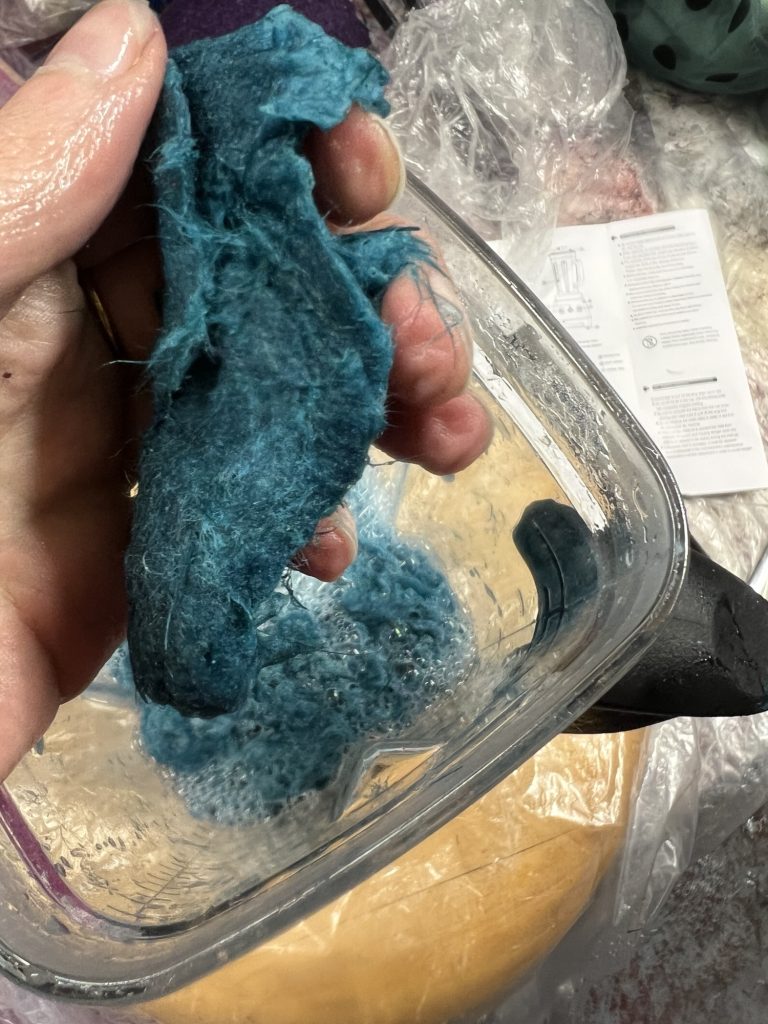
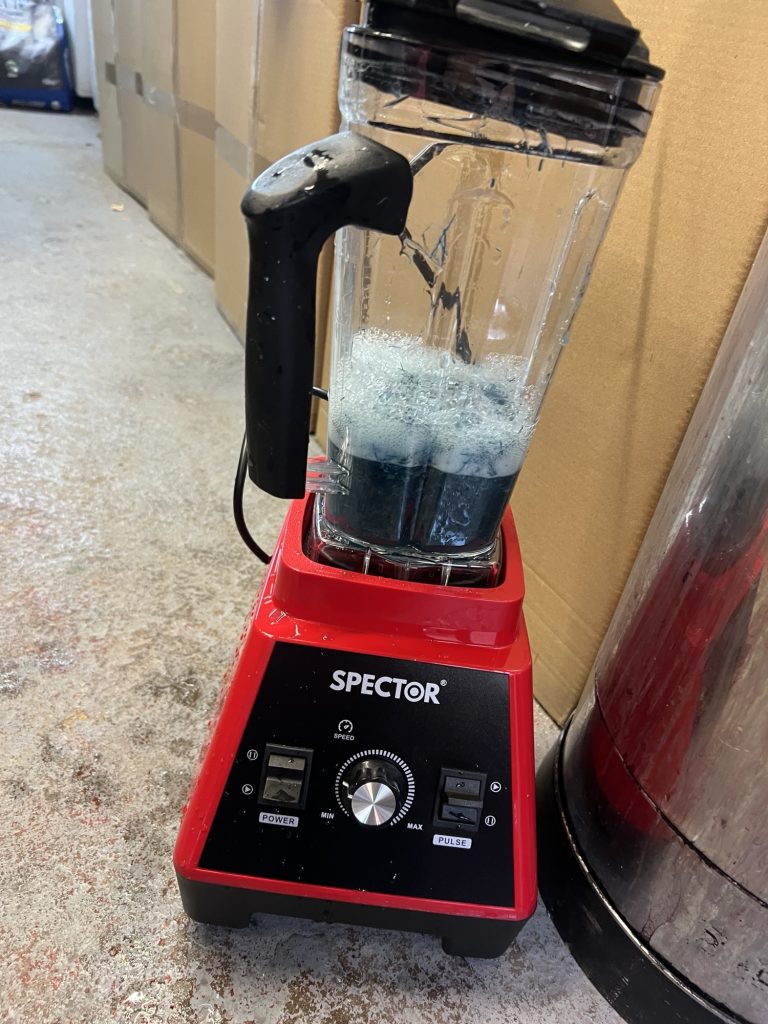
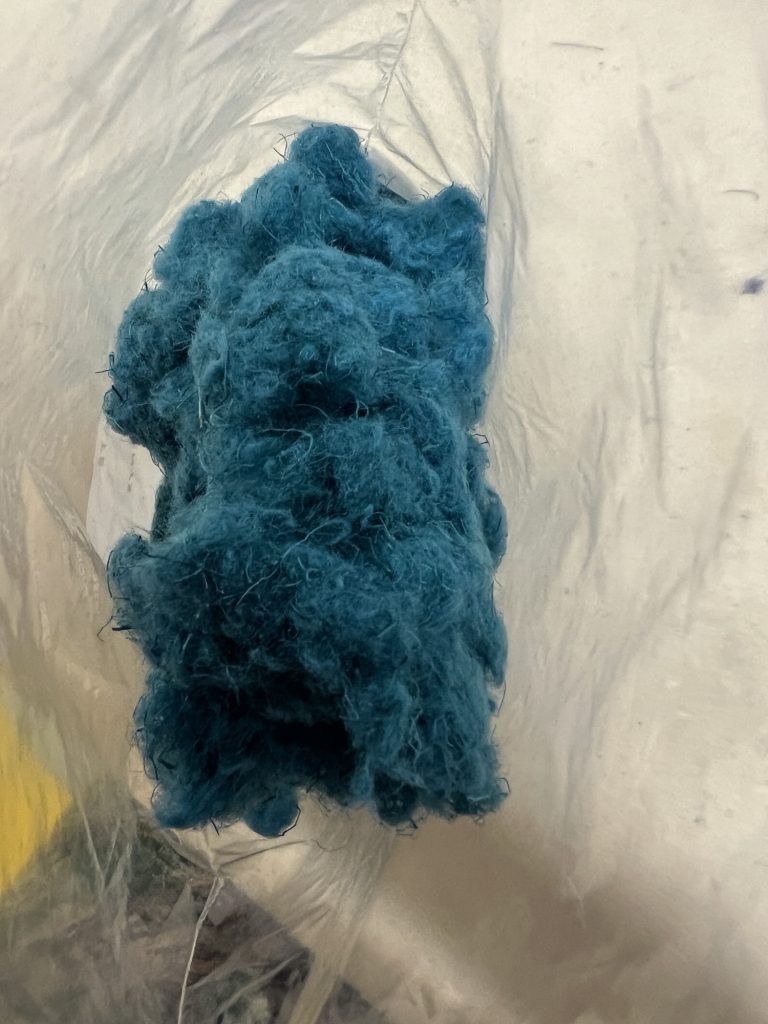

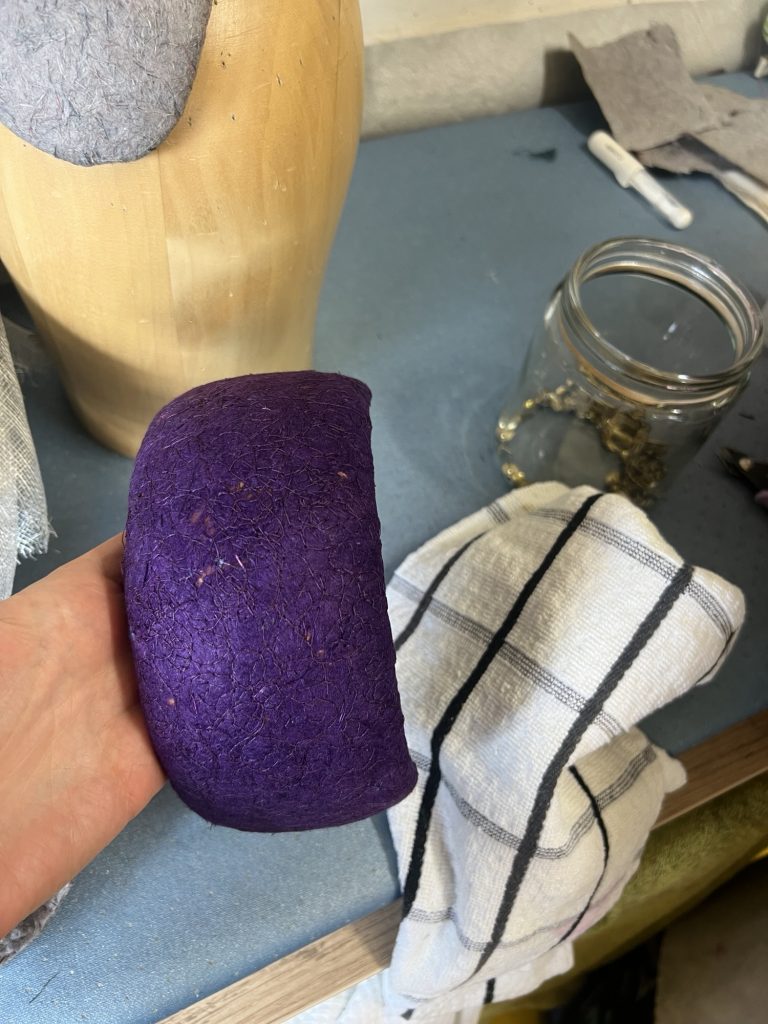
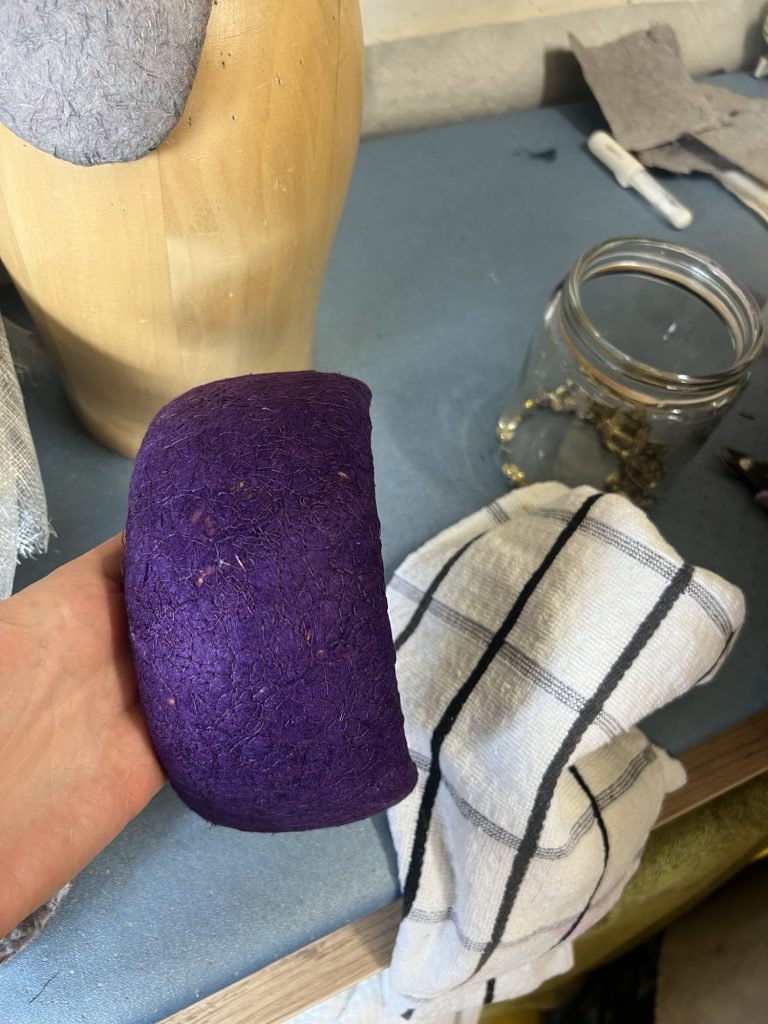
Using the remaining purple dyed pulp mixed with PVA I made sheets that I then laid straight over blocks, so that they would dry in the curved shape taking away the need for blocking afterwards, when I needed extra pulp to covered the block, in one case I parched with loose pulp, on the other I layered 2 sheets of put next to each other and pressed together to lose the seam line.




Savian – Faux fur made from bio textiles.
I have always found the idea of faux fur a little confusing, whilst we all know of the issues of using real fur and animal rights, horrific conditions, and the environmental damage in processing the furs. (PETA UK, n.d.) The replacement option is 100% made from oil to make plastic that is not only not biodegradable so will remain on the planet for thousands of years, but it also release thousands of tiny microfibres into waterways, 9% of ocean microplastics can be linked back to the fashion industry. (PBS SoCal, 2025) and therefore into marine life and even our own food chains. Whilst the technology available now that can create faux fur that looks and feels so real is undeniably incredible, it is no longer an acceptable solution as a replacement for real fur in terms of planet, pollution and wildlife – Faux fur still causes the same damage to the things it was initially created to help protect.
The idea of bio textiles being created to make a replication of faux fur is also a complex topic. Why are we looking to replicate something that we know causes a lot of harm. why is human psychology such that, even when we know it is bad for animals and planet, so we still want that item? Why does it need to be replaced with an alternative rather than just dismissed and not used? Creating bio textile such as Savian by Bio-fluff have obviously created sensational technology to be able to create plant base faux fur. (I have not felt or seen myself, but I can assume that it is used by Stella Macartney (McCartney, 2025) and has been made in collaboration with them, that it must have a luxury edge to it and be of high and realistic quality.)
‘Savian explores natural fibres in a way that has never been done before, harnessing the true structure of the fibre to create natural alternatives to fur, shearling, and teddy. Our process significantly reduces CO2 emissions by a 40-90%, representing a meaningful approach to lower-impact material production.'(www.savian.bio, n.d.)
Is sustainable, eco and animal friendly the ultimate luxury?
The reason I started looking at faux fur, was that a supplier of luxury faux fur that we have previously used at work has stopped operating. this left us with a huge bag of samples that no longer had a purpose, what could we do with these pieces of faux fur, we had over 100 pieces of 25cm squares of faux fur. Obviously they had had a use to us previously, but now we couldn’t really face the thought of putting perfectly good fabric samples in the bin, knowing it will not biodegrade as it is 100% petroleum didn’t sit well, so we have set about repurposing them. we decided that by choosing similar tone and length furs we could then cut and restitch pieces together, almost making a new fabric, whilst we could have gone bonkers on the colourways, our clients would probably prefer the more subdued colours (Plus I’ve had an idea to make faux fur soft filled cubes for my godson for Christmas with the more garish colours!).

Initially with the new fabrics created by slicing pieces together we were going to make faux fur hats, however, we then decided it didn’t really fit our aesthetic, and the extra time spent to create patterns to make an 8 piece crown with fur band, probably would financially never repay, so we changed it into make scarves, as then they were much more wearable and would fit a wider demographic of customer, as well as being easier to sell as Christmas gift ideas and a more palatable price point.
They have worked well and made lovely scarves with a high-end aesthetic, all made from waste, backed with left over fleece and boiled wool from previous projects. There is a lot more scope within using the rest of the samples and we will continue to experiment and create.

Looking further into this topic of I was interested in the consumer viewpoint how shifting attitudes, but also cognitive dissonance affects how modern-day consumers view eco-friendly/ anima friendly alternatives. I was intrigued that in reading (Choi and Lee, 2021) whilst the big animal welfare and animal liberations movement happened in the 1970s after the publication of Peter Singers Animal liberation book and it wasn’t until December 2013 that online search results tipped from real fur to ethical alternatives. Interestingly even now, the wording ‘Cruelty free’ in fashion items, still has more effect on consumer behaviours than an eco-based wording statement, meaning we are probably still a fair way off from the position we are currently in with real fur to hold the same clout as using petroleum based faux furs in regards to the damage to the environment that they cause.

This led me on to a little reading about more cognitive dissonance in general and why our values are not often strong enough for us to always follow through with actions of buying sustainably according to (Basso, 2024) whilst 37% demand more info on how clothes are made, only 13% use the information about how stuff is made. and 80% of people still make choices based on price and are price sensitive, so whilst people have good intentions, it comes down to the amount of money in your pocket. Because clothes are such a part of identity, it can be hard to not ‘keep up’ with trends. Ultimately, and I know from my own experiences that I have the best intentions but price, convenience, time and lack of choice means that every day we are making choices that are not the most sustainable options, that is too easy to gloss over our sustainability transgressions, we can excuse new purchases because ‘we will wear them loads’.
I think it is certainly true, my clients love the idea of my sustainable collections, but ultimately will buy the hat that matches their brand new outfit, unaffected by how sustainable that item is or not, (Celik and Ekici, 2024) mentioned that brands can easy the consumer guilt, buy offering the customers aftersales opportunities to offset the buying of a new outfit. This is a very similar idea to the project that I launched which allows previous clients of mine to be able to list their items for sale online as ‘preloved millinery’ allowing clients to not only make some money back from their purchases, but to also ease the guilt of buying an item that only really for most people has one wear – making the cost per wear probably one of the highest of any accessory of fashion item. We also must option for clients to fully erase their guilt of buying a one-use item to list, by offering an option where the proceeds go to a charity that we support. So, it is some of these sustainability measures that can instil more trust and ease the guilt of buyers. they still buy the item they want, but they then send it back into the marketplace to go on and live another life with someone else. Whilst we love offering this service and it certainly builds trust with our clients, the nature of reselling millinery is not always as easy as it sounds, if we have made bespoke pieces for someone they only really match one outfit, so can be a hard resell. Often, although we provide pricing help, people are expecting to receive a lot of money back for their preloved hats, nothing wrong with that, but as an online only marketplace, and hats being such a personal item, where people don’t have experience of what suits them etc. so demanding a high price without expert sales knowledge and techniques can be tough. Financially for us, whilst we of course are passionate about sustainability, it does not make sense for us to store the preloved hats and offer them to our clients in person, as the physical space they take up and the labour required for the sales time involved simply would not add up or make sense for the small commission that we receive on each sale.
Thinking about the term cognitive dissonance, also brought up other things for me…I have realised that I have stalled a bit on the creative project, creating new fabrics from sinamay fibres, whilst I am invested in the concept of the idea, I am not enjoying the process. it’s very slow pulping the material, messy and has loads of drying time….meaning that it take weeks to get from stage to stage, the sustainable glue I made from corn-starch and sugar started going mouldy as I couldn’t dry it quick enough and I’ve become a bit bored of the project, I also don’t think that I really see the concept working to create luxury items at the end of the day. It is feeling a bit more like a rigid science experiment than creative, So I am experiencing my own cognitive dissonance with this, I value the idea, the concept and have a desire to be sustainable, but the journey there is not fulfilling me. Leaving me feeling quite torn. Perhaps the idea of sustainable millinery can be explored, but maybe it is unfixable. Is the reason there being no more zero waste options in fashion is because it is hard and therefore financially and process wise it doesn’t work.
Millinery is sustainable anyway from a material perspective, most traditional millinery materials are natural, but millinery is not sustainable because it had no function apart from social and class, so resources are being used for something that isn’t even necessary.
Baudrillard – Reclaiming the real
War in Iraq -save Kuwait and oil fields.
1st time when a war was broadcast live – seeing bombs dropped live on tv – guilty watching bit couldn’t stop watching. Negotiate relationship with the news.
Situationist – Guy Debord – the society of the spectacle.
Have stuff – make copy of stuff.
Spectacle of sea of images a world full of images – a social relation between people disrupts the social norm. Get people to rethink where they are in relation of place.
Why? Unlike Marx we work for factory, we make, we subjected to alienation because of boss.
Now just have images, all our social exchange is just images ‘a spectacle’ – our means of exchange. Is watching live or is watching playback better?
Lots of images but underneath it flattens out reality, we don’t have a choice of stuff in the world.
Cinema social activity – experience as a group
Tv home in family unite alone isolated – alienated through the image.
Now phone – even more so- see a gig – still behind the phone. We now create own content on phone…. Social media not showing actual reality, curated reality.
Baudrillard 1980’s – Reclaiming the real – the gulf war did not exist…. we watched it.
The way the war functioned for most was through a screen – the object and people dying – didn’t carry the meaning. The visuals carry the meaning – simulation. The copy of images is 1st; the reality is in decay.
Veterans of the war only felt what it was like once they got home and watched tv – even though they were pulling the trigger – tv gives them a wider viewpoint – the most relevant is conveyed in a copy.
Map of kingdom – kingdom decays as map is more important.
Gulf war didn’t happen – message and relevance are taken by copy not reality.
You need the real to create the copy.
- Image of fish
- Taste the difference M+S Image becomes distortion of the reality connection to actual fish is mangles – propaganda – manipulating us.
Take us away from fish farm with life / factory farming.
Advertising
- Absence of basic reality – what is reality – could be fish in breadcrumbs, could be mush in breadcrumbs – vegan nuggets.
- Swedish fish – round with jelly – nothing related to reality – even the fish shape took away. Ended up with nothing related anymore to original.
Gold nuggets
Bar of gold
Coins
Credit card
Bitcoin/blockchain
No longer attached to gold but all came from gold. Original came from gold, not currency, currency is the exchange, gold is the original object.
Pumpkin spice original from pumpkins – not anymore just chemicals
Soldiers in Ukraine army – e points – app after made target, use points for more equipment – gamified, the more points the better they can buy, so best resources are being directed to teams who use best.
Are you in the army or are you in a game – alienation and separation – in competition and marketisation.
Disney
Neuschwanstein
19th century castle – copy of an idea of a medieval castle. – Rapunzel tower
Model used for Cinderella animated 1950’s and Chitty Chitty Bang Bang, sleeping beauty, Rapunzel.
Castle is already a copy modelled on French chateaus.
Animation moves away.
Then Disney castle built in California
Then take the plastic reproduction back to Paris (where first ideas initialised from chateaus).
When you go to Disneyland – go to castle but can’t go in…. brought up as a child that this world is magical, but reality doesn’t exist either.
Disney is hyper real because our expectations now are more like Disney than of real castles, so is a facade but we then think that Neuschwanstein is the real…. even though that in itself is not an original….
Hyper-real Disney land is fantasy- obvious fantasy. Disneyland represents America to its self -optimism and belief in shared common goal, fun, lack of oppression, freedom, all come together in the new world, but all pretend. When you leave and return to normal life. You have left the fake, the world of ideals, Disneyland supports your ideas of world of possibility. Our daily life becomes hyper reality, world is empty of meaning, Disney, trying to make reality real. Disney is defence mechanism from real.
Disney example Symbolic of other stuff
There is no reality we are all in a simulation. The stuff we believe in is a con, how we interact is a con, we recycle images.
Is making art copies or original, fashion all done before, hearsay, research to create something new, your role as collector of information is a part of the cycle.
Media saturated world – just building other people thoughts then being cynical or critical of them.
Love Island – reality dating show & game show people play themselves or performing for a camera, playing at intimate relationship – intimate relationship is being copied. Polished and presented in a certain way. Authentic relationship does not exist; we look at this world to understand and repeat what a relationship should be. – but it’s created so not real. – must look and act a certain way to get ‘love.’ So surrounded by simulation it now becomes real. Look back to first season – normal people, but simulation, future seasons is more curated – gets further from reality. Our experiences are flattened out.
When does it becomes social unacceptable to not talk to someone because they disagree with you and AI tells me all I want to hear…so much is copied, the words knowledge is being distorted (AI continues this). The way we constructed the worlds to have meaning sets up for this. We live in a simulated word of copies – even words Philippe is saying is a mixture of you tube videos being performed. Are there any new, or any correct ideas.
Can we bring anything meaningful into the world, exchange of image is not attached to reality and is all a performance.
Reclaiming the real.
Is creative practice attempting to do? Discuss?
Can we only explore the surface as we only have copies.
Withdrawal – rejection, I want to return to a state of authenticity. Live a real life in forest with no internet, only paint trees and animals…. but is it streamed on you tube? Is our reality not affected by all the images we have been fed since birth…so is living in a forest reality as you have been informed whole life of simulation. Going for a walk – interrupting sea of images – to become lost.
How can you be original as an artist? Have you seen before? The function of the story is still the same – repurpose but change elements.
Cosplay – playing a character from a computer game…video games social media but 1st person perspective. Get a character and choose how you act in the space and how you interact, so can add yourself to the character, so you have agency to change the story, because you can select your part, you can add more of yourself to it as you connect with them more, then that can turn into a real life character and making physical objects for the character. Game is like Disney land – not real but bring it back with you into real world. Fallout is masking the reality that we are already living in the apocalypse. The game play Is comforting, in real world, wearing the cosplay as it feels more comforting in the real world. Is the apocalypse happening…….as a child anxiety exists ….by bringing it closer in computer games is comforting, because thank goodness it actually happened.
Advertising -hat dressing up takes you from reality.
Don’t make art out of theory, you want to make a thing and don’t know why, but to grow the idea, taking knowledge can get you to next idea. Usually understand afterwards. Escaping reality
But should we Resist this cynicism and find the human spirit in everything.
Image in marketing more important than the item – lifestyle image sells.
My Thoughts and How It Relates to My Practice
This is an interesting concept to reduce life to images, it is not something I immediately feel at ease with, however it is true that much our lives are now through a screen and many things are copies. It is said in fashion that there is nothing new, just a rehashed example of a previous fashion trend, but in which traditional skills are lost, hand embroidery in exchange for machine embroidery, and now even some fashion items just have prints of embroidery style stitches to give the illusion of real embroidery, so it is an actual simulation. Whilst in my creative practice it is all about physical things and how it feels in the hands as well as when it is worn. Traditional craft is important; however, do we lose sight of what traditional craft actually is. Are we taken so far away from what it one was that our idea of original isn’t actually true in the first place? When I have studied and analysed vintage millinery, I am often surprised at the interior finish, you can see long obvious stitches and areas of glue. Today for a luxury product those finishes would not be acceptable, so our skills have had to improve, meaning we now believe a couture piece of fashion should be flawless, but if you look back at historical fashion, it rarely was made flawlessly. It is ironic based on the low expectations of fast fashion, where everything is made a cheaply as possible and finishes are cut, that we still pay good money for poor manufacturing when it is the lower end of the scale, but would take offence at the tiniest flaw in something made by couture craftsmen by hand. Are we getting confused? Should we not be more accepting of hand-crafted luxury having flaws because that is part of the joy of handmade than mass produced fast fashion having flaws? Are our expectations now that hand crafted means it needs to look like it was off a mass-produced factory floor to be desired? Or does it all come back down to price?
The wearing of hats itself is something that takes one away from reality, there is a quote:
‘I myself have 12 hats, and each one represents a different personality. Why just be yourself?’ (Margaret Atwood)
To me this is really what sums up hat wearing, it is about who you want to present as, maybe you are taking yourself out of your reality for that day, it can give you confidence, or the ability to hide in the background, the ability to stand out from the crowd, or signal a social status (whether real or not). We as humans always layer ourselves to fit in different situations, a hat is just a physical embodiment of that, like a performance. When I do marketing photoshoots with my hats, the main aim is to sell a lifestyle, to ensure that some-one looks at those images and aspires to be that person in the photograph, as effortlessly stylish, and glamorous, with that beautiful lifestyle that goes alongside wearing bespoke pieces of millinery…..The marketing of my millinery is therefore no longer about that actual hat, skill or craft, but about the person it will make you be when you buy the hat. The image of the hat is more important than the hat.
I think understanding these factors is really key in my creative practice, allowing me to think about the craft and its traditional roots, versus what I think the traditional roots may be, how traditional crafts are viewed by consumers versus how luxury fashion is viewed by consumers, and how marketing imagery may in actual fact be more valuable than any product.
20th November – Bataille – How can a fascinator prevent World War three
The Potlach
Dinner party take wine/ flowers – come to ours next time – do that better when come to yours
General gifting economy
Questions capitalism – no money
But gifting is core to being a human being.
Generosity – sign of respect
Function and utility of fireworks-waste of time but pretty= community building – civic pride. What is the return is council put in money.
Gift isn’t payment – if you gift and expect gratefulness – still a gain, just not payment.
Start with bartering – people would specialise in certain things – more efficient way to work, I will swap grain for hide.
Only works if you have what you need. Need to match up with what people need. – bartering does not work fundamentally – informally occasionally. – bartering is not in exchange of money.
Instead – contribute to general good of village – goodwill is the currency that is unmeasured – but do you do enough?
Does giving to foodbank then give you status as you have contributed by choice- sense of fairness. Those on fringes and don’t take part aren’t really in community.
Gives status and belonging.
Those who don’t contribute have less say, those who do have more power. How you conduct or give yourself to society.
Giving creates a social bond.
Meeting of tribes – like a dinner party – go and give – sacrifice of stuff instead of stabbing (land/resources etc.) survive better through collaboration.
Marcel Maus – Gift economy – Book the gift
Works because is a flow of energy – spiritual energy – unmeasurable -unit of prestige. We know when it is not exact.
Relies on the idea that given something that costs you. Unthoughtful gift not great just bought and given, making something by hand- thoughtful – more value.
Bataille
Expanded od Marcel Maus idea.
Giving wine demonstrates appreciation.
Competition of gift giving ramps up., until cannot longer keep up…sacrifice, to show how much un-needed. Sacrifice is spiritual currency.
Cut flower – sacrifice – will die – more charge because is linked to more loss (sacrifice and death) spiritual worth more as already dying as gifted.
Potted plant – less charge, will continue to live, and grow, its alive, continue to nurture it. Has a different charge.
I would rather cut flowers as then I am not responsible for the death like on a potted plant.
Conservation (capitalist production) VS excess (dispense) Accursed share.
Capitalism seen as a merger and small life according to Marcel Maus. Hoarding like in capitalism (buy and rent to others and gain riches) does not allow you to have a richness in life. More power in generosity.
There is an excess in the world with excess energy that needs to go somewhere, the Accursed share. Can go towards war or extravagantly dispensed off or sacrificed. Bill Gates foundation – giving away wealth.
Elon musk shoots Tesla’s to space – excess given away like fireworks – but less sacrifice.
Billgates is a more productive way of giving away excess.
But giving away needs to happen regardless. Sacrifice must happen.
Engagement ring cost ‘rule’ 3-month salary – all about the sacrifice.
A fake diamond looks the same – no one will know. So, the value of a diamond is the amount of money you give up (burn) that could otherwise be used for other things.
Prestige / Sovereignty / power
Can you barter with the gods – will I then get a good harvest – barter with the spiritual world. – give away without knowing that you will get it back
Ordinary world or extraordinary world – extraordinary is true expression of being human.
We will all die, as part of full expression of humanity – to sacrifice is acknowledging that we are part of a bigger story and death is a part of that. More in continuity of humanity, than the capitalist conserving mindset which ignores death.
We know we will die – other animals don’t. if you accept it helps to concentrate on your own humanity.
Continuity /ecstasy/death
How does this relate to art?
Teressa of aviola erotic ecstasy of being speared by Gods love in sacrifice and death. Charcoal drawing of a sculpture has value because of the sacrifice made by drawing it.
K Foundation – took money from pop songs and burned £1million – don’t know what to do with it. Sparked anger because of not respecting. Is it any difference to fireworks? Apart from doesn’t give an even for watchers. Not perceived to be good, could have given here or there, charity, family etc.?
Damien hurst – diamond encrusted skull – not purchasable – just a show of sacrifice – what is the Purpose?
Golden toilet stolen from museum – if a rich person eating a £200 meal or a poor person. It’s the same shit that comes out and has the same value.
Kidworth – lower- and upper-class different sewage systems, so don’t mix.
Coffin railway – 1st class 3rd class
Transgression / Taboo
Break norms of society to be in a wider sense of loss and sacrifice.
How does this relate to art?
How can we apply this.
Being in this room studying, doing higher education. Will lead to more money and a better job / higher social status.
In general, will it get us high paid job – difficult you get money from – not worth it financially but is worth it in wider full expression of humanity – yes. If no one transgress, who will?
The work of art is useless and is a gift – it has time sacrifice with meaning.
More relatable individually as a person than capitalism, manifestations of a layer of human nature, but contained by the capitalist views.
An object in art is closer to a diamond – serves no function apart from to express the sense of giving and sacrifice – runs counter to capitalism.
Implicit value in personal investment and sacrifice—something is good because dangerous and outside the norms… and not caring.
If you dare to do truly you, you realise life is too short, death will come, just do it, no expectation of return, but is significant as part of you. Has no use in society, but is fullest expression as human, the excessive stuff is what life is about, not paying the rent. Not useful but a world without art is a poor world.
Time funnelled into creativity to make pointless stuff. If excess is circulated, meanness of hording creates war. Therefore, is it vital not frivolous, so the unnecessary becomes necessary – bring in the extraordinary give gift to the world, elevated spiritually and socially compared to estate agent. Is it about perceived sense of purpose.

My Thoughts
Today’s session about Bataille was interesting. There certainly is a culture of gifting that is about expectation and sacrifice. I do agree that something made and given time to, rather than just bought for the sake of its hold more value to both the giver and the receiver. When time allows, I am a keen maker of gifts, but sometimes time does not allow. I am unsure whether you always expect something of the same or more value in return, sometimes the joy of giving is the reward, sometimes, you know others are not as fortunate and you do not expect, nor want them to give you a gift in return….your gift is to help them raise themselves up, not to bring them down which excessively giving may do, but perhaps this is the confusion between capitalism and the gift economy.
Perhaps what is being said when translated to art, as everything in art has no use, but the act of making it and gifting it provides and innate value that maybe doesn’t need reciprocation or anything in return, as the nature of the world means that your sacrifice will bring back a more spiritual value than receiving a physical gift in exchange.
Giving gifts to children in a wider family environment and understanding the concept of giving and receiving gifts and the part it plays in society as a currency of value. It is also an element of relationship building with children an opportunity to build a relationship.
It does argue against capitalism, however I think there is a cost for both to be running side by side, community status has a value and what you can’t contribute in the financial ways which capitalism requires, you can gain status in the act of giving time or services, which can make you richer in the way you are living life, giving back to communities is ultimately more fulfilling in life than working just to hoard money.
When looking at it from an art perspective, is the artist who invest the time to create the gifts or give the time to communities who really understand that we are just a part in the circle of life, hoarding money and wealth and working in the capitalist ways doesn’t actually bring us more happiness or spiritual wealth and enjoyment as we are all coming to death.
For me perhaps a healthy and realistic balance of conforming to capitalism but creating for the bigger picture would give the most realistic to achieve, to be able to conform for the necessities of life but see the world as more than paying rent, and more about what you can give to enhance others and their lives…with that a good life will come back to you in spades. Be generous and receive generosity back. Create art because you can, not because of monetary value but because of its spiritual value.
Can a fascinator prevent World War three? By giving time to something that is not functional we are pushing excess energies, instead of fighting we are creating art, a valueless commodity, unless someone see the value in it. But art could also be seen as propaganda, saying something that could also start World War three. It will be all about how it is framed. As an expenditure of excess energy it is a positive thing, taking the pressures of societies structural issues, therefore preventing World War three. Unless the art is there to antagonise the opposition.
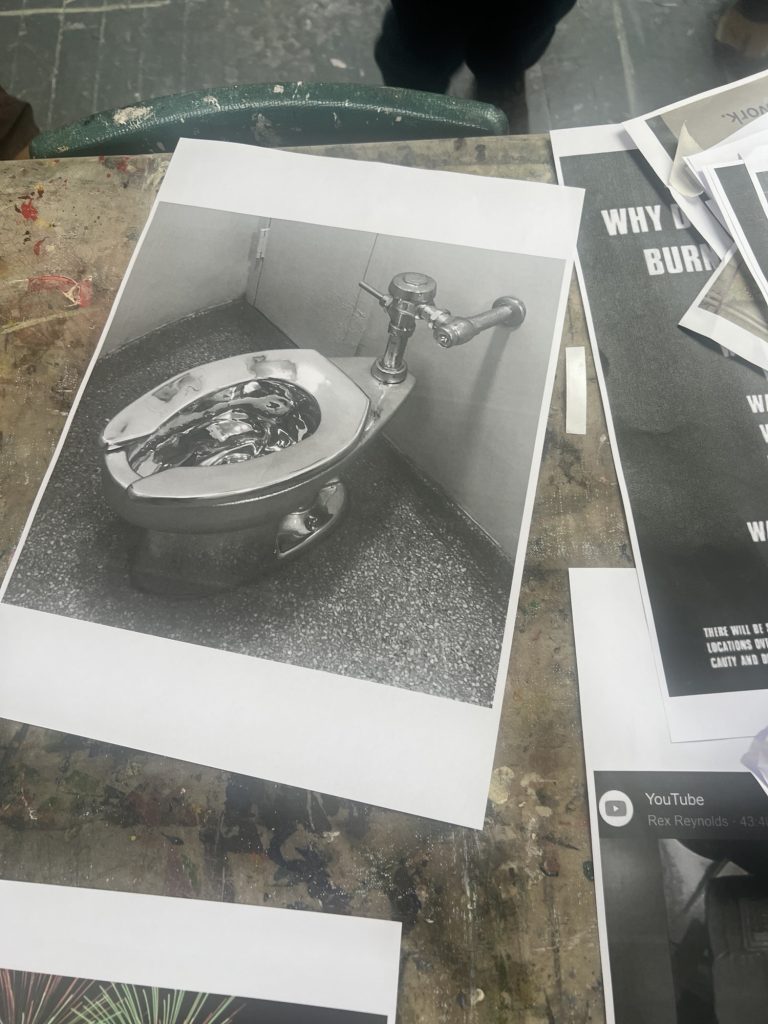

20th November
I visited a Christmas fair and was inspired by two things, the lady on the right was making accessories from waste textiles and then using all the offcuts for other accessories, being truly zero waste, down to her tiny threads and offcuts which were set into resin and made into really pretty earrings. It was inspiring to see a small business, not only with well thought out products, which didn’t look like they were made with waste, but one that really demonstrated the zero waste credentials in action.
On the left I saw a kids toy car but was drawn to the label that said it was made using wheat straw. in millinery we use wheat straw for some hoods, so is a material already in my workroom, but this was it seen in a different light. there is something in how these natural materials can be used just by looking at them for different applications than how I already use them.
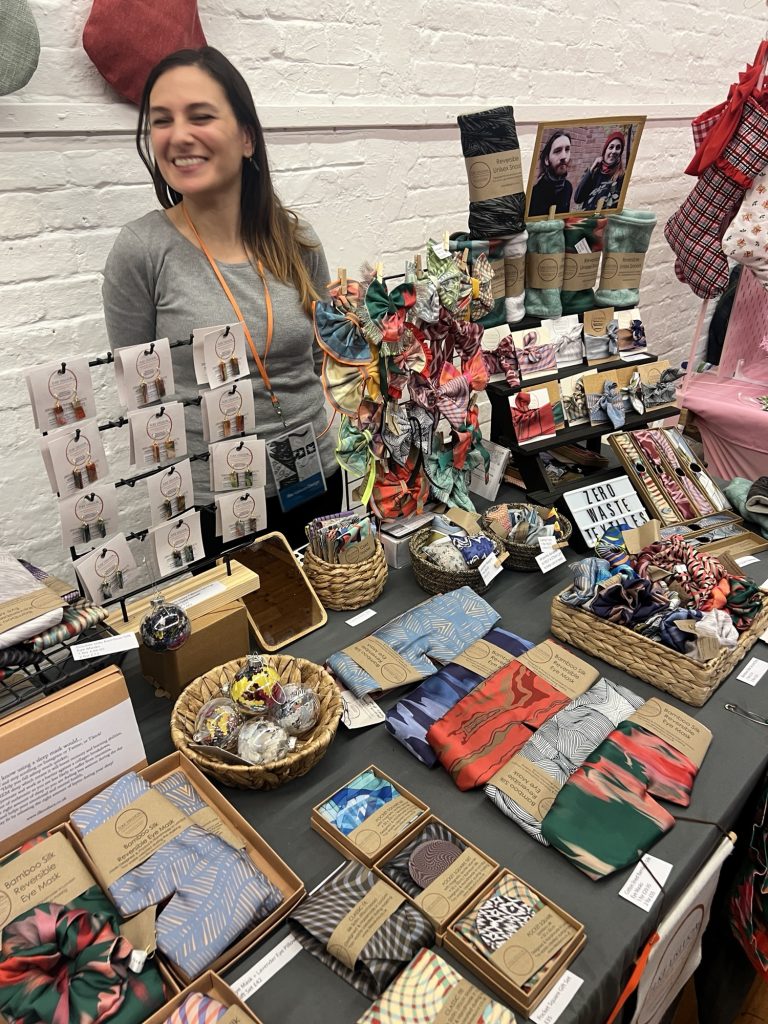

I stiffened and ironed the moulded shapes from before and started to stitch into them to see how they could be sewn and if the fabric had enough integrity, I was pleasantly surprised at how well it held together when stitched. I am not happy with the finish in the curves it has wrinkled, so I started trimming it with left over crinoline scraps that I had left over from other projects, which meant I could use the integrity of the bases of the structure but conceal the less finessed areas.


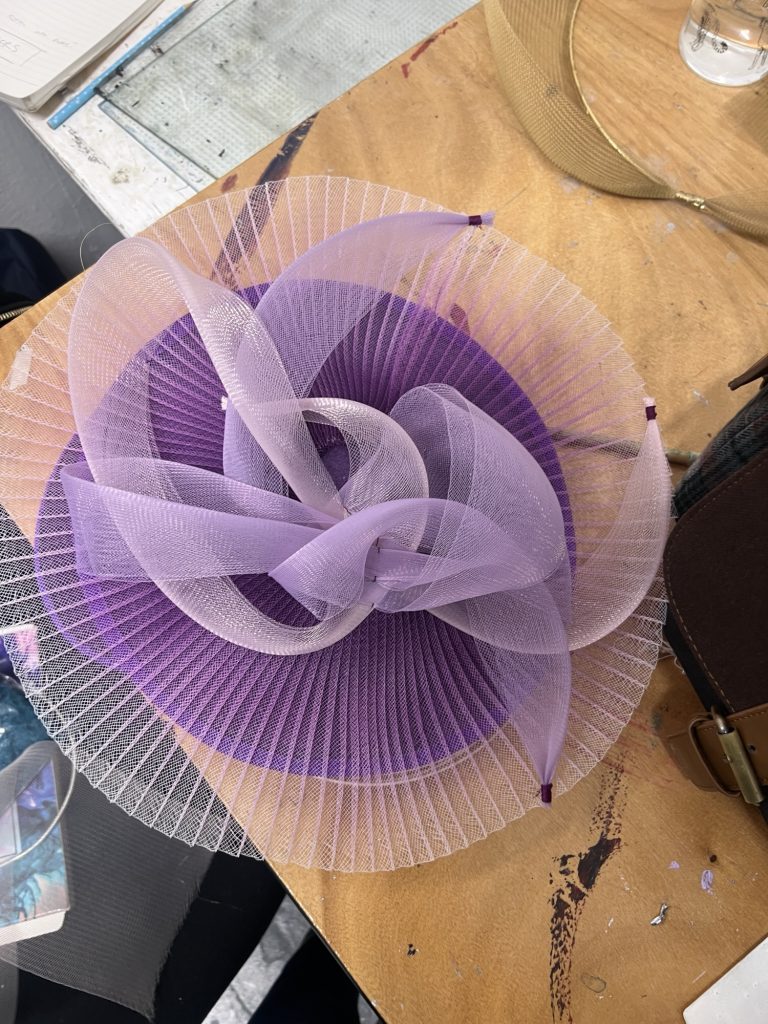
As I had been feeling some cognitive dissonance to the project I decided to step away from the pulping for a bit and make some pieces that were more inspiring and make a statement about sustainability, rather than try to be sustainability. So, I made a hat which graduated down from full new material to material offcuts down to the pulped fabric. I’m really pleased with the results as it uses the offcuts hat it creates to be made and is an interesting textural mix. It shows the various levels of the fabrics being broken down, from new to pulp and how each still has its place.

I then felt a little more reinvigorated to return to the idea of the pulping. I took some dried pulp and whizzed it up dry, this made a soft light fibre, which I then thought may make a much smother cleaner finish. I then made a flat sheet and blocked a shape using this method.


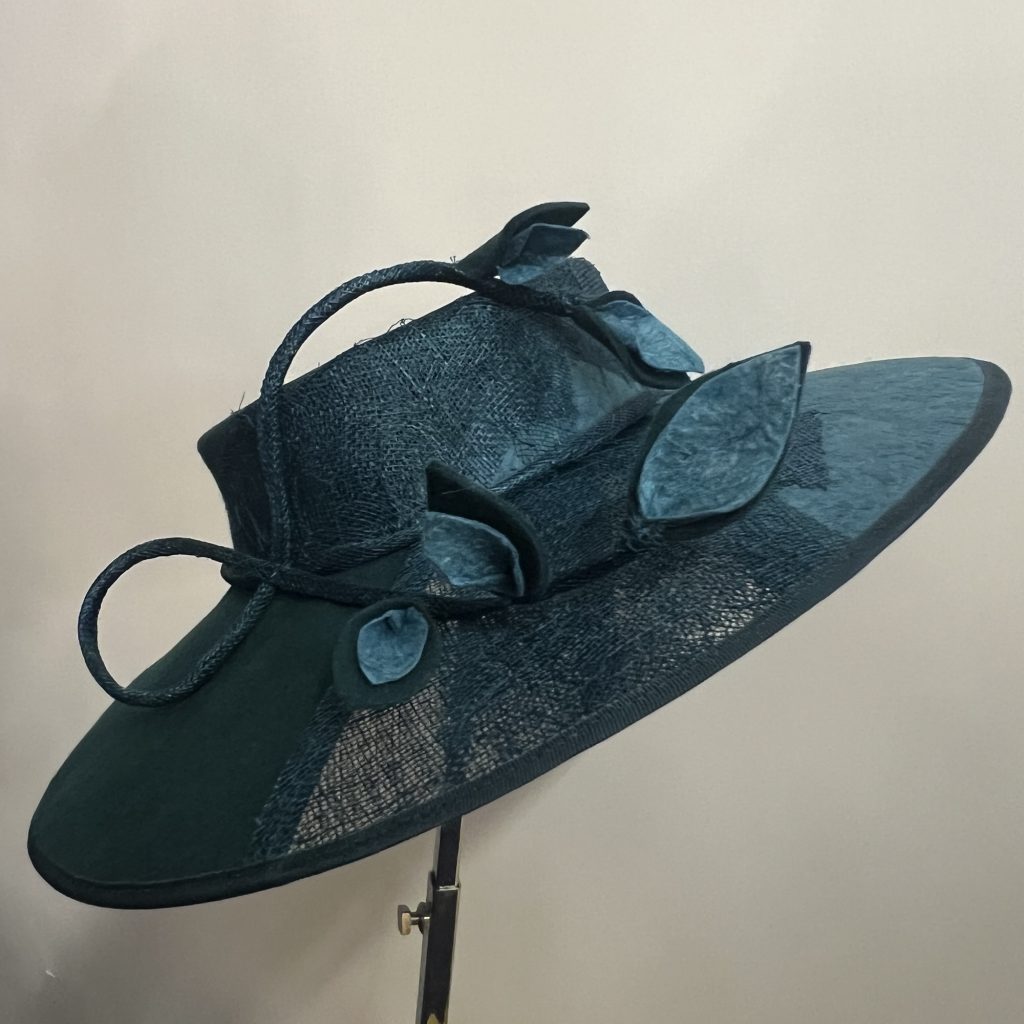
I wanted to play with the materials in all stages of breakdown, documenting the process from full material as we know it is produced to a paper pulp material. I wanted the hat to show the layers and seamlessly blend between the colours. I started with all the same colours but the pulping process lightened the colour so the hat naturally has tonal qualities. My experimentation was in the joining of the materials through freeform machine stitching, adding depth and pattern, but also showing the human impact in the production and reuse of waste, the human interaction in this piece creates a full circle of the creators of waste, but also how it becomes our problem to solve. Overall whilst it works as a hat, I don’t think it is clever or deep enough to show the breakdown of the materials as conceptual piece. It shows how materials breakdown, but is still to conformist to have a conceptual meaning behind it.
I have started researching Bio-resin and have come up with a product called Reslin, which I may try out mixed with the pulp, it is made from linseed oil and sugar beet molasses, meaning it is slightly soft (better for a hat to be slightly softer) and completely biodegradable, also it looks a bit quicker and easier to use than epoxy resin.
1st December – Visit to Phyllis Tuckwell Hospice Retail Warehouse
As part of the ‘preloved’ millinery resale platform that I run as part of my business, I have partnered with a well-known local charity, Phyllis Tuckwell Hospice. They are quite a large hospice in the local area, and most people locally have at some point known a friend or family member sadly must make use of their services. My Gran used their services as a part of her end-of-life care, and they were impeccable at the care they provided.
They have many charity shops locally and a large retail and e-commerce warehouse, I had some hats that had been donated to them through our preloved scheme and as we struggle with space, I like usual, once I had a few took them over to the warehouse.
Whilst I was there I asked my contact what other hats they had, as some materials in millinery are no longer available either at all, or in the quality that they once were made in, so sometimes a rummage through a charity shop for a millinery can be very fruitful. What I was not expecting was the literal mountain of hats that they had, most in pretty port condition and worthless as they are. I looked through and could pick out a few designer names that suggested they should list in their eBay page as they would be sought after designers. I also managed to find 7 hats in materials that would either cost me a fortune to buy new or made in materials that are simply not available anymore, for £2 each these came home with me.
But seeing the mountain of hats got me thinking about the wasteful nature of hats, either designer pieces purchased usually at a not insignificant piece, worn once, left to languish in a box under the guise of ‘sentimental attachment’ as it was worn to their daughters/son’s wedding. Until the time comes when they pass on and the family no longer know what to do with the hats and donate to charity…..now years later the styles even if well looked after are dated and no one at a charity has the understanding of what has value and what doesn’t, either from just a material perspective or designer perspective. Or the other scenario is that someone had bought an average department store hat, again work it once and donated it. Unfortunately, in this case the quality of the hat, care it has received and cheap materials and processes in which it was made means that often these pieces are just not realistically resealable at any value, they are generic and over saturated. My contact at the warehouse said sometimes they do well with them by selling them super cheaply to drunk people at festivals!
The value in the material of the higher quality/ older style hats only has a value to either me, or other milliners. No one from the public without training and experience would have any idea of the treasures that milliner see when we spot a vintage tightly woven para-buntal or sisal. So understandably to a charity they do not see or recognise this.
As my brand and the charity are both well known locally I suggested I take one of the worst hats and repurpose it into a new piece that could be auctioned off by the charity raising more vital funds for them.
When searching through the mountain of hats I had 2 criteria- the hat should be pretty much unsaleable as it is, the hats should be in a relatively popular colour way to increase its chances of selling at auction…to be palatable to the widest audience possible. I selected. Navy blue factory-made saucer hat with cream trimmings, generic and unremarkable (to my eye) in design or materials, it has mostly fallen off its headband, and the feathers were broken. With this I would take it away, completely reimagine it, add a video of the process and then both myself and Phyllis Tuckwell can market an auction in the spring to raise them more funds. The value of the hat in its current state has no value to even the most bargain basket in a charity shop as it is unwearable in its current state. Bringing the joy and life back into pieces and reimagining them can be extremely rewarding so to do it to raise funds for this meaningful charity will make it a lovely joint project with even more heart and community around it.
I also want to think more about what else could be done with the rest of the mountain of hats they have, of which most are unsaleable in their current state or if saleable of little value as they are. There may be some legs in millinery up cycling workshops or projects either with other milliners for charity auctions or for the general public to get involved with community workshops, helping people understand how much waste is created around the fashion events industry and how we can take something unloved and predominately unusable and create something beautiful and wearable from it. The British hat Guild offers funding for selected project proposals so I may formulate more or a plan and try to get funding this way to run an event/auction that more fully embraces the circularity and upcycling of fashion within the community.

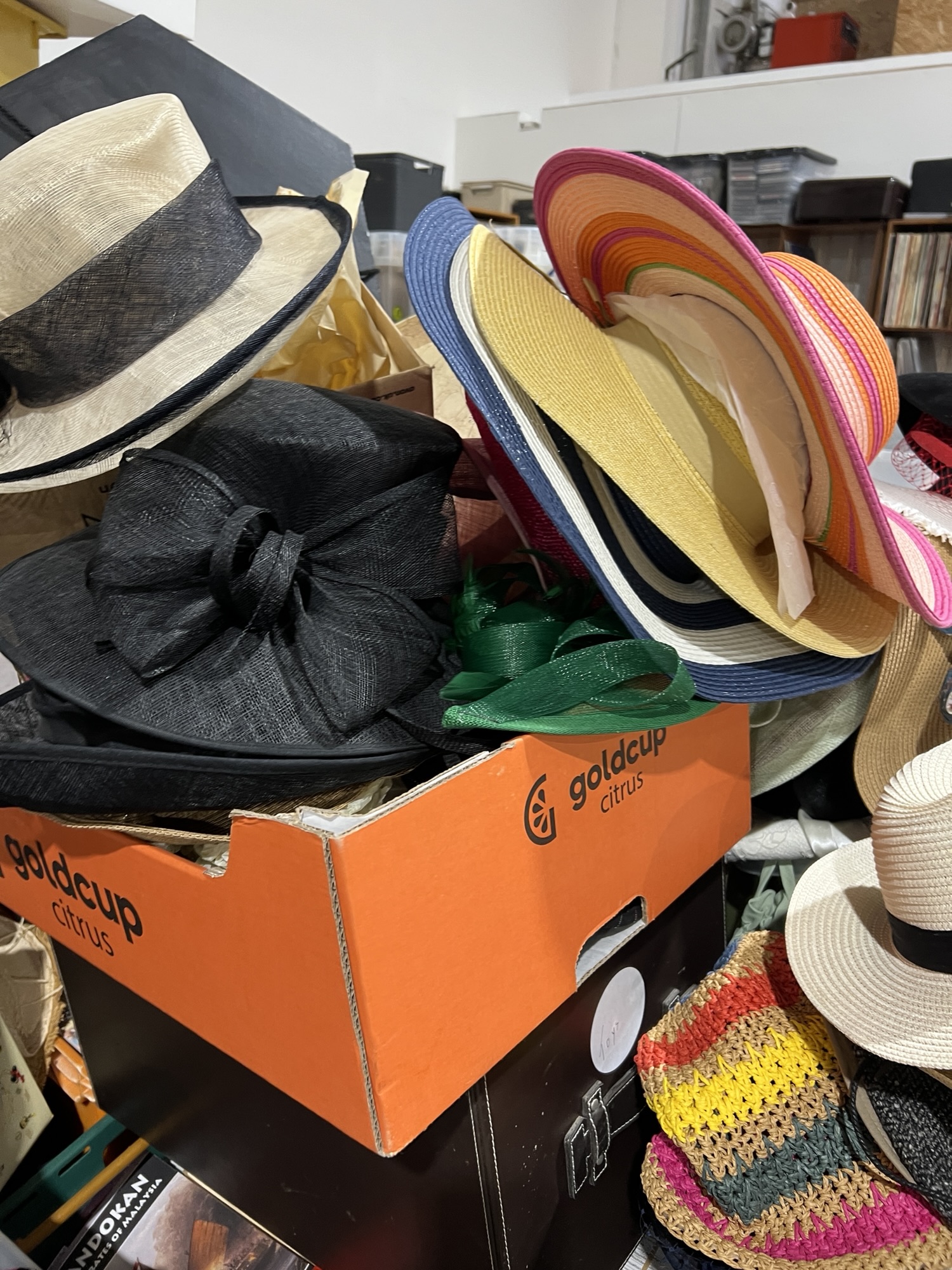

4th December – Mid Term Crits
Watch recording here:
I was a little nervous of the midterm crits, having never done one before I knew nothing of what it would involve or how it would go. Sadly, I didn’t think my crit went very well, or that I got what I needed from it. I left feeling deflated from all the work I have done so far and as if I just didn’t start from the right standpoint. I also feel I didn’t explain or make my intentions and standpoint clear enough.
Unfortunately because there is no other experience of millinery in the room I felt that a lot of my crit was explaining to the group and answering generic questions about hats and the materials, so I didn’t really feel I was getting real feedback from the wider group as others had on their crit reviews, where there was already an innate understanding from the rest of the group of the subject matter, simply because the group didn’t have enough information on what I do to be able to offer it to me, so that was to my disadvantage. But also, because I have spent so long blending pulp, all I really had to show was the processes, not the finished pieces or anything that showed the real intention behind my work.
I did feel the feedback that I did get was very art centric. My creative practice is millinery, I am being pushed to look at my work from an art centric approach, whereas I have only ever really considered it from a fashion or costume history-based approach. I think looking into how these approaches differ and discuss if fashion is art, may be a good route for me to explore to fully understand this wall I seem unwilling to push through into the ‘art’ world. And if that is something that I do need to push through, or if I need to stand up for millinery more as its own creative practice, because I have predominantly fine art tutors, it is understandable that this is the viewpoint that they are coming from. Whilst I agree that there are boundaries between art and millinery that should be crossed and explored and there are certainly benefits to seeing each other’s points of view. I think that the drive between creating fashion and art is quite different. Fashion can be art and art can be fashion, but equally they both have their own creative voice. I think looking down this route further in some research may help either get me to the place where the tutors want me to be or allow me to be confident or be able to express myself clearer in my own approach to my creative practice.
What struck me most from listening to other people’s crits is that the art needed no purpose or function, it just had to have meaning. I would always look at millinery as firstly having a function and secondly to either follow or make new fashion trends, with meaning coming much lower down the list. I really value the function that millinery has in making people feel confident or that millinery gives them a certain ‘mask’ that allows them to step out of themselves and feel empowered through hat wearing, and these purposes and functional needs have to play into designs.
For my HNC final collection, I made all my pieces from welded laser cut steel and soldered jewellery wire. Whilst I was pleased and my collection was a success. I have since always regretted spending the time welding and soldering when I could have been refining and homing in on traditional millinery techniques, which are dying out. Of course even whilst using traditional millinery techniques I can make more meaning based pieces but my motivation for this MA is to further cement skills which are dying out, with a sustainable eye and I am very aware that I do not want to make the same mistake that in hindsight felt I made on the HNC. I want to push myself and this is certainly pushing me, but I do not want to step away from my intention as I need the work in the MA to serve me into the future, in a way I failed to do on the HNC.
Having been advised to let loose and be less restrictive I have created the following works, the first where I tried to let go, but still quite ordered, a representation of how my brain was before entering the crit, seemingly open and willing but still ordered and unwilling or maybe just struggling to unlearn my experiences in millinery. The second is a response of how my brain felt after the crit, thrown into disarray and chaos, and wanting to hide behind, feelings of inadequacies, embarrassment that I haven’t approached anything so far on this course from the right angle. I still want to work sustainably from scraps as this is a major important theme that must be considered with any fashion brands as well as aligning with my personal values.


11/12/25 Visit to Luton and Wardown House Museum
I took a trip to Luton, the British home to hats to visit some suppliers. Luton is the home of British hat making and the remnant of the industry covers the town. It is really sad to see the number of hat factories from a once thriving industry which was the backbone of the town now closed and the deprivation in the area, which was once rich from the straw being grown then plated and made into boaters providing most of the economic viability of the town. As hat wearing declines so has the industry in Luton, the few suppliers and hat factories remaining are family owned and 2nd generation, but most facing retirement age with younger family members having no interest to take over the businesses, within the next 20 years the landscape of the millinery industry at factory and supplier level will change again. There is also a major struggle to recruit skilled machinists or blockers, so the knock-on effect continues. The art of straw plaiting, once a major part of the business is already almost extinct. And since I have been working in millinery, I know of several hat-based businesses that have closed in Luton during that time, but many heritage hat brands.
The suppliers I visited are heritage. The machines they use are 100+ years old, none of the techniques, workrooms, or equipment has been replaced or updated, mainly because you just can’t not buy new ones and the skills to create new ones do not exist.
I visited Wardown house, which talked through the journey of the once thriving industry. I hadn’t visited the museum before, but it dd make me stop and rethink how important preserving the millinery industry especially in Luton is. I was inspired by the reminder that the women working in the hat industries were renumerated for their skills and could build up the ranks to even owning their own factories, in a world where men would have historically been more powerful, in the Luton hat trade women were and still are the backbone to the industry.

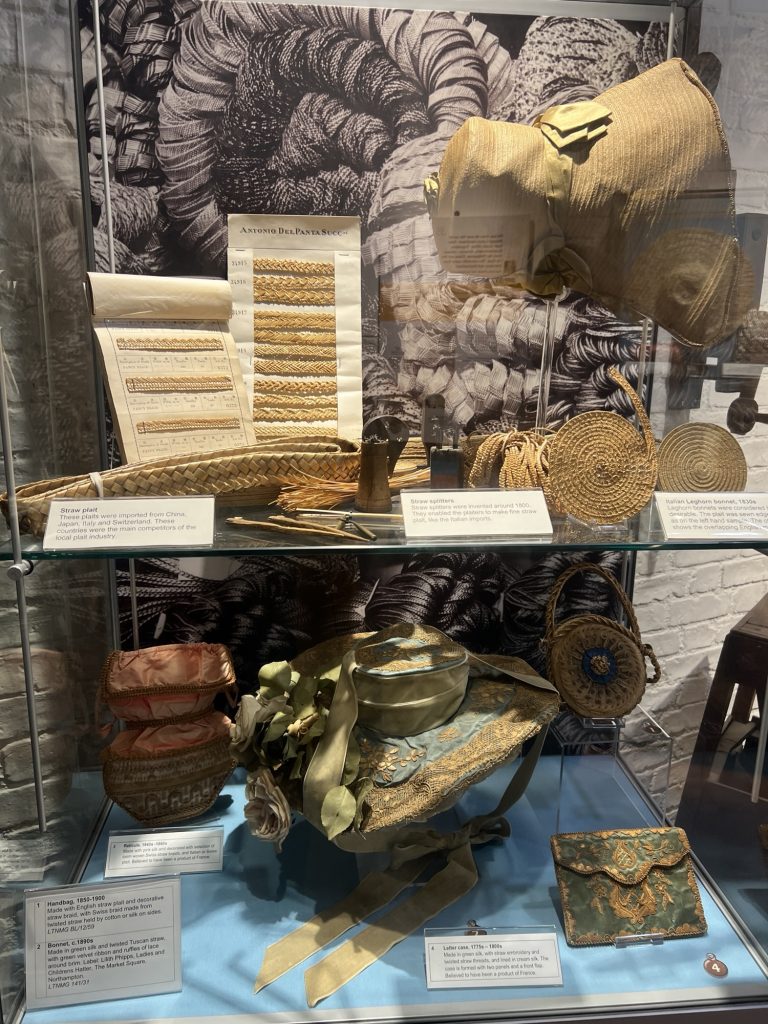
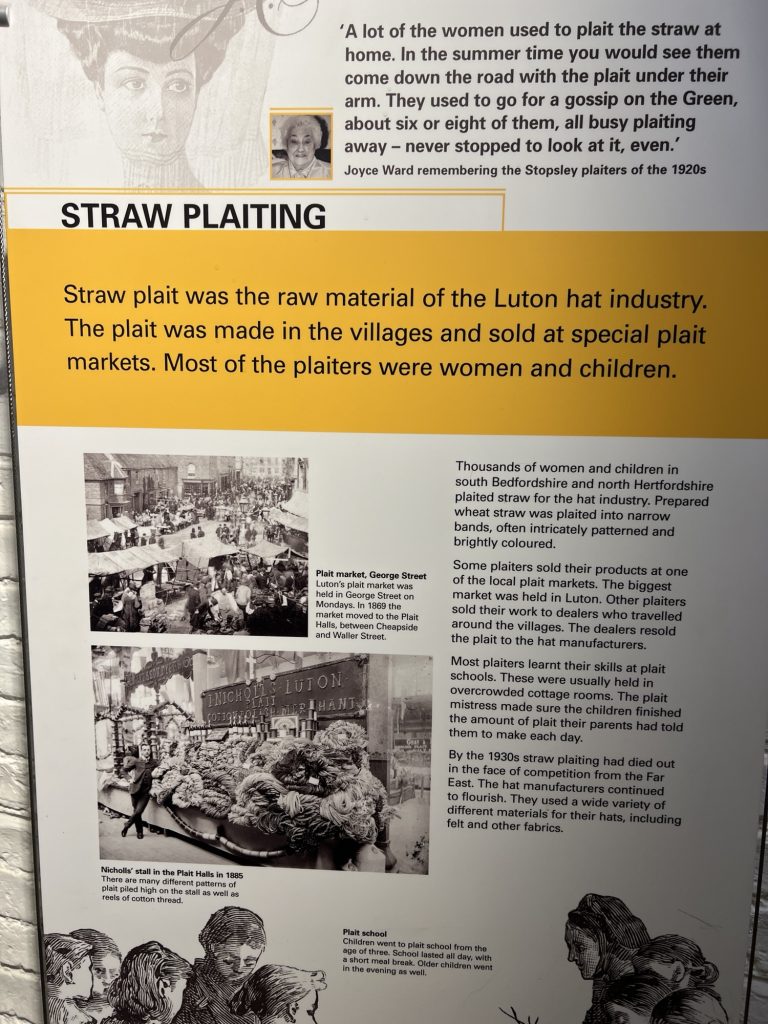


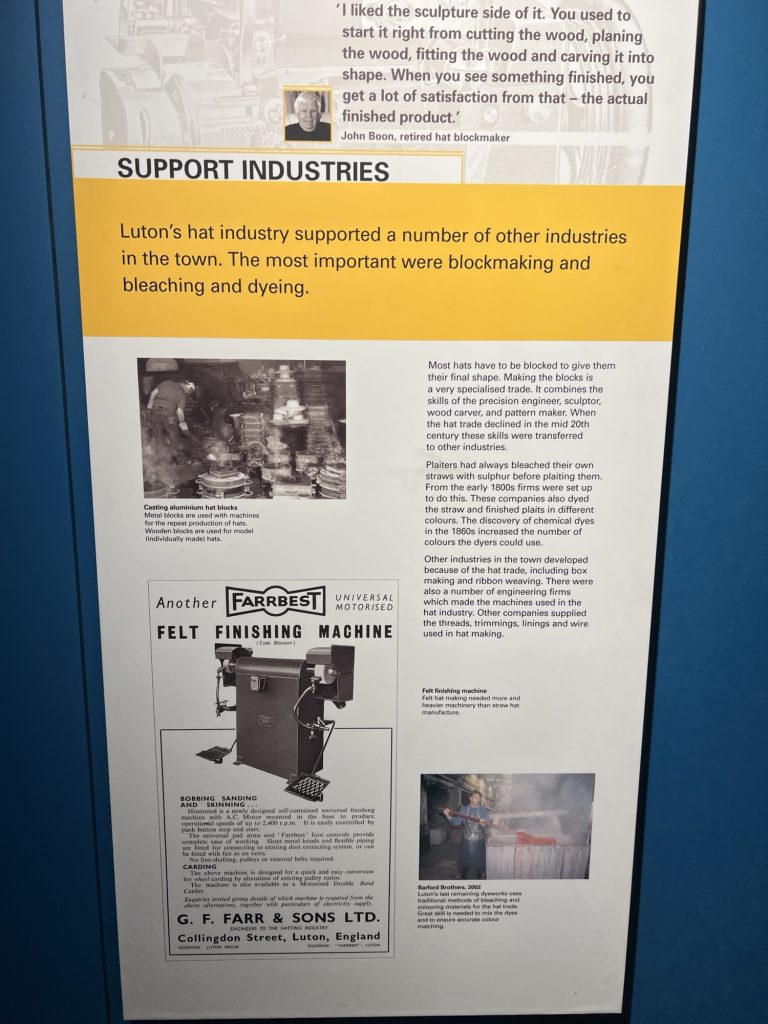
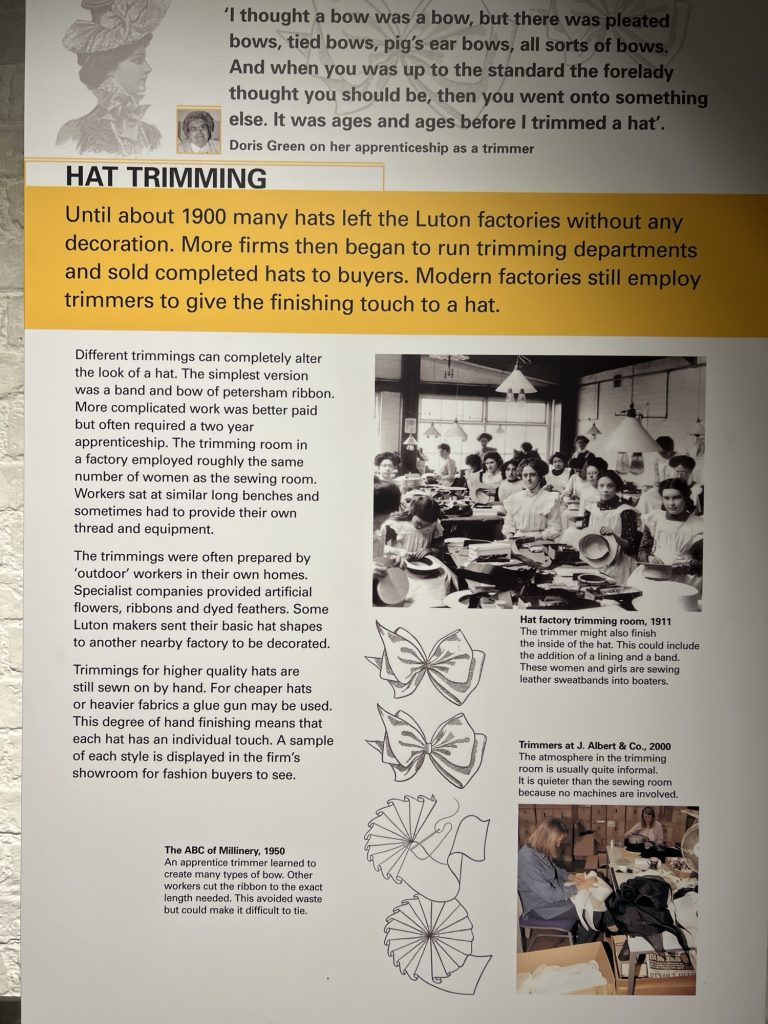
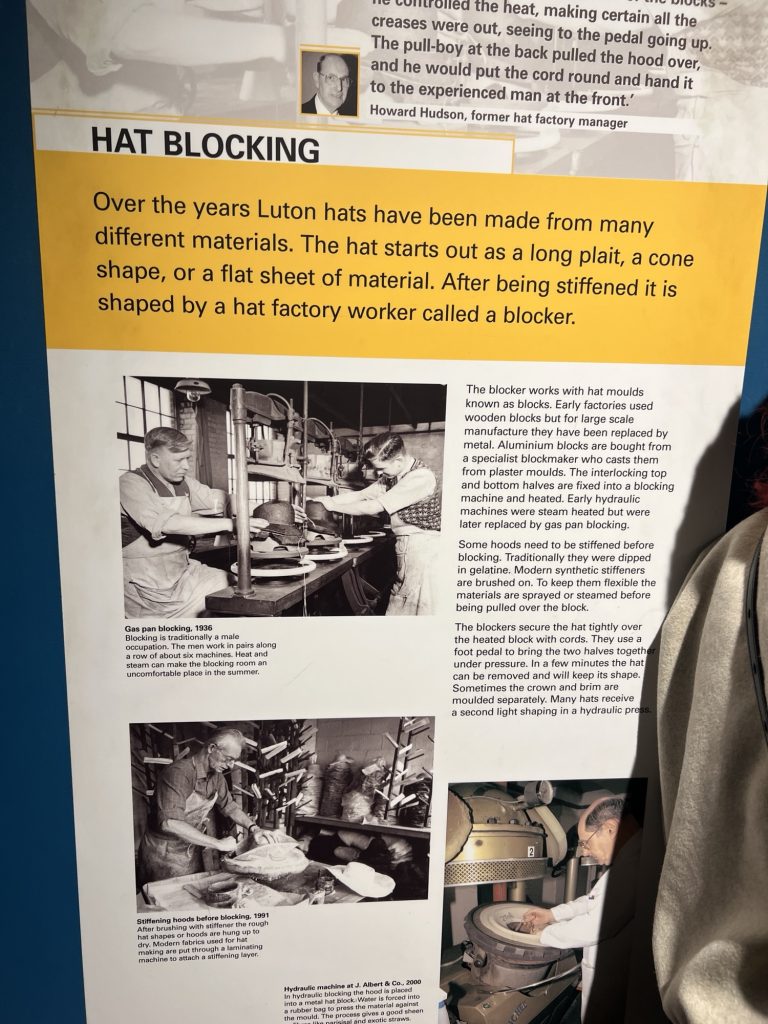

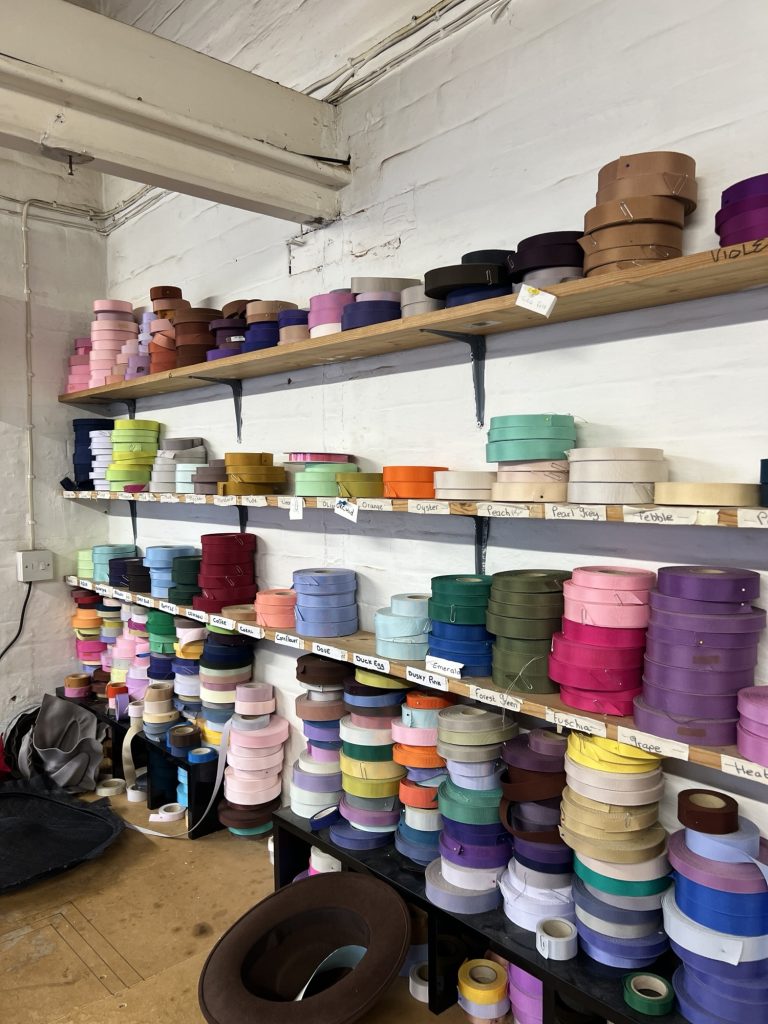
There is some more scope in working with straw braid further, here are some pieces of some work in progress images from my upcoming spring summer 2026 collection.
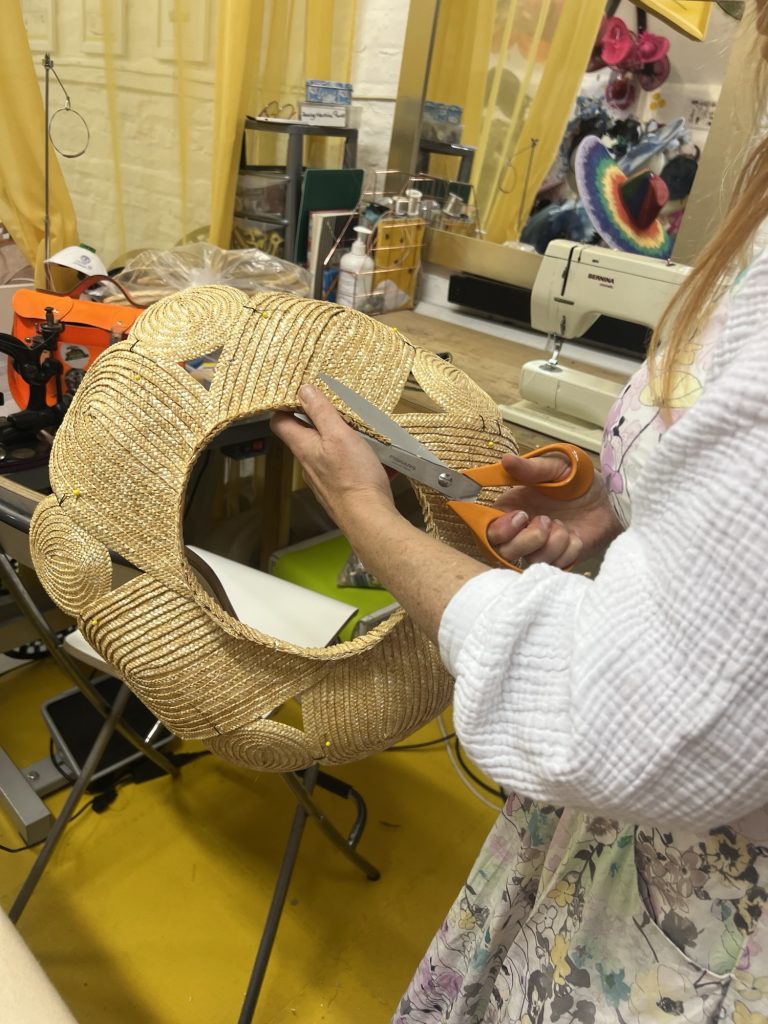


I need to think of a more contemporary way of using straw braid, one that reflects the state of the straw braid industry and the wider hat industry in Luton. Lucy Barlow does some quite contemporary pieces using traditional straw braid techniques https://www.lucybarlow.com/ and is quite a conceptual artist alongside.


I like her overall playfulness with oversized scales. And the obvious nature of the materials she uses, it is both classic and contemporary, fashion and art.
Another thought that came up in discussion with a relatively new hobby milliner was her slight snobbish view that ‘Philip Treacy’ and others get their hat bases blocked in Luton at the factories, and that it was bad for bigger brands to use the factories rather than make everything by hand, and how she would never do that as it undermines the handmade nature of millinery. Personally I do not see any problems or issues with using blocked bases, as a business proposition, it comes down to time, margins and costs – these milliners with larger audiences would not or could not exist, making everything themselves in house, therefore the whole industry from top to bottom would shrink. I had to explain that there are plenty of hobby milliners and milliner’s with business all using handblocked and handmade techniques, however for our suppliers to exist they need to receive the volumes that they get from the larger milliners who need to outsource some of the blocking and machining. The traditional hat factories in Luton and the suppliers are at such high risk of dying out, that although millinery is still and endangered craft, it is still nowhere near as endangered as the hat factories are and the skills of blocking on the hat presses and machinists. Also, there is a misconception of what the word factory is and how things are made, especially in the hat world. The hats are blocked on heated presses but still need human interaction and attention on every single hat, it is a quicker process than hand blocking, but not an unskilled and in need of human interaction process, the machinists who stitch in wires and head fittings with absolute precision, again all done by hand. The factories left in Luton are usually down to just one blocker and a couple do machinists and all struggle to recruit the required skills as well as being able to generate enough work to survive, most factories in Luton are uninsured as the methods used for blocking are often now uninsurable, meaning that when the family lines ends, it will be very hard to find people to find any value in the businesses. It is a different process to in a milliner’s studio, but not unskilled and not unworthy of saving. Once the hat factories die out, so will the suppliers as they will not be able to service on the sales from micro businesses alone. I tried to explain that in fact it was more important to use the factories to preserve the craft and the artisan skills than making something entirely by hand in a home studio as it was part of the bigger picture of the hat industry. To be snobbish over the techniques used to create jobs within the industry and keeps the backbone of the whole industry alive is short sighted. It is vital that the skills and craftmanship found in Luton, whilst different to a traditional milliner’s craft are protected for the sake of the whole industry.
11/12/25
Further reflections from last week’s crit sessions. I do understand that I am purposefully being pushed to think differently, the way I have been ingrained to think about hats over the past 20 years does need to be unlearned to create space for more pursuits. maybe this was the aim, maybe my uncomfortableness from the crits were more useful than I first thought…my natural reaction is to push away but now I have sat in it, been a little more experimental and listened to more crits from other people today, and I think my views maybe softening slightly. I still want to make sure that I do create something that means something to me, that fits in my values and future, but I need to be more open to where that exploration could take me. Visiting Luton and sitting in the history of the Luton hat trade also drove it home to me how important I think traditional millinery is, but I do need to find a way to make it be more than just a hat that matches and outfit, that looks flattering on someone’s head. If I did a crit again today I think I could go in much stronger and my work would more have its own voice, in the first session I taught about my craft, going ahead I can just let my practice be seen and interpreted. Speaking with Vesna also helped and I have asked her to review my crit herself as I would be really interested to get a response to my work from someone with an understanding of millinery.
17/12/25
Response to Claude.ai crit summary
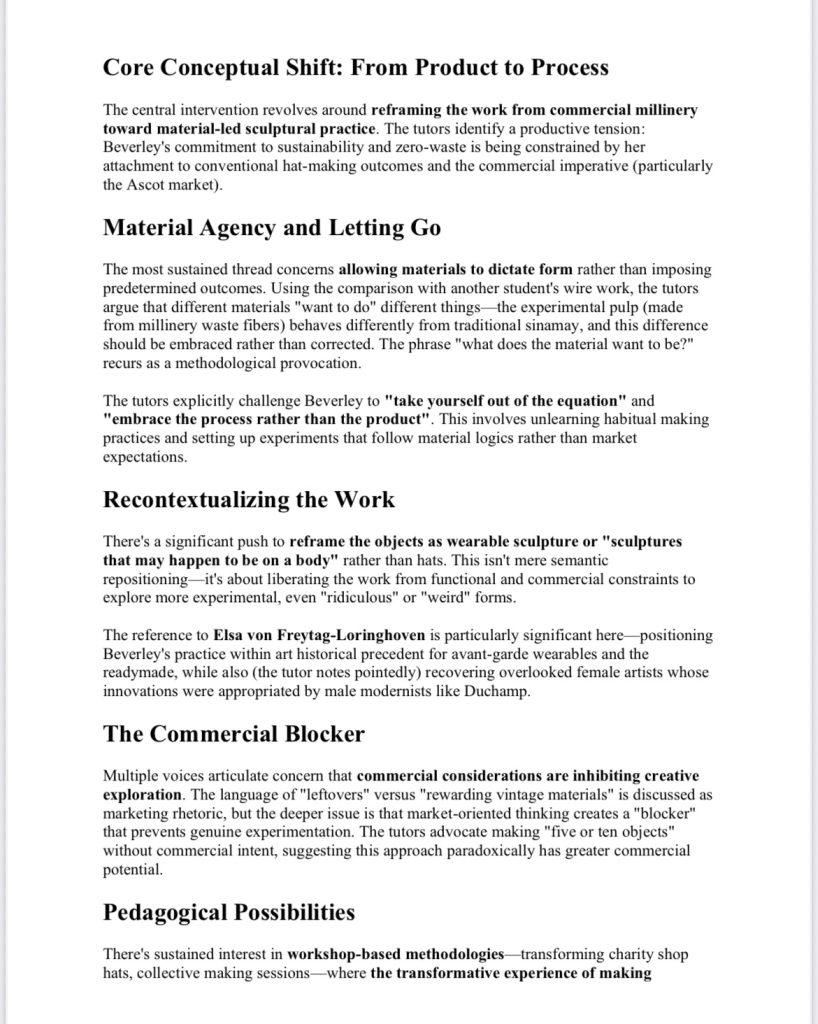

I really enjoyed reading the summary from claude AI (Anthropic, 2025). It really took away my emotion from the discussion and highlighted the key important things that I need to take away. It hasn’t judged my work or me, as I have, and responded to it with actionable points.
Key takeaways:
-Remove the need for commercialism
– Allow materials to dictate form
– Embrace the process over product
– Explore the transformation more important than the final product
– Is a labour-intensive process sustainable – where is the value, in transformation or in recontextualization?
-What do I want to talk about? What is my theme?
-Use my time to research and explore rather than production for the luxury market.
I think before this summary, I had already started to understand that I need to step away from commercialism and look at how materials could act if you use them in a unique way.
I had also looked at the charity shop hats and discussed how a worthless second-hand hat could be transformed in workshops, either alone or in groups. Is just the use and understanding of how products are made in the taking apart and re using them for art pieces. This is quite an exciting route to look down further. I know the course encourages students to run their own short courses, and I think this could be an interesting concept for that. More than using just the materials that already exist, the existing structure in a hat can be played with to change form and shape, it could also be fun to play with the ideas of Baudrillard in this concept.
I love what I did create from the pulped paper, it was time consuming, resource consuming, but gave a great result, on scale to be able and play further with this idea, I don’t believe is sustainable. I have investigated the processes where pulping is done on mass and the equipment required is rare and extremely expensive. I did note that there is a Hollander beater at the Waterloo centre, and I have reached out to the paper making tutor but not heard back. I probably should request further if using the Hollander beater from the college is an option – but I am also aware that this process can still take 8-10 hours using the Hollander beater, which again still may not be a realistic amount of time when weighing up against what is truly sustainable.
My theme and what I want to talk about is my least clearly defined points to tackle from this summary. This is where I am most struggling. I started wanting to make luxury hats from offcuts and a zero-waste process. This is an important value to me, but it is also restricting me. I need to be thinking broader initially, before nailing my thoughts down. What I am trying to say on a broader level is that the fashion industry is killing the planet. The world is groaning under the weight of fashion waste, ecosystems are being ruined and the fashion industry has a lot to answer for. Taking these themes and making them more conceptual rather than trying to solve the problem is a route I need to explore further, I need to develop a message that can be seen through my work, lifting the restrictions I placed on myself in terms of zero waste will help me to look broader and open up new avenues to explore. Perhaps looking at how ‘we’ as a society are hiding from the issues caused by our own pollution for the planet. The idea of conveying the message of us knowing the harm we cause to the planet, yet continuing anyway, blinkering ourselves to the issues and when suits our own agendas and incorporating how cognitive dissonance plays its part.
It has been useful removing the emotion, because I can now see clearly where I need to research and where I need to be spending time, which areas I had started looking at needs more exploration and which areas still need a lot more thought. Taking my eye off the luxury market for a while and lift my restriction on zero waste practices may lead me to something that those restrictions would never allow me to reach.
It has really given me a constructive way to look at my work rather than spiralling into my emotion and not picking out the core pieces that I need to work on and given a clear roadmap of how to move forward.
Response from Vesna
As I was feeling quite overwhelmed immediately after the crit. I asked Vesna, the millinery tutor to view the crit and provide feedback, I thought it was looked at during the crit in a very art centric manor and wanted to know how a millinery tutor would respond, if the responses would be similar or not.
‘I love these two pieces. I think this could be your concept Orderly Vs Chaos in a sustainable way. This would be quite a strong concept as it seems quite spot on at the things happening in the world right now. This is also happening with sustainability and circular fashion. To make it more manageable I think you should focus on your state of mind, or your feelings, more like an exploration. The other option would be art and fashion friend or foe. Again, you should focus on your perspective and research Sonia Delaunay, Elsa Schiaparelli, Alexander McQueen. I appreciate this is a confusing time for you but if you consider that any MA is a time for pushing boundaries, be it personal or fashion/textile related, thinking too much about commercial aspect will be constrictive. You need to go into the unknown, slightly uncomfortable space to grow. And don’t forget to trust in you, where you don’t see a sellable hat now, I am sure you could translate a lot of the concept / technique later. Now is for discovering another side of you. Your crit was okay, and I will hopefully be included in the next one. Level 7 demands going much deeper into the conceptualising your practice. You can do it! I hope this helps.
I already had Schiaparelli and Sonia Delauney on my list of things to look at so I’m really pleased that aligns. Today I have been looking at the conundrum to fashion/craft vs art to help me understand where the boundaries cross and where they overlap. So, my write up and thoughts on that will follow shortly.
I think the observation of the orderly versus chaos could really fit me quite well, when I made the felt pieces directly after the crit, they were as a reaction to how I was feeling. i.e. what I wanted to do with the feedback from the crit, versus what I thought the tutors wanted me to do, feeding that back into the bigger picture of what is going on in the world, politically, ecologically, financially etc. is a really interesting concept, it is like the swan swimming calming above water but frantically swimming with its feet under the surface. We go around everyday life as if everything is fine, whilst around us there is chaos, the financial situation of most people in the Uk is being squeezed, the economy is poor, the political system is failing us, the planet is starting to fail us due to our lack of care vs capitalism as it’s guardian. There are horrific atrocities happening all over the world, but we just get up and continue our days, ignoring the massive issues that we face. This also follows in with what I discussed above hiding from the damage that the fashion industry does to the world. These two ideas could be blended seamlessly, into how we like to be perceived as a human, a nation, a race, versus the truth behind the curtain of what life and the word really looks like. Making two pieces that articulate this, or one piece that tells a different story from one side to the other could be early ways to explore this concept. I think it would also work well for me because it feeds into my natural position of wanting to be more commercial whilst knowing I need to be freer, it therefore has the potential to fulfil both needs.
Creative actions to take:
-Explore art vs craft/fashion
-Explore ordered vs chaos
-Explore transformational design from waste hats
Art VS Fashion
I think I am starting to see things from a more art point of view, from researching and understanding the why behind how the tutors are approaching things I think will really help me moving forwards, whilst I did not initially enjoy the crit experience, I think because it has led me to this research and understanding I can be more open going forwards as I feel I have developed a better understanding of what is expected, but also a clearer line between fashion and art and where the ideas collide and where they don’t.
I do believe that because fashion and millinery has to come with function first and to fulfil a need and requirement, and therefore I will always be starting from a different place than an artist would, I accept that there may still be a slight sticking point here with regards to the course. However, if a hat does not stay on the head, it is not fulfilling its only necessary function. Hats that need holding up on the head by a hand are often described in millinery circles as handwear, not headwear!
I do not wish to become an artist, I wish to be a better milliner, I wish for my hats to perform a function and fulfil a need. However there is certainly a lot I can learn from the art world in terms of how I express my creative practice, but perhaps also in return a lot I can teach the art world, art needs a commercial appeal and brand behind it now to be relevant to today, to be seen and have success, which is taking all the ideas and commercial value that millinery has and applying it to art. The nature of fashion being copied to even exist and its desire for commercial value is lesser valued in the art world, however the fashion industry is a larger industry that the art world in today’s technological world that art does need to take note of what looking at fashion can bring to the table as fashion is better adapted to contemporary visibility, something tat art now also needs to stay relevant.
I can apply art to my millinery in conceptualism of the wider picture, the wider story and concepts and the way my work is presented. I’m really pleased I investigated these topics, I can see I was stifling myself before, there is certainly a lot for me to unlearn, but also value in my own expertise.
Fashion shows a moment in time, because clothes do not last in the same way that art lasts, there is less fashion history available, meaning it does not have the breadth or depth of research techniques that art has. This means that in an academic environment, fashion history lags behind art history, yet there is now a lot of blurring of lines between the two at university. It is acknowledged that whilst not yet fully integrated, both studies can make each other richer and prevents each other from looking inward, and opens up this really important debate (Muthoni, Nyambura and Kiu Publication Extension, 2024) where I felt my crit didn’t address the need for function (as I am now working out the language of art) as the feedback was from a purely art perspective, it was not that it was entirely useful, it was more that it didn’t also include a fashion lens, so felt disjointed and as if fashion and how fashion works is irrelevant.
Looking at the studio habits of mind (Ferrari, n.d.) was particularly helpful, looking at this, I can now understand how the tutors were approaching my work and what they were trying to get out of me. Pinning the words up in my workspace, so they become visual reminders for engaging, reflection, stretching and observing, I think will help me move forwards, getting these terms into my active vocabulary usage will really help me deepen and fully develop and understand my creative process…and open doors that I having been willing to open previously. I could look at art as ‘asking the questions’ whilst design and millinery can provide ‘answers’ that provide function.
This course is creative practice, not a fine art course and thus my focus should be on creative practice, less so than art. Art is just one view of creative practice, fashion is another, craft is creative practice, but often frowned upon as lower worth than art, because it is done for function and need, craft along with fashion, was historically bought or made by women lowering its social status, is was not a thing worth the art critics views as it was not made purely for the intent of creating art or meaning. And the need for buying and selling fashion or craft items overrides the artists requirements of intent. I need to be careful that because of these historical views of fashion and craft being lesser that art that the depth of them as a creative practice is not watered down at its own expense for the sake of art. Philosophers such as Kant dismisses fashion as fickle or others avoid it as it is tied to vanity, however it cannot be dismissed that fashion is central to human interaction, not only does it mark out rank, but it is a mode of survival, a mask of vanity and social treatment, and how we navigate the world.
Before the Renaissance craftsman, painter weaver etc were all equal with no distinction, after the renaissance painters and sculptures became higher, and craft, again, historically done by women and done to fulfil a function dropped behind In status even when using the same tools and processes at the same level of skill. (McCartney and Tynan, 2021) Craft contains incredible skills passed down from generations, skills that take years to master and in many cases are dying out due to society not seeing the worth in the skills until it is too late, master craftsmen spend their lives keeping their craft alive, but in many cases there will no longer be anyone left with the skills to pass the baton to when they are done. Mass consumerism and mass production and technology have seen the way to this. As I mentioned, when I went to Luton, once lost they will not return. the loss of craft could represent a significant and irreversible loss to society, particularly because, unlike art, certain skills cannot simply be recreated once they disappear, art can always be created and be though provoking, certain crafts don’t have that luxury of being so sure of their existence, yet their disappearance will be more greatly noticed and regretted for longer. The subject from and context for both craft and art remains the same, craft for necessity to perform a function, art for aesthetics, whilst the lines are more blurred in todays society, this does not mean that craft has fully shaken the view from artists that it is of a lower class and lower value.
In summary I think that what is considered as art comes from institutionalised frameworks, which places more values on certain ways of working than on others.
19/12/25
The Long Gallery – Salamanca Arts Centre – Hobart
An Annual exhibition of Tasmanian artists linked to the UTAS School of Creative Arts.
I went around this gallery with the intention to look at what I was naturally drawn to and then from that assess what it is that I am most drawn to and how that could be translated into my own work.
From glancing at my camera roll afterwards it was clear that bright and bold colour played an important part. I was immediately drawn back to thinking of the work of Kandinsky, and the masked chaos piece I made after the midterm crit from the colours and spread of colour on the camera roll. I am naturally drawn to colour, and I think that the psychology of colour is important, I do believe that colours have a really big part on moods and how we see spaces. I also note that most pieces were more collage based or layers of materials or paints. Thinking back to my Art A-level, collage played a really big part of my work then as well, different layers creating depth and texture. Thinking about how I apply that to hats, hats are often about layering, the base, the edge, the trim, all different materials and textures, some used to draw or distract the eye to or from certain areas. Layering with colours also enables a more sustainable finish as often smaller areas can be made from offcuts and leftovers.


Apart form the bright colours and layering textures I was drawn to interestingly it was 2 black and white pieces, one a photography piece of 60 individual household items, unedited in black and white, unclear at first glance what each image was but still recognisable. I think this spoke to me because of the group project and how we are looking at items from different perspectives and taking it away from the real. I will add this to our group project chat. The second piece in black and white was a digital drawing, almost like scribbles, but with differ depths, over all forming a wonderful pentaptych. I loved that close up that you could see the pixels, but from a distance it looked like charcoal, a juxtaposition between nature and modern technology. both pieces sort of initially lied as to what they are in reality. But they also both have a classic feel that I am also drawn to.

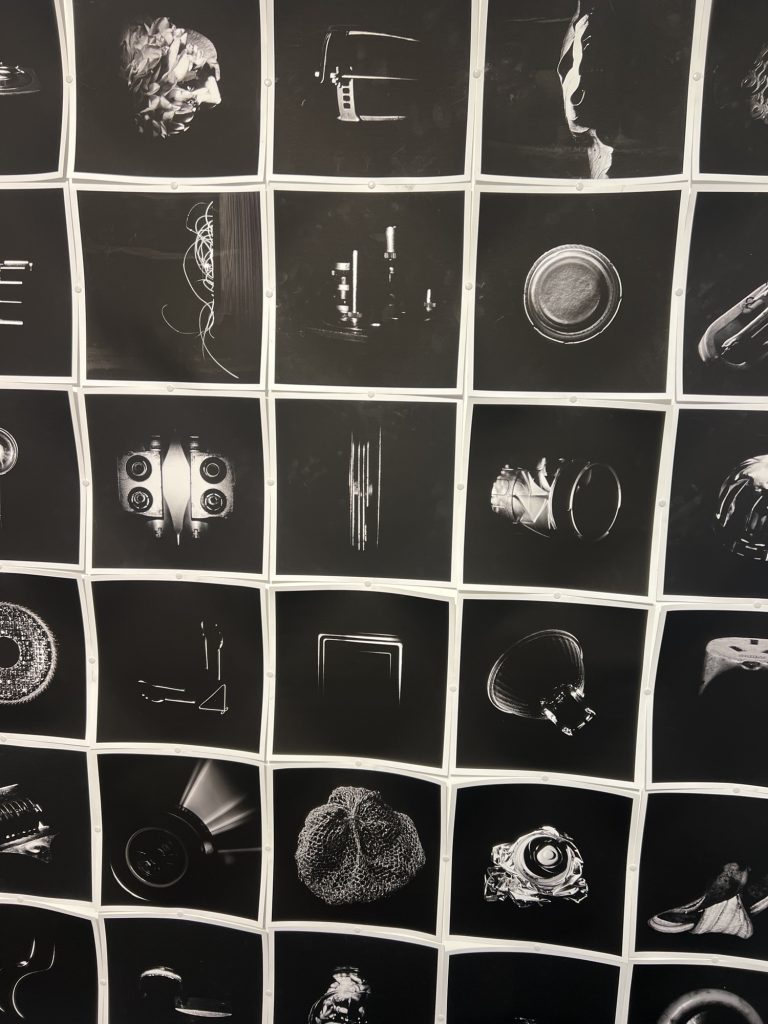
The exhibition reminded me how much I love colour, texture, and layering. But I also noticed I was drawn to pieces that play with perception, making familiar things look different or unexpected. I want to bring this into my work, trusting my gut more with material and colour choices, and thinking about how everyday objects seen from weird angles can spark design ideas.
The Nolan Gallery – Salamanca Arts Centre
I was drawn to Leonard Bensons work , it really used exaggerated shadows on faces and bodies, maybe I was drawn to his work because they contained hats, and I enjoy the way hats can add a shadow, which in turn creates another angle where meanings can be changed or twisted, by much you want to hide or be seen beneath a hat, I also found a because there was a familiarity to some of Picasso’s work in the feel of it.

Whilst speaking with the gallery curator, they pointed out Elizabeth Barshams work, it was beautiful colours, but also gothic an ghoulish, not a theme I am instantly drawn upon, but the curator explained her work reached complex issues on sustainability in a humorous way, and the more I looked the more I was drawn in by the skill of incorporating the context and ideas into a dramatic art work.
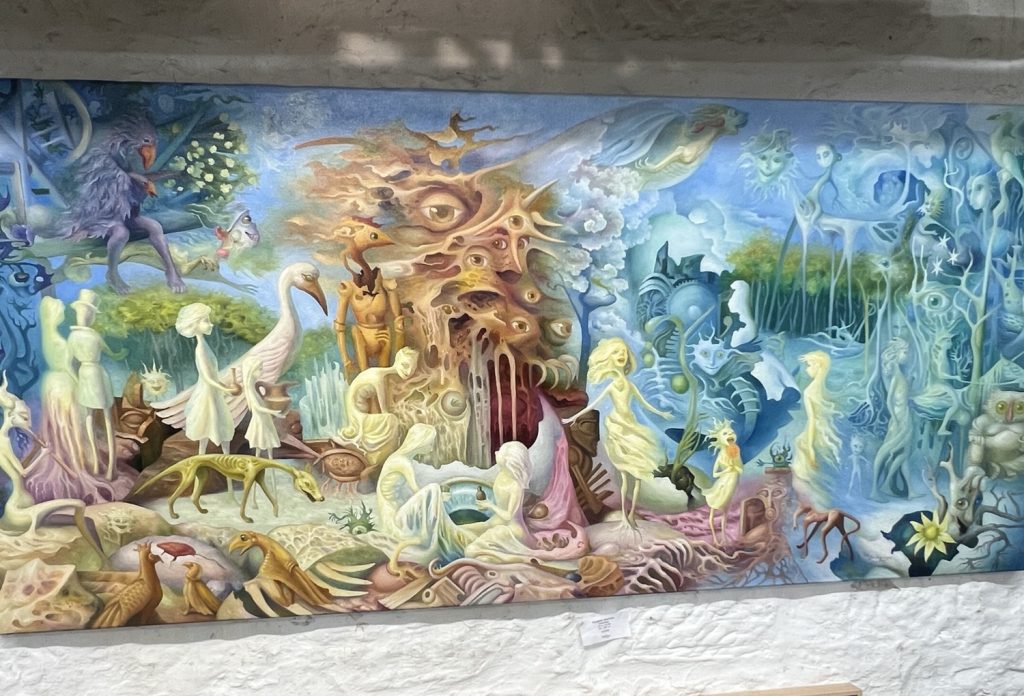
I looked at work by Keith Lane, and artist trained in London and his work certainly had feels of Constable and Turner, the work felt familiar and skilful. The Curator showed me a painting from his back catalogue (Zest, 2025) called ‘Great Expectations’ of a dress, in body form, but without a body, the textures of the lace and brushwork was extra ordinary, but it also really drove home, what is a dress without a body, and body is any clothing canvas, without the human form it has not point or purpose, I found this quite powerful, seeing the dress held in form but with no-one inside. Returning to my thoughts about fashion requiring a function to exist, I thought this painting summed it up well…a dress can be of beauty, but with out a body it can not be the best version of itself.

I think what stood out to me was how drawn I was to work that plays with shadow and form—Benson’s exaggerated shadows reminded me why I love how hats can obscure and reveal at the same time, changing meanings depending on what you choose to hide or show. But for me Lane’s ‘Great Expectations’ painting, that dress without a body really drove home something I’ve been thinking about a lot—that fashion needs function to exist, that clothing without the human form has no purpose. It can be beautiful on its own, but it can’t be the best version of itself without someone inside it. I also liked how Barsham looked at complex issues through humour and drama, it made me think about how ideas don’t always need to be presented seriously to have impact. This visit reinforced that I’m interested in how context and perspective can change meaning, whether that’s through shadows, absence, or unexpected approaches to serious themes. I just need to work out how I can apply that in my work.
27th December – National Gallery Victoria – Westwood Kawakubo Exhibition
I was really taken initially by the mannequins and the use of negative space; I think this could be a fun idea to play around with. It could really suit the need to stretch outside myself but also to keep the elements which are fundamentally part of me. Making classically shaped hats and headpieces in a negative space, could really add a look form a different perspective.


I have always been a fan of Vivienne Westwood’s work, especially her corsetry styles and the emphasis on body parts, I didn’t actually know much about Kawakubo’s work before this exhibition, but interestingly actually found myself more drawn to her pieces than many of Westwood’s.
I found myself really drawn the way that they saw the body and how fashion related to it, both are quite anti- establishment and anti-rules, (probably not my strong suit, but something I’m trying to embrace more!) Vivienne Westwood took inspiration from historical dress by emphasising waists and busts, with padding and compression and geometric cutting techniques, taking away the body type that is considered ‘most fashionable’. Kawakubo also used a lot of padding techniques to almost create more sculptural dress, things that stood on their own away from the body and disregarded the contours of the body and of comfort and function.


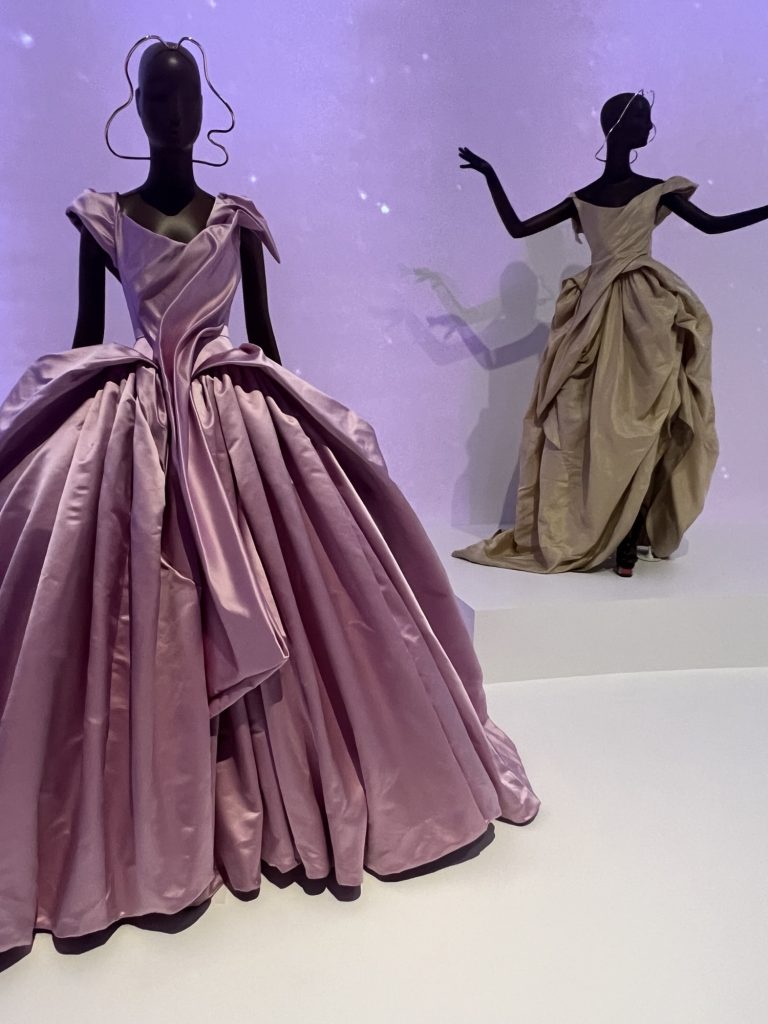
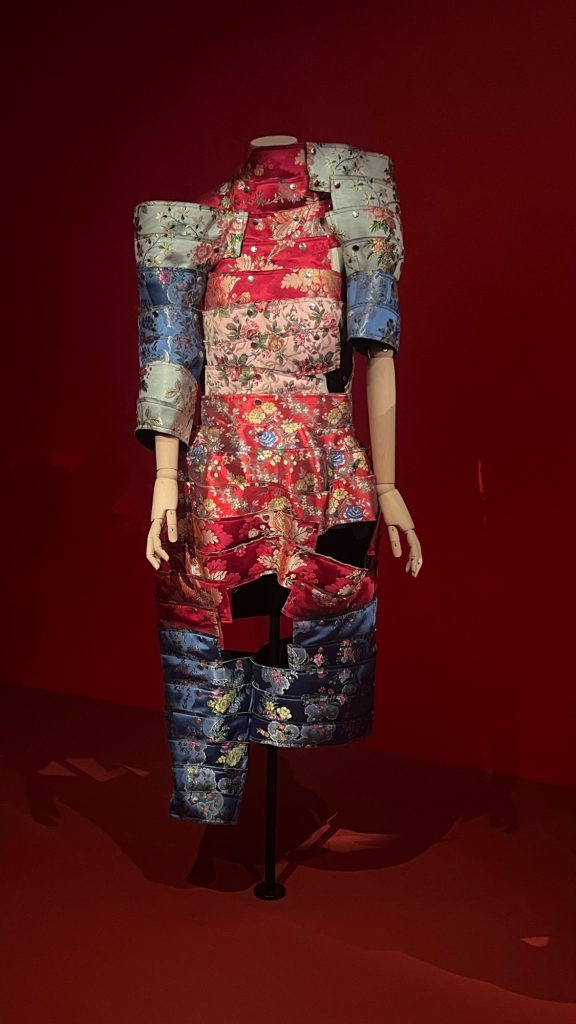
To incorporate some of these ideas into my work, I think I need to look at the head as less than something that fits to the head, but more takes it’s own space, perhaps something could be created that did the ‘function of a hat but that fitted from the shoulders, so has no need to fit the head.
Notes that I took to play with creatively when back home:
-Negative spaces
-Taking an existing piece of clothing and making it into a hat but allowing it to still look like the original article.
-Creating a hat that could be made of pieces that popper or clip or unclip together in different ways to create multiple different forms that would be down to the wearer’s choice, depending on their perspectives.
-Be more inspired by historical designs maybe 18th century bonnets with all their flounces and bows and see how I could contemporise them.
-Play with scale
-Create shapes that don’t conform to the head, use Foss shape, padding and quilted forms
Many of these ideas could also be combined and multifunctional aspects such as using an existing item of clothing or making them interchangeable in design would work with the sustainable credentials, I wish my work to embody.
I think this exhibition really crossed the boundaries between fashion and art by deconstructing what we would usually consider to be traditional dress and aesthetics and creating commercial success as fashion brands despite dismissing mainstream ideals. It was interesting placing the designers together, whilst their commercial brands are quite varied from each other, the haute couture and the initial drawing boards come from similar viewpoints which dismiss the mainstream and have an art centric approach.
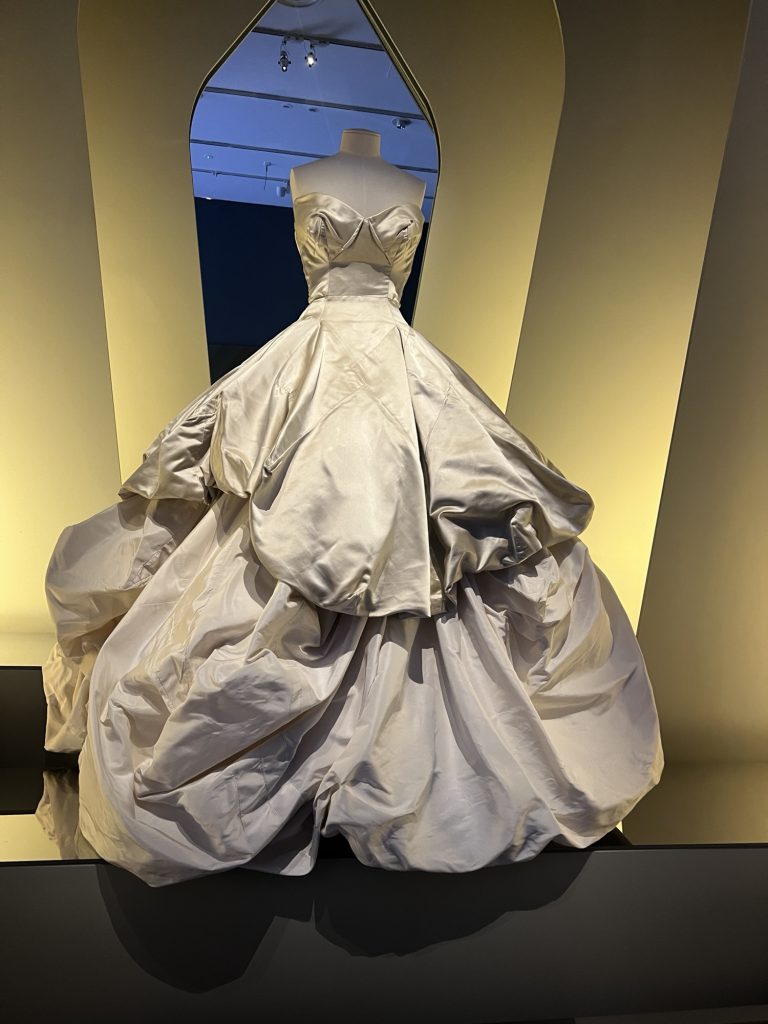
Baroness Elsa Von Fretag-Loringhoven
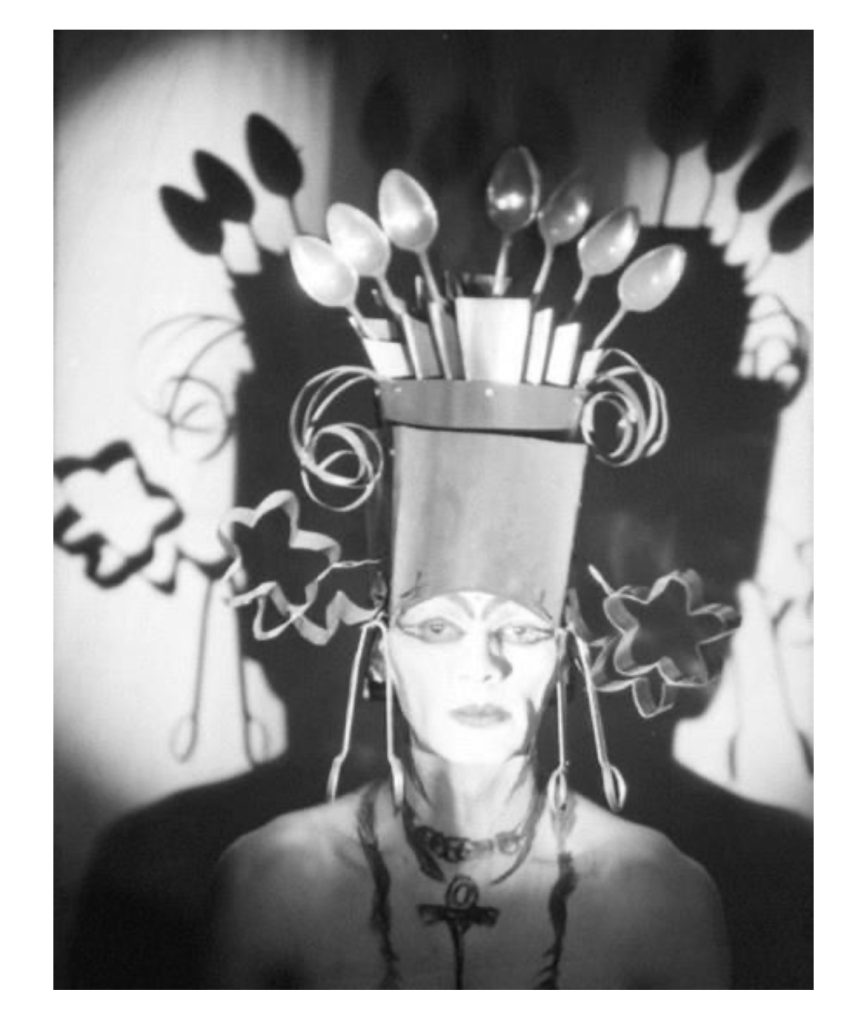
During my crit The Baroness was mentioned so I have looked into her work. Duchamp is often credited as the founder of the ready-made, however the Baroness was actually the first to explore this kind of art as part of the Dada movement not as a follower but as a creator, creating illogical nonsense to protest against social norms, using ready made items and turning them into art pieces. Unlike Duchamp taking a mass produced item and calling it art with little connection to the item, The Baroness took discarded and trash items and made them into live sculpture on her body, from coal scuttle hats, to cutlery earrings and tomato can bras, she turned and adapted trash into visual conceptual art, that challenged gender norms, social hierarchy, poverty and decay all at once.
This way of thinking can feed directly into my project, by using trash or discarded items and reimagining them into wearable pieces, links into my sustainability goals as well as seeing items from alternative perspectives, challenging how we see items and using non traditional millinery materials to create new structures and see how they transform in a millinery context, is one man’s trash another mans treasure? This is an idea I will play with and develop further into my work.
The Baroness often used several layers of materials and found objects to add texture, texture is a really important aspect to millinery work, she also used her work to display serious issues, and using depth of layering could help explore social issues of today, but also could allow me to play around with the concepts of function vs the statement it is making, could it be a pieces of visual art that only works with the body? Unlike the dress with no body in the painting from Keith Lane at the Nolan Gallery, by using the Baronesses ideas the body would play a full key part in how the art pieces come together, the body is a key element to the design.
Schiaparelli


Schiaparelli blurred the boundaries between high fashion and art. There is a large Schiaparelli exhibition at the V&A in March called ‘Fashion becomes art; that I will ensure that I go to as it will give me a deeper overview and understanding not only of Schiaparelli’s work, but also of the blurring of the lines between art and fashion which is so far becoming a recurring theme in my research. So I will do a more in depth write up then, but as brief thoughts that will be relevant to my work now, key points to look at win my work from Schiaparelli would be:
- Fashion as wearable art – not just clothing, this thought really fits millinery well, there is a lot of room for play and sculpture on a hat.
- Unexpected placement – Like the baroness as spoken about above, Schiaparelli played with unusual placement, a shoe as hat, a lobster on a dress e.t.c. so can think of unusual placement and context. ‘Ingenious couture’ (François Baudot, 1997)
- Like the Baroness’s work I could also play with what happens when you put mundane objects in a millinery setting, whilst Schiaparelli is less about trash and more about high end luxury, they both create a similar talking point, is there a middle ground between trash and luxury that can be explored, and at what point does a piece loose its wearability to a client?
- Tackle complex issues with humour and break ‘rules; of fashion’ to add meaning to pieces
- Bold colour that demands attention and shapes that push the human form and change silhouettes.
- Really plays into my thoughts about how fashion needs function and the tenson this creates in an artistic setting.
- I can look at what adding surreal elements can do to a hat or the balance against the body, and its wearability in a commercial setting.
The Bauhaus

Looking into the Bauhaus movement felt quite fitting to my project as I am interested in the commercialism of millinery and function of millinery, whilst I apricate that I need to step away from these and be more free within my work, I think it would be a mis-step to not look at the art movements that lead the way in combining art, craft and mass-production-able design together. I think I have always been more unknowingly connected to the ideas of the Bauhaus movement, that beautiful well designed objects with function can be mass produced and affordable, whilst I am not mass producing items in my business, there is a certain amount of repetition in designs to make our processes smoother and decades of practice in getting the balance and fit correct to ensure of pieces are wearable and have function. This is at a juxtaposition to how the dada movements saw art, and as to what my tutors want me to look into, but I believe a mixture of the freer more meaningful conceptual art and a healthy dose of the teachings from the Bauhaus may be a mix that I can get on board with, can a hat be artistic and practical at the same time?
I liked the way the movement combined artists with craftspeople, again this links back into my questioning about what is art and what is design (or fashion) that I investigated earlier in this project. And gives craft a place on the platform where function plays and important part in the design process.
In the Bauhaus there was a strong lean towards geometric shapes which fits really nicely into millinery, it is a collection of brim circles and angular trims, focusing on these forms could create an interesting piece, using the shapes and the building blocks to create a hat. Again, we could look back to the Kawakubo inspired idea with separate layers that could be connected in many ways to create many different forms.
As well as including the colour theory of the Bauhaus, strong use of primary colours, which could in the fashion word be translated to ‘colour blocking’. The use of colour is as much a part of the design as the form of the design. In the Bauhaus world, trims would play no part, it would all the about the shape with no extra unnecessary adornment.
There will also be an interesting look at how to make things most efficiently using the lessons from the Bauhaus and therefore being more sustainable by default – offcuts and minimising waste, as well as showing construction techniques and being honest in the materials used rather than covering up.
Kandinsky

Part of the Bauhaus movement, I was interested more in his use of colour, colour is always something I have used, often opting for bright colours and avoidant of greys, blacks and neutrals is quite natural for me and using colour to lift of affect moods is something that when I looked into the Bauhaus movement is something that Kandinsky also incorporated strongly into his work, and is something that I incorporate into my life (clothing and interiors) and my work, so I decided to look further into his work and how it may be relevant to my projects.
Kandinsky saw colours as having spiritual and emotional qualities, whilst I would not but so much weight on the spiritual side, I certainly woold agree with the emotional qualities of colours, he also used the colours in a way that felt natural and intuitive to him to use together rather than just by rules of what goes.
Playing around with the ideas of colour combinations that evoke emotion and can change the feeling of the wear could provide and interesting experiment, to make the same hat, once in neutrals and duller colours, one a bright concoction and assessing the emotional response to each, but also placing colours that would usually fight or not be considered classic colour combinations could also unleash a new angle
He also played around with depth so the idea of layering and seeing how that varies the overall feel and emotion of piece would be worth exploring. Kandinsky art represented feelings, not just by colour but also by shapes and structures within his work. Making a piece of millinery that was based on inner feeling over external design such as my ‘masked chaos’ piece that I made after the crit, purely based on an emotional response was an interesting way that marked a change in my work, from approaching from a different direction. Whilst I still need to do more practical exploration within my work, using an emotional response certainly did unleash a different part of my creative brain, that perhaps needs nurturing a little more.
Kandinsky work still held structure when when based off emotional responses, this works well with millinery as you always need the structure first, and a visual balance, even when using clashing colours, I can use my innate knowledge to place colours in places to draw the eye to certain places and add the visual balance and create and energy through the visual effect.
Sonia Delaunay


Sonia Delaunay blurred the lines between art and ‘decorative craft’ she seamlessly combined the art with fashion and homeware and lifestyle items. Using what she described as ‘simultaneism’ combining dynamic contrasts between kaleidoscopic colours and shapes and abstraction of the two. The art became part of ‘life’ and living within lifestyle and can be credited to the roots of modern art, but with history lost in the world wars she does not get the credit and recognition as male counterparts. This is an area I could look at addressing in my work, as millinery is predominantly made for female, it gives a good canvas where I could express how women have been held back against the patriarchy.
I particularly enjoy the way Delauney has been quoted as saying:
“For me, there is no gap between my painting and my so-called ‘decorative’ work. I never considered the ‘minor arts’ to be artistically frustrating; on the contrary, it was an extension of my art.” (Lesso, n.d.)
Again, arguing the gap between fashion and design and art and how they are thought of as one rather than separate to one another and the ‘minor arts’ perhaps considered lesser. Like the baroness was described earlier Delauney’s art was living and part of her own body and self-expression, a living sculpture of wearable art with little to no separation.
Delauney’s husband wrote
“Until now, fabrics were dealt with the same way as wallpaper, by the kilometre, with no conception of their future use – or at best, by chance. That was up to the dress designer … Sonia is simultaneous. She gives her conception a perfect creative harmony, by thinking about all the transitions between the ready-made fabric and the final garment.” (Lesso, n.d.)
I love this combined view of the fabric only working when it works in a dress, that the concept of how clothing would fall, drape and move was considered before and as part of the inception of the fabric, again, combining and brining in the function and design aspects into contemporary art. I think this is certainly something that always has to be considered in millinery practices
She also brought in designs and colours that were inspired by her Ukrainian roots colours with energy and abstraction, bringing in parts of my own culture and background could be a place where I could personalise and add meaning to my work with purpose. For example, I have some Prussian history from my grandmother, there is the colour ‘Prussian blue’, the intense blue used in the famous Van Gough’s starry night painting, and baroque architecture but looking deeper into the arts and crafts of Prussian history could add a further source for inspiration.
Simple shapes in her painting and clothing and overlapping of colours feed into work from the Bauhaus and Kandinsky, but with more freedom, Delaunay’s work could be the bridge between many of the artists I have discussed above, is it softer then the Bauhaus, more refined than The Baroness, and less spiritually charged than Kandinsky and more free than Schiaparelli. I like the added movement aspect of her work that is perhaps lacking in the others listed above. but the connections between all of them are very tangible.
Cecil Beaton x Jackson Pollock

I already visited the Cecil Beaton Exhibition, but since then and further research into the cross over to fashion and art, I realised that I may need to revisit the collaboration between Jackson pollock and Cecil Beaton, the use over oversized abstract and expressionist paintings against fine fashion, it is a fun and somewhat usual line between chaos and polished structures, something that I need to embrace in my work going forwards, can I find luxury within the chaos? My ‘masked chaos’ piece sits within this tension arguing can fashion be equal to art and can chaotic structures create luxury, how can I further develop this idea to have the structure a hat needs but also have a feeling of spontaneity. Again, the images bring up the question of scale and proportion, the model and fashion dwarfed by the canvas, and almost as a negative space on the canvas something I had already pinpointed from the Westwood x Kawakubo exhibition. It is interesting how a lot of ideas are being shown up consistently time and time again within my research, I think it would be wise to listen to the repetition and find my own way of expressing what they mean. Again, pollocks work shows intention, but embraces the mistakes, some is controlled, some is pre planned. Perhaps a working method to embrace further. Cecil Beaton also did drawings inspired by Schiaparelli, again connecting the link between my research artists.
Using backdrops and the way a hat is photographed or created shadow and the way work is presented in scale will add a different level and layer to how my hats are seen and how I present them. It will also add different layers and depth of what is real or how it is perceived using Baudrillard’s thoughts.
Some sketches of ideas I want to experiment with from reaseach topics above:

Sinamay Waste Hat Evaluation – Using Studio Habits of Mind Method


| Stretch and Explore I looked at my sinamay scraps and wondered how I could take the discarded and unloved rough pieces and make them into a refined piece of millinery. I knew in theory that breaking down the fibres could create a pulp, so I experimented with breaking down the fibres through boiling, baking soda and blending. I found two things which didn’t work, mixing all colours together created a grey mush meaning that you could only dye to a stronger or darker colour and would never be able to achieve a light finish. Also the process of blending was long and laborious and kept breaking blenders putting into question the notion that it was a sustainable solution to use sinamay scraps. This meant that once the I used up all the blended scraps it made sense to look at an alterative solution. I unexpectedly changed the outcome when a tutor mentioned that they loved the specks of alternate colour in the newly created fabric, and then I decided to make the paper by mixing the 2 colours I had created together, this worked really well and added a link, yet a contrast to the trimmings on the hat. It did raise the question as to whether I was limiting myself in the design, by only using waste, and if I was too focused on the process over the design. Whilst in careful handling the piece stays together, with moisture or steam it would fall apart, meaning that’s its use is probably limited in the real world. Envision My initial idea was just to work out a process of using scraps in hat making in a sustainable way, I did not have a final vision for the piece in mind, it was more of another step of experimentation, once I had the processes nailed I would be able to look further into the design process and what could be done with the created materials. The form I chose for this sample piece where I was still understanding the newly created ‘paper’ fabrics properties were to see how I could block the paper pulp around curves and how malleable it would be to created flowers and 3d forms. As I did not have a set design in mind before making and was just a sample test of how the material behaves, I only had loose ideas, I do think I managed to create what I set out to at this stage and whilst there were really good points about the use of material. Sadly the process being long and laborious lost my motivation and its delicate end use mean that this was of using scraps may well need to be shelved for now. Engage and Persist I persisted over the pulping of the material, being only able to blend very small amounts at a time, due to A) breaking blenders B) the time it took to break down the fibres I found this quite frustrating as to create enough pulp to be able to make anything useful. I tried to purchase 2nd hand blenders but they were not strong enough, I purchased a new higher powered blender but you could only blend 1 handful at a time and only blitz for about 1 minute at a time before the blender needed cooling off, each pulp needed around 25 minutes of blending time, so it could take days to pulp enough to create this hat. I put the blender beside me whilst I did other work so that I could be as efficient as the process would allow me to be with it. I did a lot of research into Hollander beaters, but the reality is that they are not readily available, and ones I saw available from the US are several thousand pounds and not an option, even using one would still take around 10 hours of beating time. I think I did become disengaged with the process at this point, whilst I liked what I produced in the end, ultimately it did not meet my sustainability goals as the energy and resources used far outweighed the benefits of using the scraps. Reflect At this point I wanted the work to be and experiment of the techniques I developed but also for my current clients, for them to see beauty and workmanship but also the wearability and sustainability. I wanted it to be encountered as any other piece of millinery for weddings or special occasions would be, with the sustainable aspects being underlying, proving that you can be sustainable and commercial. I feel in someways thrilled with what I created, I think the finish far exceeds my expectations, however during the crit is was clear that my limitations by only looking from a zero-waste perspective would really limit my creativity and the laborious time taken in itself is unsustainable. On reflection I can critique the work as a success by the fact that pulped sinamay made a hat that is wearable, but not as one that meets the requirements of this MA, I was very focused on technique, not design and not it’s meaning or intention so on these fronts the piece failed. Develop Craft I developed skills and proved a method could work in a physical sense, even if it failed in a sustainable sense. I am conflicted by being proud of what was made from scraps, which was a succuss, against how it was undervalued as it had no intention behind the finished piece beyond making a hat from pulped sinamay to face the wasteful aspects of the fashion industry. Observe I observed that the requirements from tutors were different to my interpretation, through reflection on this, I can understand the point of view but also feel that creating or preserving what could be called craft skills is undervalued against artistic intent. I am still not sure this is a viewpoint that I agree with. I do think that whilst my opinion may differ to my classmates, nurturing craft and craft skills are incredibly valuable and these skills provide makes with both purpose and function which to my mind is more valuable to society than intent alone. Finding a way to merge the two I feel maybe the direction I will need to nfollow. Understand Art Worlds This work sits alongside other designers such as Helen Kirkum, taking disused trainers and remaking them into new trainers, a similar idea, taking the discarded and making something new. Sadly Helen Kirkum Studio has recently announced its closure. I wonder like how I found are the processes to re-use materials two long winded to be sustainable and financially beneficial- I strongly suspect this may be the case. Leaning into the circular economy is important moving forwards, but perhaps we are at a stage at the moment where mainstream consumers and big business aren’t quite ready to commit leaving those trying to break through in a floundering position where it is near impossible to see the circular economy as a profitable venture. Looking into Baudrillard’s work and what is real, this hat fits well in his theories. We have taken traditional millinery materials and transformed them into an unrecognisable fabric and made a hat that the traditional material could never make in the same visual way. Is the final hat the art piece or is the process of getting there the art piece? Express I don’t think this piece of work expresses any wider concept or feeling, as it was the product of a process rather than an artistic concept it would be hard to evaluate it as anything but the result of an experiment. As a hat made without deep artistic intent, I think it reflects a certain aspect of my millinery style, one that I need to break in order to open more boundaries of exploration. My voice can be louder and broader than I think I even understand myself at the moment. I need to be freer to play and experiment and to not fear failure, as the only way to fail would be to keep doing what I have always done. This piece wont create much emotional resonance from audiences as it’s story is not clear, it looks like a well presented piece of millinery, but doesn’t really tell the story of why or how it came about which is where it’s real story lies. |
Wear Next – Clare Press
Reading this book was one of the most standout pieces of writing I have read about sustainable fashion. Most focus on everything we do wrong in fashion manufacturing and how bad it is for the environment, animals and labour forces involved in it, but offer little to know forethought on how things need to change in the fashion industry. They offer piecemeal ideas and large sweeping views of what the future should look like, but include nothing actionable, no clear vision on how to get there. This book, I think really understands that whilst the world of fashion manufacturing and fast and ultra-fast fashion is problematic and changing peoples shopping and dressing habits and large multinationals ways of manufacturing is a messy, complex and imperfect process, yet delivers real world visions of how it can be achieved and. Usually books on sustainable fashion are quite doom and gloom focusing on the negativity, this book felt light and full of potential and possibility.
In talking about why perhaps there is an area of cognitive dissonance around our fashion habits and consumption she writes and includes these two passages:
‘We should embrace this push-pull and necessary while we figure our way through. I like how the American philosopher Charles Eisenstein describes our times as ‘the space between stories.’ The old narrative – the ones about individualism and dominion – has stopped making sense, but the new one has yet to take hold. This limbo state is uncomfortable but inescapable because transactions take time. The Future belongs to the story of what the Buddhist teacher Thich Nhat Hanh called ‘interbeing,’ in which we recognise the truth of our interconnectedness not just to one another but also to nature, and realise that everything relies on everything else. We’re not there yet, but we’re getting closer. If we take the time to dream a little, we can see the positive scenarios for a more sustainable, socially, and economically just future taking shape.’ (Press, 2023, p. 5)
‘Before we finish Sanderson [Christoper – British trend forecaster] has something else to tell me. ‘I think, he says, ‘unprecedented change is causing a moment of paralysis. We know we need to do things differently, but we can’t quite bring ourselves to work out [how]. I’m calling it the “Paralysis Paradox”. It’s a bit like when you drop a coffee cup and you see it happening before your eyes, almost in slow motion. Your reflexes should be quick enough to stop it but somehow all you can do is watch the calamity unfolding.’ What is freezing us, he suspects, is the knowledge, deep down that ‘so much of what we will need to do involves letting go of the past, what we used to do, or how we used to cope.’ He believes we are at an inflection point. ‘Just how long that will last, I don’t know.’’ (Press, 2023, p. 42,43)
These passages essentially make the same point, but what they are saying is powerful, we need to get away form the capitalism and rediscover collectivism to work together. The passages go a long way to explain the cognitive dissonance that I know I feel about my own consumption habits and bringing sustainability so heavily and focused into my work. But if anything, it has really strengthened my gut to know that focusing on sustainability so important to me and my work. During this ‘inflection point’ is the perfect time to create and produce the principles that can be carried forward, it’s a time where ideas now can set the stage and be the visionaries for our future. There are so many opportunities that haven’t yet been explored or realised because our visions are broadly not wide enough to see past what we already know. Digital and virtual fashion also exits in virtual spaces with NFTs of fashion items available, it is a world beyond what one could have imagined 20 years ago, it is just about having the vision to see what it could be. There is so much space for purposeful and impactful work right now especially as an independent designer, to push beyond what we know about sustainability in manufacturing and consumerism and enter a place that hasn’t been explored is incredibly exciting, the ability to create alternative systems that are functional and desirable. This is something I’m going to think on. If I took away all my preconceived ideas about what sustainable fashion could be where would I end up? There seems to be so much space in this idea to set up classes and teach in this field and it really excites me to conceptualise what that could look like.
Returning to other areas in the book, I was really inspired by the creation of art in upcycling and repairs, can art be made and have a conceptual identity from repair and revamping? Also, that we need to get back to having a connection with out clothes, by working together in communities, repairing, making, or crafting together and balancing out excess and deficiency.
It has inspired me to think about starting a fashion repair ‘sewical’ evening as part of my business, a chance to be social and to breathe new life into garments and hats and for garment owners to re connect with what is in their wardrobes and with local people in a mindful exercise. Fashion started as being craft in the living room, a million miles from ‘fashion weeks,’ The phrase ‘threads of life’ whilst used in many contexts these days, originated from Greek mythology and the spinners and cutters making clothes. Going back to everyone having a hands-on approach to what they are wearing and being part of the creation process, clothes are more than fabric, they are a whole part of human existence, if we can connect that back to that we will all find deeper meaning from our clothes. It is important to also recognise that often, especially with haute couture fashion that successful designers do well because they bring people fantasy and aspiration, the trick to doing that using upcycling and repairing techniques would be the challenge. But I love that way that this future of fashion embraces crafts value.
Some techniques I could investigate in creating conceptual art from upcycling:
- Visible Mending
- Sashiko
- Decorative Darning
- Kintsugi
Another quote I loved from the book ‘‘I’m barefoot because there is nothing more sustainable than being as naked as socially acceptable’’ [Venetia La Manna] (Press, 2023, p.68). There is something quite powerful in this, perhaps I could play with this idea of nothing being the most sustainable. It reminds me of reading in ‘Fashion a Manifesto’ by Anouchka Grose where she was saying saying that the reason body modifications, tattoos and piercings are so prevalent these days is because there is so much clothing fashion around that the market is over saturated by things we don’t need and can no longer stand out in or self-express in like you could in say the punk era, nothing in fashion clothing is shocking any more ‘it’s like they are trying to demonstrate that they haven’t made choices’ (Grose, 2023 p.135) in reference to younger generations dressing style, by ‘not making an effort’ they are trying to stand out against and create their own look away from what has been done before, and that is also where non-binary dressing has it’s place in todays cultural society. and that the next logical steps beyond that and body modifications to express oneself would be back to the naked human body… I think this could be an interesting way to look at what the future is regarding ‘ fashion’ perhaps we are too early to be naked yet, but a piece of artwork that represents not being tied into a box though fashion, the human body and modifications of that the body over a physical hat could be a great way to challenge what the fashion future looks like. Giving an identity to what this trend in society is now and could be leading towards in the future.
After reading this book, I really felt a strong sense of my purpose, The book has also highlighted to me that I don’t want to be making future landfill just to pass a master’s degree, so I must be mindful of how my creations are made and their futures beyond the project, even with expanding my practice beyond the potentially limiting zero-waste ideals. Three words that sum up where I would like to focus on this MA would be:
Transformation
Both as a physical act of turning discarded materials into new things, and as a conceptual shift in how we perceive value in fashion and craft. Working within what Clare Press highlights the “space between stories,” or the ‘’Paralysis Paradox’ I will use material experimentation to conceptualise what the future of fashion and consumerism may look like. The term “trashformation” (as a potential exhibition or collection title) captures this perfectly, playful yet acknowledging both the waste crisis and the creative potential within waste materials.
Reclaim
To take back power and ownership from landfill and the situation we have put the planet in, from the narrative that craft is lesser than art, and from systems that treat materials, skills, and human labour as disposable. My work reclaims sinamay offcuts, charity shop hats, and waste, while also reclaiming the status of traditional millinery techniques and the endangered trades that deserve preservation. Through repair workshops and community-based making, I want tell the story of how we can reclaim ownership over what we wear, shifting agency back to the wearer and maker.
Renewal
Transformation and reclamation lead to renewal, toward new systems and new ways of being in fashion that are regenerative, inclusive, and rooted in craft and community. It embraces failure and experimentation, my sinamay pulp project renewed my understanding of process even as it revealed the limits of zero-waste ideology. Looking forwards, renewal means imagining fashion futures that don’t yet exist, visible mending as conceptual art, digital intervention and alternative value systems that prioritise connection over consumption.
These three words form a framework for me to navigate the tensions I have found within my practice between art, fashion and craft, function and concept, sustainability, and commercialism. They will guide my work going forwards as I explore what millinery and creative practice can become when purposeful, transformative, and future facing.
January 2026
A deeper look at my crit reaction pieces
- I wanted to go back and explore my creative reactions to the crits further. By layering fabrics I developed the technique of a more chequered board tartan layering and stitching of felt, trying to break away from my commercial brain and logical mind, however in the experimentation of this I realised that actually I was still acting upon my usual creative and commercial urges and had not actually engaged with the conceptual art of it. At the time after my crit I was feeling quite frustrated and not sure of the direction to turn to, and when I realised that I was yet reverting back to my comfort zone of behaviours , so I needed to take more risk, with the offcuts from the first reaction crit piece I unplanned started free-machine stitching all the offcuts together in a random form, therapeutic to release the frustration felt at that point and a relevant reaction that would create the kind of work my tutors were after. There was no creative clarity bar ‘frustration’ and how that feeling could be translated into a piece of millinery. This then developed into the slight feeling of shame I had over my misinterpretation of the crit format, so created the veil to evoke the feeling of hiding behind, making myself invisible. The first piece I then gave up on, I realised it still didn’t represent what the tutors wanted from me, so I focused on the chaos of the other piece. The reactions to this new piece from Vesna and other classmates has been overwhelmingly positive, there was something in this piece that spoke to them…while I may not see in it what I have conditioned myself to think millinery is clearly with the art and conceptual mindset on, it evokes a reaction that is what I need to learn to harness moving forwards. Since looking into Baroness Elsa von Freytag-Loringhoven, in can also see the power of waste or discarded items is not only in using it for design, but also how it is presented, sometimes, allowing it to show up as waste, rather than trying to turn it into something more glossy can have meaning in itself. I can also see from where I have been attracted to colour from Salamanca Gallery and in my research of the Bauhaus, Kandinsky and Sonia Delauney that brights and colour is naturally something that I am drawn to, as these colour were put together prior to these later investigations.


Exploring The limitations of my own viewpoints
I wanted to create a piece that reflected my initial viewpoints on what millinery is for me, but that also demonstrate the worldly issues that I want to address, staying within my comfort zone in terms of creation yet turning that into a piece that had conceptual meaning behind it, to try and fully understand how I am limiting my own creative practice. This was a valuable exercise for me as I start to unpack my own areas of stagnation within my thinking, where personal biases and habitual approaches initially restrict experimentation. By trying to be confronting my own closed mindedness, I was able to question my assumptions and physically see the limitations I have historically put in front of me.
Creating the mask that shielded the eyes, with natural feathers, flowers and drips of black latex, I created a piece that should say these are the tears of a world that is dying because of the human race and our lack of care for our own planet, but what I created was something quite main stream with latex drips that only ask the question…why would you put that there, rather than having broader context. This piece was important to make because it laid bare my own limitations, it failed in making anything commercial nor conceptual highlighting the gap between intention and outcome.


A second piece, I used discarded materials, a straw that had been painted for a previous project, but that didn’t come out as the desired effect, along with pompoms made from acrylic yarn (pink) and cotton yarn (green). It was put together because of what I had made up already in certain colours, again, it didn’t have a wider concept behind it, it was more of the ‘these colours go together well’ and I have them. I made visible stitching on purpose to highlight the ‘craft’ of the making of things by hand. Post making, I applied the thought that the pompom hanging off the back could represent how the world ecologically and politically is ‘hanging by a thread,’ but from the front we continue pretending everything is fine. again, it commercially missed the mark and conceptually is weak.


These experiments served as a reminder that failure can be a tool for critical self-reflection and growth. It forced me to evaluate I how I approach design, materials, and ideas. This will help me to make more intentional and innovative in my practice moving forward.
Taking on the advice of the tutors in my crit to just play and make, even if what I make is rubbish, and taking in my recent research ideas and other questions that have arising this semester and seeing where I end up and what I learn from it, with no set outcome, just a lesson in learning how to be free and creative with my ideas and where it may lead me. My write ups below are not using the framework of Studio habits of mind in such a literal way as my pulped sinamay pieces, as it was repetitive and non-flowing. In these write ups I try to focus on a few areas mention in the framework and to incorporate the language, but being much freer with it, and letting my style develop naturally as I go with just the few pointers to help me.
Exploring the concept of Negative Space
I started playing around with the concept of negative space as discussed from the Westwood X Kawakubo Exhibition. First starting with cardboard and using a scalpel to create shapes within it. Within this style of design, I initially set out to create something of a ‘classic’ fascinator style but in the negative space. I wanted to evoke the hollowness of the fascinator, not a hat, a fashion accessory with no purpose except for social, I wanted it to question the purpose of the fascinator. Maybe it is in the nothingness that is in the negative space that you need to be able to see the beauty in the world. And what the negative space where the fascinator would be would represent. My first attempt I discovered that a ‘walled’ carboard was maybe not so suitable to use to I tried a second attempt on a piece of thinner cardboard I retrieved from the bin, the scalpel cutting techniques was far more successful this way than on my initial experimentation, and once I’d create a design, I though using quite expressionistic paint would add a different texture, I was also looking at the idea of colour representation as discussed from Kandinsky’s work and how colour can evoke mood and how mixing less obvious shades together an created unexpected colour pallets. I hadn’t realised until I finished that the box I took out of the bin was a Tesco lasagne sheet box, ironically in the same colourings as I had painted the front in. This unplanned element, really brought in deeper meaning to the space, the idea of big brands in the space of the beauty of a fascinator, sort of bringing a full circle to what I want to say about craft and sustainability, that we need to focus more on the smaller makers and how we create and how the capitalist world of big business stops this growth in the smaller creative sectors to flourish, but also how waste can be revived. The irony of it being on the reverse, is a humorous accident as the colours from the front blend so well that rather than the back being unpainted and unfinished it does feel purposeful.

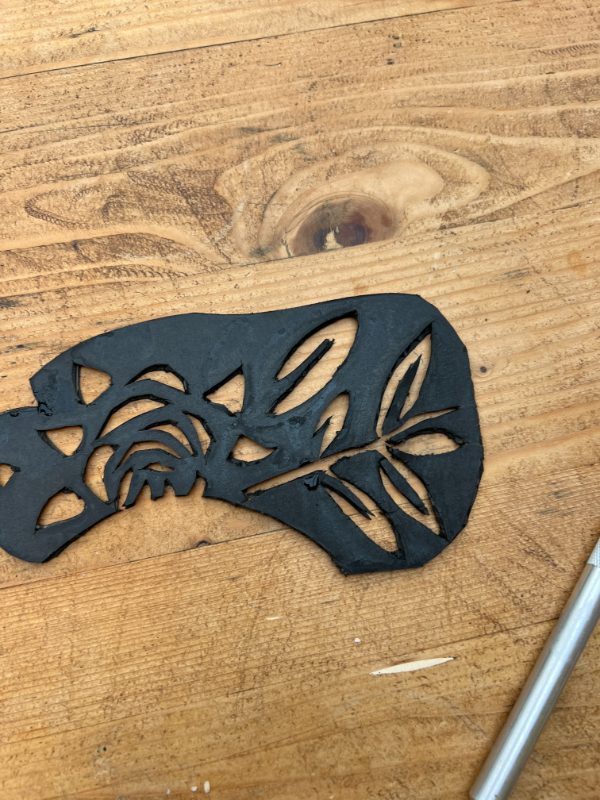


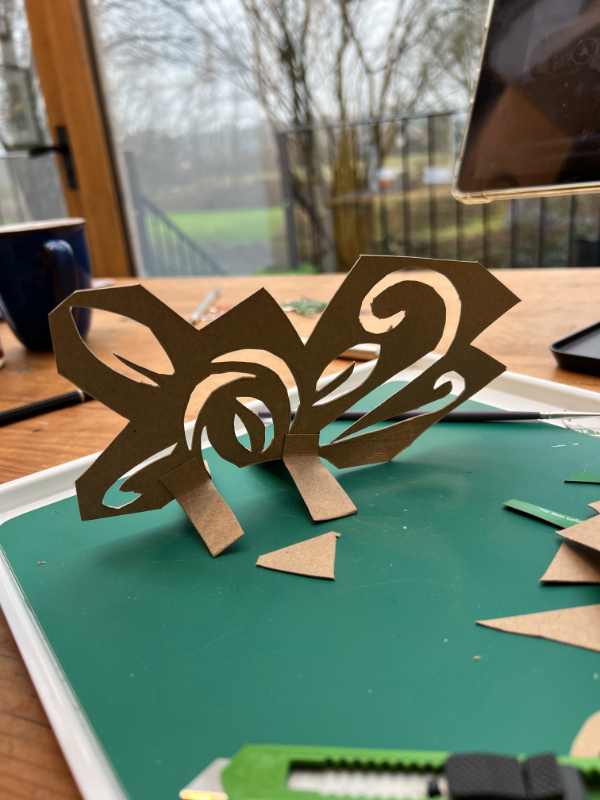


My exploration then moved on to felt, and created a mask using negative space ideas, evoking the feeling of our own cognitive dissonance on the state of the world, we are hiding behind the truth, covering it beautiful yet unnecessary things. I accidently cut through a piece that I didn’t mean to, rather than waste the project I thought it would be an opportunity to make a feature of it instead, with contrasting embroidery thread, a simple cross to denote the space, visible mending evoking the view that a mistake can still be beautiful and to show mistakes is actually a more realistic part of human existence than the perfectionism that is pushed in media, and that without a face or head this piece can’t come alive at it’s best, it needs a face to complete it and give meaning.


I continued by wanting to explore the ordered vs. chaos theory and how this could be combined in one piece. Continuing with negative space ideas, it was possible to create some quite clean and clear lines, with what was left over, initially looking as if it was scraps and worthless from this piece and the mask piece before, I free machine stitched them all together and stretched them over the crown. From the front the hat is ordered, neat and consistent. From behind it shows the chaos that was caused by the making process, a reflection like that of the Cecil Beaton X Jackson Pollock collaborations. Perhaps and interpretation could be that whilst we create refined objects, to create them we leave behind a mess, pollution, waste, unfair labour abuse amongst others, one hat but with two quite different stories woven into its creation and use.


There is still more scope in these negative space ideas and would like to delve deeper into the space where there is nothing, like how I could perhaps draw an onlooker’s gaze through the piece and how that can add different layers of interpretation. I like where I have started and where the unexpected and the unplanned have led. The stories being in the spaces in between is quite a powerful viewpoint. Photography with the use of light and shadows will also help develop this concept further, meaning could shift again using the shadows they create. The presentation of negative space pieces could potentially be how this concept could be pulled together.
Celebrating the craft of Panama Hat weavers
I took a Panama hat that I wore in 2017 and has hugely faded and not been cared for, the soft lilac blue, now a dull grey a dusty brim and trimmings. I wanted to make something that represented renewal and honoured the Panama hat weavers and celebrate the craft, like the straw plaiting and millinery techniques that are being lost in Luton, in Ecuador the same thing is happening with traditional toquilla straw weavers. There is little money in the trade, the younger members of families are moving to cities and not training in these ancient and valuable craft skills, so the skills are slowly being lost. I wanted to value the hat as it was, misshaped and dusty and add a story to it, to have a representation of hope and the future, to evoke the ideals that craftmanship had value, that it can have a loud and bright future. That it has more value to communities than technology and modern ultra-fast fashion manufacturing techniques. Also inspired by Elsa Von-Freytag-Lorihoven’s approach to take discarded items and make them into art forms I took bright paints and took strokes to the hat, allowing the brushstrokes to take movement, loosely inspired by the art of the artist Sophie Tea, allowing every brushstroke to add a layer to the story, colours to evoke joy and renewal. I didn’t want to take away anything from the hat, just transform it into a new place, I crushed the crown and stitched it creating a freeform abstract shape, creating a saucer shape that was then attached to a headband, at the back, ensuring that the Label ‘100%Toquilla Genuine Panama Hats was exposed, to give homage to the weavers, honouring the cultural and social history of the Panama whilst bringing it into a new life. I didn’t want to hide its origins, rather enhance it, and celebrate it. The brushstrokes like ‘Funfetti’ a symbol of celebration of the craft, and how it can be brought into the modern day.
The hat has become more sculptural than the more functional piece it once was, in critical analysis the brushstroke in theory work as a concept, however maybe they seem too ‘applied to the surface’ and not enough a part of the fabric, therefore coming across as a performative statement rather than something integrated. In hindsight, whilst I was trying to honour the craft of Panama hat weaving through renewal and modern craftsmanship, I feel there is a slight disconnect and feel maybe there would be a better way to tell the story in a more cohesive and perhaps respectful manor.


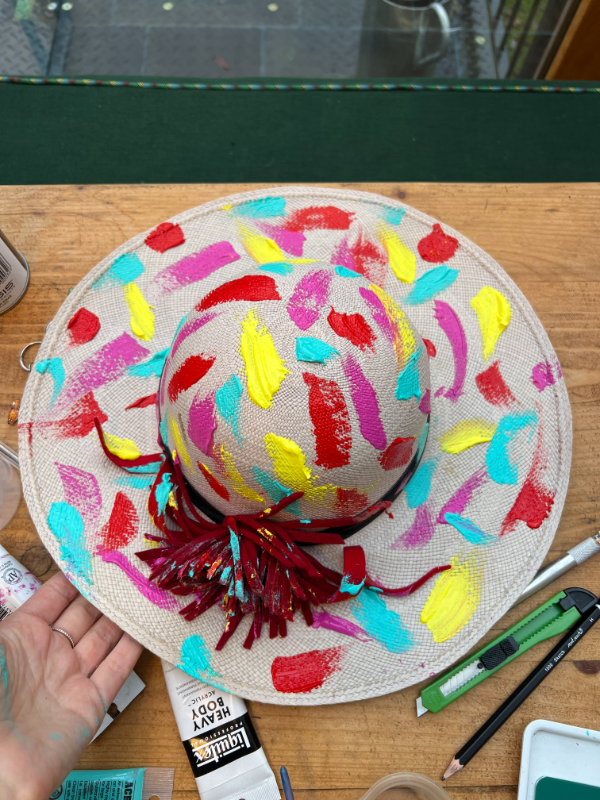


Painted hat
I really wanted to play around with some of the colour and shape ideas as seen in Kandinsky’s and Delauney’s work, allowing shaped to flow spiritually colours to contrast, and be less prescribed in my colour choices by ignoring traditional colour rules. I took sage yellow greens against the teal and splashes of bright pink. I let my brushes flow freely and as they wished, soft curves and strokes and straight lines combined, with no plan. The way the paint lifted the felt fibres on the hat and created interesting textures was very inspiring. Whilst less deep on meaning, it was a much more spiritually created piece, giving calm tones with flashes of colour, as a piece I think it works really well, it expresses movement and freedom and being on a heart shape, links again to that more spiritually engaged level. I am not sure if this pieces says much more on a deeper level, or if it engages in my wish to incorporated sustainability and the questions and or tensions around it, but the paint does feel more connected in this piece than it did on the Panama, I notice the fact the paint can kind of blend into the texture of the felt helps in this scenario and as a technique on the material I like it, it could also be used to cover blemishes in felts, meaning that imperfections could be made into features, embracing the nature of imperfections and building them into my art.


Resin and Reslin
I had mentioned previously that I wanted to explore a bio resin, and I found a material called Reslin a nearly clear (slightly yellow) semi flexible resin type material made from linseed oil and sugar beet molasses. I previously have made moulds of my hat blocks and tried casting in traditional resin, however the results were imperfect, to heavy, and not functional for a hat, however I thought the breakdown of my fabrics would be interesting within a resin style environment. Firstly the Reslin was much easier to use than traditional resin, allowing it to be more of a craft experiment than a scientific one, I struggle with the exacting sciences of temperature, weights and measurements, I am too much an imperfectionist without the patience required for resin, so Reslin as well as being ecofriendly, bio degradable and non-toxic was already getting lots of extra points from me.


My first attempt solidified a little quicker than expected, however as a first attempt I would still have time to hone these skills. I put some of the sinamay pulp dried into a mound then poured over the top, unfortunately as the sinamay did not want to automatically soak up the Reslin, it meant there was an uneven surface and that some did not get covered. I hindsight I don’t mind this accident as you get to feel the ‘insides.’ The slight yellowish tint is noticeable, having not added any dyes or colouring, but I like the slight flexibility of it, it feels lighter, less solid than traditional resin. As second experiment led me to mixing into the poured Reslin with the unfurled fibres of an old unwanted synthetic knitted dress, loosely stirring to get coverage without losing the embedded formed curl left in the fibres from being previously knitted together. I then poured into moulds, with much more control over the setting time than my first attempt and laid in wires so they could be supported once solidified.
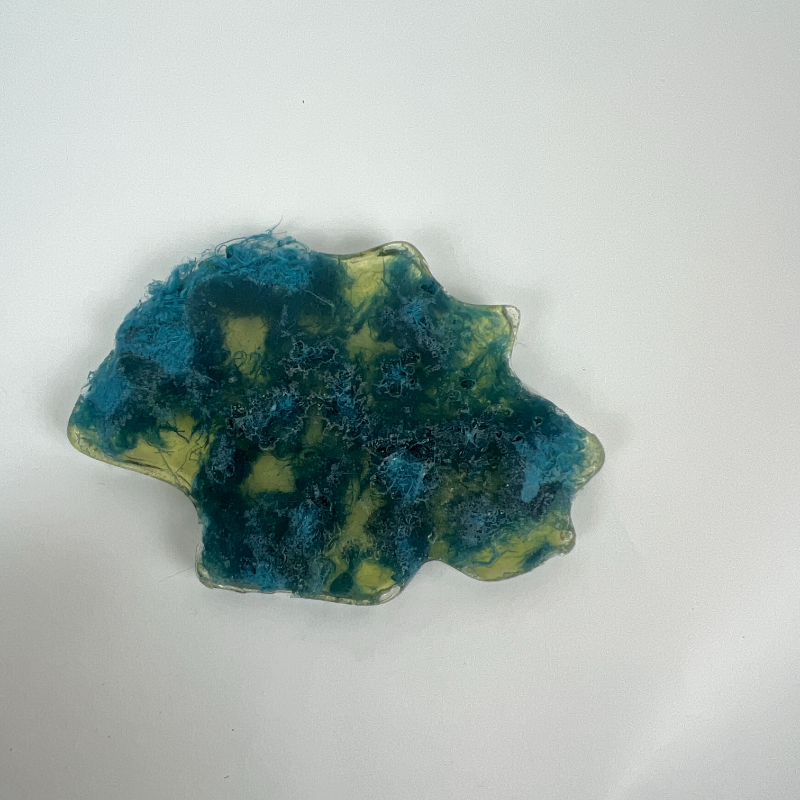


Once tried I removed from the moulds and realised I had poured the mixture too think and that they wouldn’t really be suitable for millinery as they would be difficult to attach and too heavy, they were even too heavy for the wires I had added so they just drooped. Part of the problem was that I probably added too much yarn to the amount of Reslin and should have added less. However, in this it did leave a lovely texture on one side of the loopy bubbly shapes of the yarn but now encased in Reslin. The other side smooth with a visual to the threads.
Having spent quite a while researching and acquiring the Reslin because of its bio credentials, I then realised that I had filled it with synthetic yarn – something that is not biodegradable and that releases microplastics. Or maybe that is the juxtaposition of the question I am asking, whilst we try and now have planet friendly solutions has the damage already been done? What we do now to try and revert and change the climate and pollution issues cannot reverse the past, plastic and synthetics and landfill will not disappear just because we do better moving forwards. Maybe that is its meaning?
Using more dress yarn I wrapped a headband, attached a heart – with the weight, there was little else that could be done with it – then tightly wrapped more of the dress yarn as if the synthetics were suffocating the heart, a meaning on several levels could be extracted from that.
Whilst I enjoyed working with the Reslin, I don’t see it fitting in with my creative practice at the moment, the finished pieces, whilst yes could be refined over time by honing my skill and practice, I don’t feel that Reslin or Resin has lead me anywhere where I feel a need to follow from a creative standpoint. Perhaps some of the thought processes of how do old polluting and new healthy environmental habits work together that these experimentations exposed is more what can be developed.
At college a classmate saw the heart headpiece and loved it, I didn’t have any like for the piece and had already decided that the route was not one I want to follow directly in terms of the creative process of making it, so I said she could have it. Cue her wearing it all day and beaming at here newly acquired headband. Again, another lesson in how people perceive stuff differently to myself, and just because I don’t like it or perceive it to be ‘good’ or well made, other people will value it and see beauty in it. Another reminder to open my mind, and how one mans trash can be another mans treasure. Perhaps ‘perception’ is a great starting point to explore from.
Short Sighted
Inspired by The Westwood x Kawakubo Exhibition and pieces such as the ‘Foulard hat’ by Maison Margiela (a man’s shirt made into a hat), The Dada movement and Baroness Elso Von Freytag-Lorihoven. I really wanted to paly with the idea of taking a discarded item of clothing and making it into a hat but still retain what it was originally. I had a pair or Primark shorts, years old, that were no longer serving me. By turning them upside down I could explore the idea of making the waistband into a head fitting, the cord waist tie, then becomes a pretty bow above the eye. The shorts had piping around the bottom and up the sides, I threaded wire into this, entering through areas that were poorly manufactured, not repairing, but almost demonstrating and highlighting the mediocre quality of fast fashion clothing. This gave them structure to stand up but also allowed them to take on their own shape and for the shape to be changed and moved, it you look at the pictures, you can see how just minor nudges and the shape and form changes.
I am quite engaged with how something slightly unplanned but inspired by a mixture of references has managed to portray such deep conceptual meaning. The hat is a pair of shorts, easily still recognisable as a pair of shorts, but now they are a pair of shorts that can turn your own thinking about the fashion industry and the sustainability issues within it upside down.
The head-fitting, able to change size and fit anyone by undoing and re-tying the bow evoking how the issues of the fast fashion industry are relevant to all, we are all complicit…as they say…’If the hat fits.
The movement of the short’s legs, show how we can all change the shape, make it more ‘you’, could be interpreted as all the ways we so easily justify our consumption habits, or cognitive dissonance over the brands we engage with, which conflict with our outward sustainable values. We justify to fit the moment or need, just as these shorts can not create multiple different looks, we can create and justify reasons why to be less sustainable in that moment.
The fact that they are ‘Primark’ shorts a well-known producer of fast fashion and over consumption with questionable ethics and greenwashing when it comes to manufacturing. When the Rana Plaza collapsed in 2013, Primark’s name could not escape the news as being one of the companies who used the factories speak volumes about worker exploitation in favour of capitalism on its own.
A piece like this doesn’t really meet my creative wishes, it does not engage enough with my skills as a milliner, but it is possibly the most successful piece in terms of conceptual art that I have created so far. It is simple, understated, yet communicates a lot.


Colour and Shape theory.
I wanted to really look at the shapes of the Bauhaus and colours from Kandinsky and experiment with different creative avenues, I had some dip resin lying around in pastel yellow, green and blue shades, and created squares, circles and triages with them, I created a sinamay hat base in clean stripes in similar colours from what I had in my offcuts, I wanted to use the geometric strong shapes but still have an air of softness. Whilst this piece wouldn’t be suitable for mass production as the Bauhaus worked, it does also notice blends and tones from Willem De Koonings work ‘Villa Borghese.’ Blending the yellow with the green and blue, created a softness and quietness to the quite clear colours.
I placed the piece centrally on the head making it the focal point of the face and was expressing exploration of shape and colour, how hard strong geometric shapes can still work with the lines of the face. The colours softer against the skin but still with their own power, not as intensely pigmented as they could be.
Overall whilst it has made a nice little piece and allowed me to experiment with resin dip, and some ideas from Kandinsky and the Bauhaus and connect to other artist’s work, conceptually it is less defined. This highlighted that focusing on material exploration can sometimes dilute the strength of underlying ideas. I did however gain insight on how I need improve on balancing my experimentation, with materials and colour with concept.

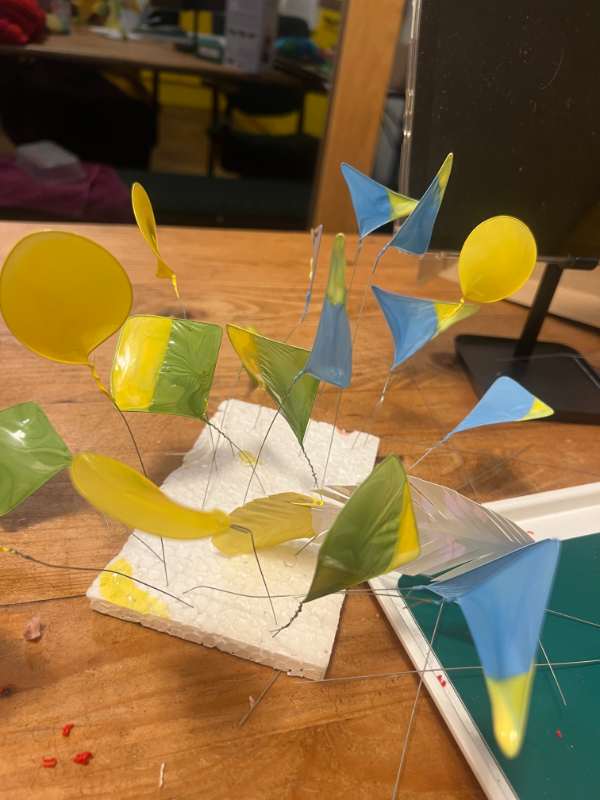

Structured Disorder
I wanted to take the bright colours and geometric shapes into another piece, from my crit reaction pieces I learnt that felt offcuts were a great way of making bold statements with colour, to let the colour shout and have meaning to evoke the feeling that between the darkness there is still light and fun and happiness, the dense matt finish of the material lets could exist clearly and boldly without textural or light distraction. Along with the Bauhaus, I was inspired by cubism and stained-glass techniques. I wanted the black to outline the colour, to make the colours pop, and shout. The black lines define the chaos of the shapes and give the ‘chaos’ more gravitas. Almost like by defining the edges of each colour you are giving context that could be accepting the chaos, but keeping it contained. A reflection of how we live our lives, swimming madly underwater but trying to display a level of ‘put togetherness’ on the surface, hiding the internal chaos to display control.
Comments have been that it could have been inspired from Mondrian and abstract art which I agree, the geometric shapes, bold colours and dark lines do reflect his geometric abstract art that but it weas not one of my initial inspirations but see the value in aligning the piece with his work. I wanted to keep the edge an undefined line, undulating and shaped with curves, and points and straight lines, again, not to contain, but to allow the slightly messier to come in rejecting modernist perfection.
I think that shadow and photography and presentation could really benefit how the conceptual elements oft his hat could be greater displayed and identity deepened, the way a model were to wear the hat and how their identity may be changed by it will all add more symbolic impact when scale and lighting can add to the complexity of the thoughts in this piece. And I will look to explore and develop this piece in the photography and digital media area.
Some behind the scenes footage creating the piece:


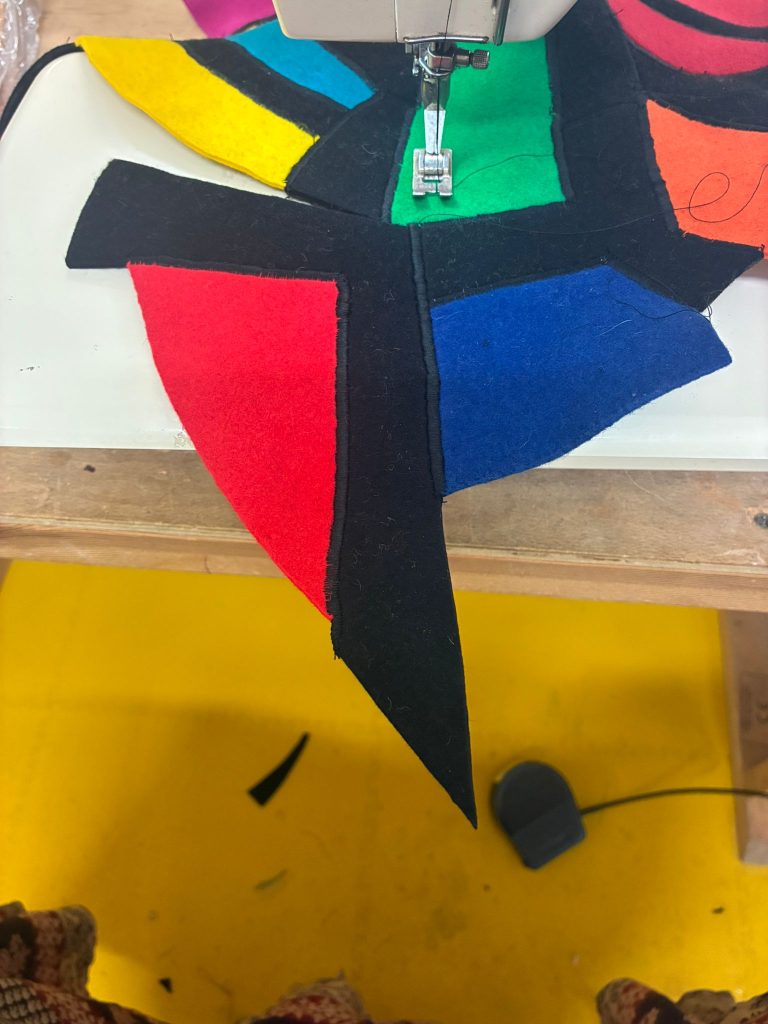
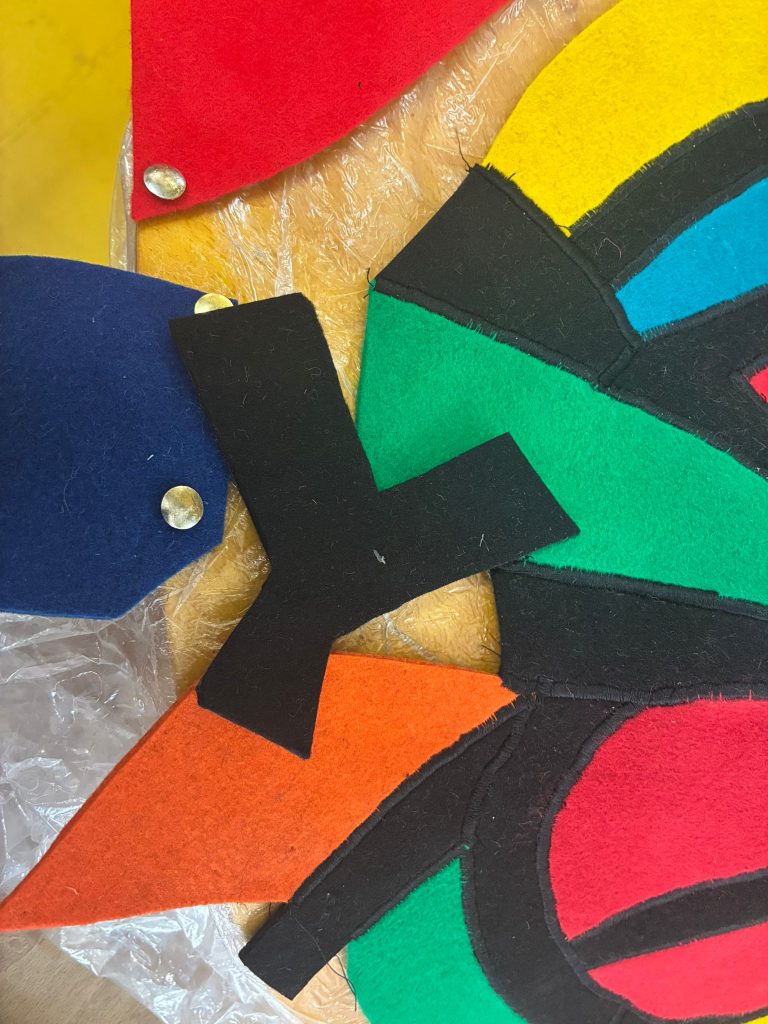


When home is gone
I really wanted to delve deeper into imbedding meaning and conceptual thinking into my work, as it is not yet something that is happening naturally. I noticed that my dog was malting a lot and with hair on the floor I suddenly thought what if I were to felt his hair into a hat, a hat couldn’t be more personal and meaningful to me than one that is made up of the parts of man’s best friend using his hair adds a personal materiality with meaning to my work…and maybe better in a hat than clogging up the hoover.
My dog (walt) is an old grumpy, stubborn character, who does his own thing, huffs and puffs when he doesn’t get his own way, yet is literally by best friend and confidant, he doesn’t judge me, he loves me unconditionally and is my home, my safe space, and he clams me.
So, after many days of brushing walt and bribing him with treats for another brush, I have a bag full of his hair, his soft dark grey undercoat, mixed with longer coarse black hairs and a decent amount of his hairs.
I have welt felted once before about 20 years ago, and wanted to incorporate this ancient craft into my work as part of the celebration of handmade craft, I also wanted Walt to be part of the process so I laid out on the kitchen floor, where he could sniff and walk around my work, having him present in our shared space could allow him to be connect further into this work. I layered the fur together along with merino wool, for some longer fibres to help the fibres connect, I choose shades of greens and blue, evoking the feeling of calmness, peace and stability, a touch of Prussian blue hinting at my heritage and how fleeting and non-permanent the feeling of home could be, how my late grandma had to flee from her home in Prussia to Berlin, how Prussia, her home no longer exists in the same way it was as she grew up as a teenager and mixed with Walts white hairs, show how fleetingly in my life he will be around to be my home and my calm.
I then added water and washing up liquid and using my fingers worked and rubbed the felt together, before rolling it matting all the fibres together. Although I had washed Walt’s hair, there was still a slight dog smell, so I experimented with a few drops of essential oil, sandalwood to add scent to the felt known to evoke calm and grounding. Often referred to in the perfume world as ‘Liquid Gold’, its value is in its natural benefits, adding it the scent adds a new sense to the work, rather than just visual and tactile, smells can evoke many feelings memories and connect us deeper to the work.
Blocking the felt into a miniature fedora shape, I wanted to play with scale to demonstrate how small and fragile ‘home can be.’ By choosing a fedora shape, I chose a familiar and comforting shape hat, recognisable and understandable to most, stimulating the feeling of calm and order. I left areas feeling more fragile, visibly representing the fragility of the concept of home can be and a nod to how whilst walt is perfect for me, He is in no means the perfectly behaved dog.
The fragility I notice could be applied to be a representation to the state of the world, how unsteady it currently is, how we can not take for granted our home and the safe environment we live in, how it all could be tuned upside down in a moment.
On wiring the brim, I decided to experiment with leaving the loose hairs off the back, pushing the ideas of what a hat should be, allowing the felted fabric to ‘flutter in the wind, as if on a breeze, as if it could just drift away and be gone at any moment.
For me, this work is personal to my relationship with Walt, and how fragile and fleeting that could be. However, it does speak on various levels of displacement and global instability, which I think can be read and understood by most.
I am quite proud of this work and think it has a lot of layers that can be developed further. As a conceptual piece it is by far the most meaningful and personal that I have created. The introduction of scent adds a whole new layer, and I enjoy this element too. It still fits with my wish to embody sustainable credentials, materials that would otherwise be discarded have been uses, and it is degradable and can return to the earth, providing nutrients for plants and the natural world.


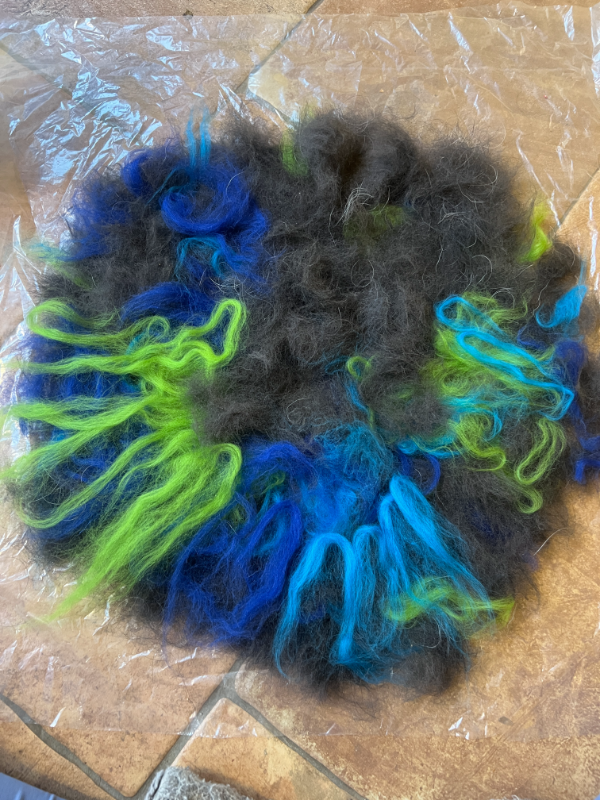
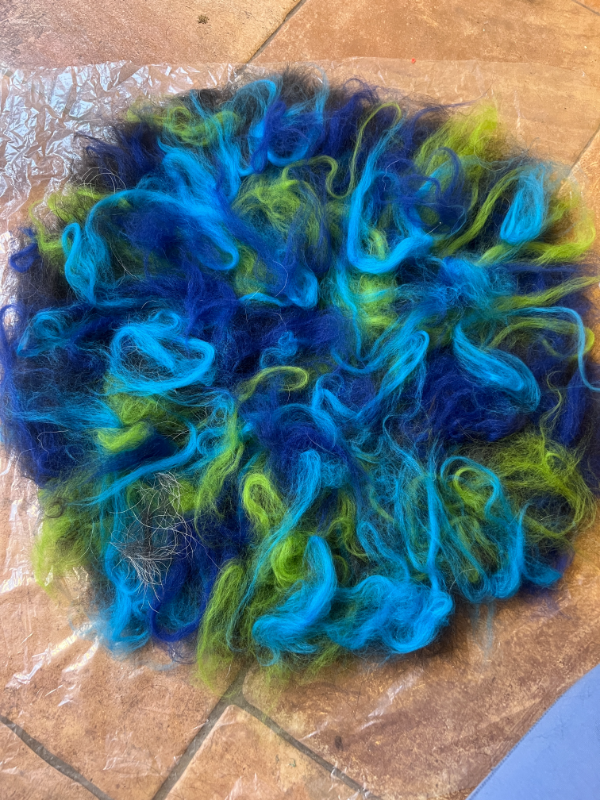
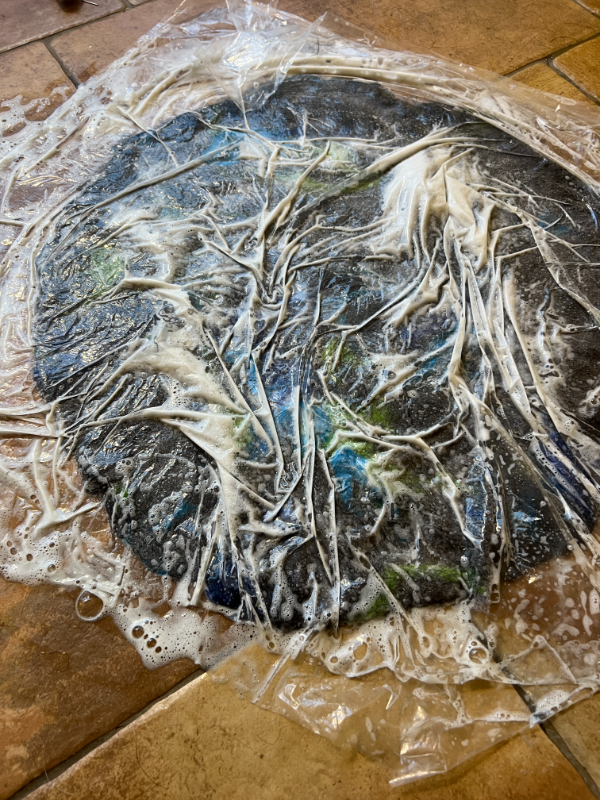


28/1/26 Lacan and Flugel
As I have been doing reading around the subjects of fashion, creative practice and theorists in these fields, I kept come across the names Jacques Lacan and J.C. Flugel , so I thought I should probably try and understand more about their theories which may be useful in the development of my more conceptual work and understanding of how their theories could be relevant to my creative practice.
Key theories of Lacan:
- The Mirror – We form identity by seeing our reflection, we create an idealised image of ourselves that we try to live up to.
- Desire is based on lack -We always want what we don’t have. Desire can never be fully satisfied.
- The Gaze – We are always aware of being watched by others. We construct ourselves with this imagined observer in mind.
- Symbolic Order – Everything communicates meaning through cultural codes and language.
Key Theory of dress from J.C. Flugel
Clothing exists for 3 reasons, and in this order: (The order is important)
- Decorative – to look attractive.
- Modesty – to cover up.
- Protection – practicality/warmth
These theories are incredibly interesting and follows up on lots if the ideas from Baudrillard, which we delved into during the group project. Especially the views from Lacan, In terms of millinery, with most millinery being worn to display, status, wealth, class (whether true or not) it is of course as we now know key to the whole subject of millinery, from fashion magazines and editorial selling lifestyle, what life could be like is only we could buy/have/wear that item, how suddenly we will ‘become’ that someone we desire to be, or how others might perceive us under the illusion that that hat would give, clothing is little to do with the item/hat, but almost entirely to do with the human condition and who we want to display as, it is our language and more important in many ways than what or who is underneath.
It is interesting that even in the whole view of clothing and fashion from Flugel, that decorative is more important than warmth, whilst this is an obvious fact within the conversation of millinery that it is more about decoration and status, it is very interesting that Flugel believes that in fact the practical use of clothes as a whole is quite low down on the list. That it is in fact the shame that we teach ourselves about bodies that has more reason for us to cover up than practicalities of warmth. However, there are also unforms and workwear, that do have practical use and the decorative is a least important part…but maybe a uniform still is about decoration as by being the same, or logo ’ed to a business, it is about ensuring the wearer stands out to others. I am surprised that modesty comes second, it is very frowned up to not wear any clothes in public, it can even be an imprisonable offence, but we are all born naked, kids run around naked, when do we build this shame, it is something we teach children. I am surprised that by the nature of humanity and how we teach shame that modesty would be less important than decoration. Perhaps again it just more important to be ‘seen’ in the right light than it is to be practical. I think women may agree with Flugel’s theories slightly more highly than men, perhaps because men’s clothes are generally less decorative and more functional than women’s since the 1800’s.
Just as I was inspired by the quote from Manni about being barefoot as it was the most sustainable way of being, perhaps there could be quite an interesting conceptual idea around the thoughts of the naked body and the human conditioning to the shame we feel about our bodies and how our relationship with clothes is in essence to distract your from the human body. Like Westwood and Schiaparelli who create dresses to enhance certain areas of the body, rather than accepting what we have, clothing allows us to draw the eye to certain places in the body whilst hiding others, but in so telling lies about what the human body is underneath. All fashion has to so with this is to influence what part of the body we are enhancing or hiding each season/trend.
Possibly incorporating the idea or shape of the naked body into a hat, laying the body bare whilst covering the head could be an interesting concept.
29/01/2026
Modernism/ Postmodernism Lecture Notes
Table of words by (Hassan, 1987)
Modernism Postmodernism
─────────────────────────────────────────────────────────────
Romanticism/Symbolism Pataphysics/Dadaism
Form (conjunctive, closed) Antiform (disjunctive, open)
Purpose Play
Design Chance
Hierarchy Anarchy
Mastery/Logos Exhaustion/Silence
Art Object/Finished Work Process/Performance/Happening
Distance Participation
Creation/Totalization Decreation/Deconstruction
Synthesis Antithesis
Presence Absence
Centering Dispersal
Genre/Boundary Text/Intertext
Semantics Rhetoric
Paradigm Syntagm
Hypotaxis Parataxis
Metaphor Metonymy
Selection Combination
Root/Depth Rhizome/Surface
Interpretation/Reading Against Interpretation/Misreading
Signified Signifier
Lisible (Readerly) Scriptible (Writerly)
Narrative/Grande Histoire Anti-narrative/Petite Histoire
Master Code Idiolect
Symptom Desire
Type Mutant
Genital/Phallic Polymorphous/Androgynous
Paranoia Schizophrenia
Origin/Cause Difference-Différance/Trace
God the Father The Holy Ghost
Metaphysics Irony
Determinacy Indeterminacy
Transcendence Immanence
Is it helpful or not.
Is creative practice a way of helping us understand the world?
Where have we been, where are we going.
All art has history, but how to make it applicable to today.
What do we understand by modernism?
Working knowledge time in history or of the now – industrial revolution – modern life of industrial revolution 1760’s
Structured society, hierarchy,
What Isn’t modernism: traditional hand made is not
Optimistic new world. Warhol -soap box
Modernism is an art movement. History and creative movement, but a loose term of dates, Some modernism happened at all times
We believed that in 1950’s world was going to get better – improvement – the motion of that.
History is not easy to date, everything overlaps and starts at different times.
Metonymic – word that is the thing, royalty = The crown. Embodies the word.
Fussiness around description.
In the past we believed the world was going to get better, actively trying to make a better world, building for the people.
The purpose of society is a modern sensibility – sci-fi stories, is blade runner a world where things got better? No, still have exploitation etc.. star trek, no money, work for the benefit of better for all, greed and hoarding wealth seen as barbaric. Post scarcity luxury communism. But still have nostalgia for the future, all wants are provided for.
Dogs walk themselves, bubble cars, robots do the washing up, end of domestic labour – background naivety to how society is. Assuming getting better
Technology – neo feudalism – tech companies capitalism regressed.
Enshittification – planned obsolescence – everything will get bad..
Facebook use to be good…then became bad, original goal get people to join to connect and bring people together – great idea, however mechanism of capitalism means always want to increase profits, increase advertising, less good for the end user. Reduce user experience but increase profits – trend of modern companies
Will the world inevitable get better, where money doesn’t exist and all domestic chores cared for.
So have we lost faith in the future?
Internet, you can see the world – life laid bare. And we see it isn’t better.
Survivorship bias – back in my day – no depression – maybe wasn’t around it, you jest didn’t hear it or have it in your face on social media – doesn’t mean it doesn’t exist.
State got more involved in peoples lives the people on fringes of society got help, capitalism mixed with state. Now state / socialist not sure where it stands, private sector takes over again.
Always have the new thing that will make improvement, break the world, and reform it.
The Bauhaus, a better understanding of art and how it fits in society, mass production, modern. Modernist way of thinking.
Lists are controversial
Transcendence VS imminence
Religious sensibility, transcendence, somewhere else a world of ideas out of reach, the soul is a transcendent idea. Universal Truth
Imminence is the stuff of everyday and what we can touch. In church bread and wine – imminent embodiment of a transcendent idea.
Hierarchies are artificial.
Less structural on the right-hand side – less easy to grasp. Modernism easier to grasp.
Postmodernism – what I feel, how I experience, performance art etc. not about the bigger societal ideas.
Own nothing and be happy – the dematerialisation of society.
Instead of buying art you go an experience art.
Dispersal, absence exhaustion.
Creating project, creative production you are doing something that is feeding into something that you believe in. You would have a manifesto of what the way forward looks like.
Few manifestos hanging around – sees slightly naive to break the world down into a sense of belief.
Pessimistic side (postmodernism) and optimistic side (modernism)
1990’s the happy smiley face represents an artificial drug happiness of the time.
Emptiness inside.
How do I feel about this?
Is all happening in cycles, but all happening all at once.
Internet is a force for good. Social evolution, we don’t have a say in it we are quite passive but have to go along with it. Postmodernism allows us to critique it, post modernism.
Open to be playful, personally, I can do what I want but limited by structures.
Postmodernism. Is not now, is it is a time in history, is that now the past the 90’s and 00’s irony. Is it now a little bit historic.
Now are we in Meta modernism…Then idea that we never fell fully out of modernism and into postmodernism fully, is it more of a pendulum swing of cyclical. Breaking of hierarchy, then space to build tradition and find meaning in the world. That is descriptive of where we are now.
You should feel confused; nothing should be smooth or linear. Is society now the same one that we applied labelled to? Has internet change things to be a hive mind…behaviours in different countries can influence others. Society is a different thing, everything influenced by everyone else and the responsiveness of time.
My thoughts on modernism/postmodernism and my creative practice
I would probably be more tempted to agree that we are more in meta modernism, we are technologically entwined, we know things aren’t better postmodernism seem too positive and idealist than the world we live in, postmodernism not meaningful enough, it is too playful and surface level, now it is so important to be ecologically aware, aware of people around you and of how everything we do has consequences, creative practice needs to address these issues of climate change whilst also our ability to connect to anywhere in the world at any point opens opportunity it also means we are drowning in content, most with very little meaning, creative practice now, needs to have real world issues and real world connectivity to stand out, Postmodernism isn’t relevant as it doesn’t take into account the state of the world. Modernism in a way is possibly slightly more relevant as it still dreams of ideals of society, maybe slightly naïve and authoritarian but at least it had the with the view of trying to be for the greater good. Sometimes perhaps we like a little postmodernism as a little lightness to the weight perhaps we, as a society feel on our shoulder these days, that perhaps in fact…things don’t always get better in time. Maybe we are stuck between the hope of modernism and the knowing better of post modernism, not quite sure how to move forwards whilst technology takes hold and we have no choice but to be dragged along with it in a world of constant content, most with no deeper meaning. I think my creative practice of millinery, it can benefit from an understanding of both modernism and postmodernism, when thinking about fashion and the evolution of fashion, we can see how ideals and especially women’s roles in society change as we float between modernism to post modernism to meta modernism, and how fashion is influenced by the same societal factors.
Notes on Coutrue Fashion Week 2026
Notes on Paris Couture Fashion Week 2026
A theme I saw throughout was a connection to nature, I was inspired by Matthieu Blazy’s collection for Chanel, very wearable couture, incredibly light fabrics, incredible textures and fine floral embroidery, I felt a connection to the beauty of the earth through many collections but Chanel stood out. I loved the wearability; the fact you could see a real woman wearing the clothes.
Daniel Roseberry for Schiaparelli show blew me away, the incredible workmanship, the delicacy and shapes, the link to animals and the natural world, inspired by the Sistine chapel (ironically something that has inspired my work since my teenage years and GCSE’s) his work made you feel the care, the beauty, the natural world. The name, ‘The Agony and the Ecstasy’, perfectly merging the feelings of the damage to the world, the anger of how we feel in the world, but then bringing us back to the beauty and joy of the world, the beauty of animals, but also the venom of animals, it was not only beautiful but also unbelievably clever conceptually. The collections creativity really excited me in terms of how it incorporated so many fine craft skills and design concept. The technical mastery reminded me of why the craft skills that are valued as lower than art, even as the ethical questions become more pressing.
I loved the classic Valentino gowns that we saw from Alessandro Michele, even more meaning layered on the ‘peep show’ display looking back into past collections for inspirations as Valentino passed away just days before the show.
Overall, Feathers across designers seemed to be a key theme that I saw repeated, the use of these delicate, light, un-recreatable materials, linking art to the natural world and the wonders it holds. Feathers obviously sit incredibly naturally into millinery, maybe they are pertinent now, the epitome of showing nature in fashion, but also the danger that nature and wildlife is in through human failure to protect the earth, the rise of veganism and animal cruelty raising questions on how ethical the use of feathers is, how sure can you be that they are obtained humanly, how sure can you be of supply chains that they are natural wastage, a by product of the food industry, or are the farmed for the feathers, often less than cloudy depending on sources. Potentially raising a pressing tension, I could explore. The technical mastery on display—particularly in the featherwork—reminds me why these skills matter, even as the ethical questions become more pressing.
Phyliss Tuckwell Hat Transformations
Having taken some of the Phyllis Tuckwell hats apart, I have now recreated them into modern wearable pieces, some to sell in my business with a more commercial edge, essentially just making the most of the quality of the parasisal fabrics that they are made from and some of the trims. A great way of making the most of the materials that cost over £50 for a parasisal hood and that are no longer manufactured at the same quality level, or the rolled organza flowers, beautiful in quality and style, transforming these pieces just goes to show how dated and tired styles can create modern and wearable pieces. With these pieces we did add in new materials and did not limit ourselves to the materials within the hat


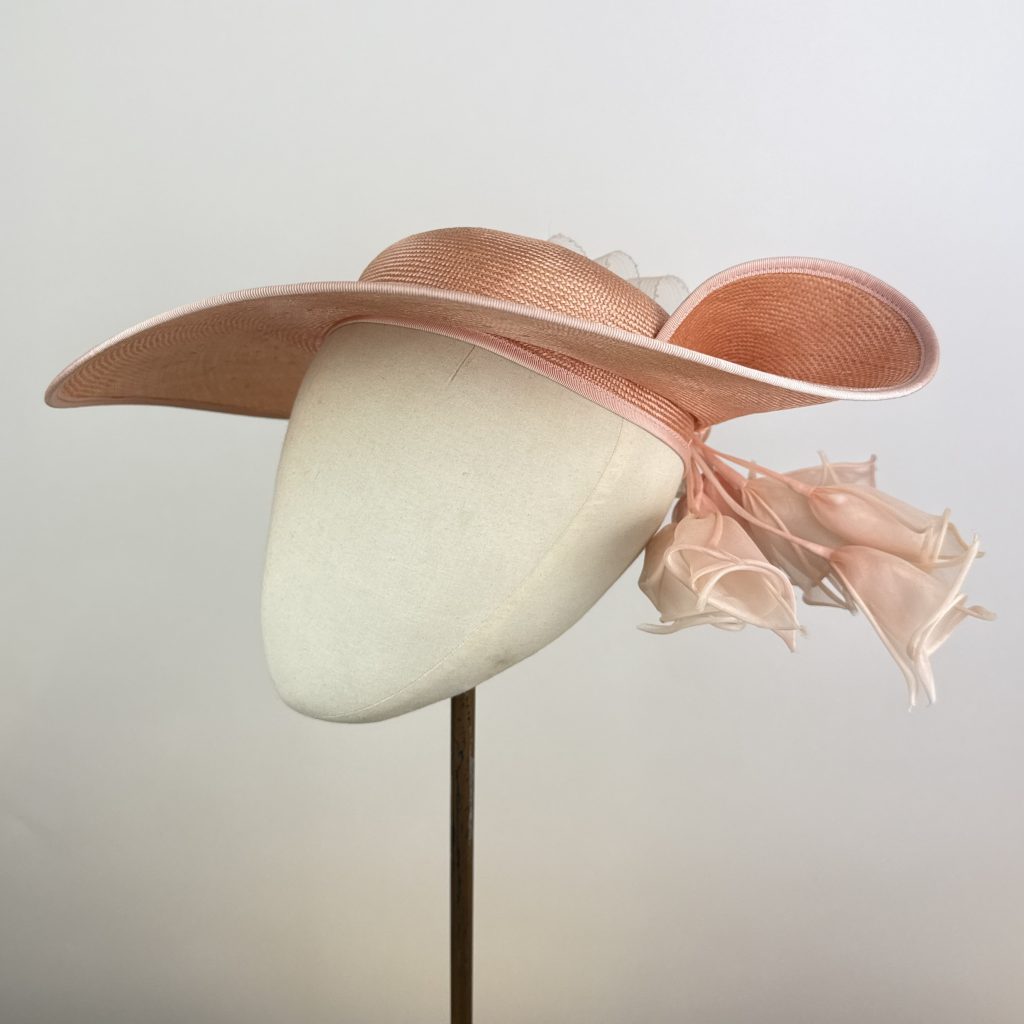

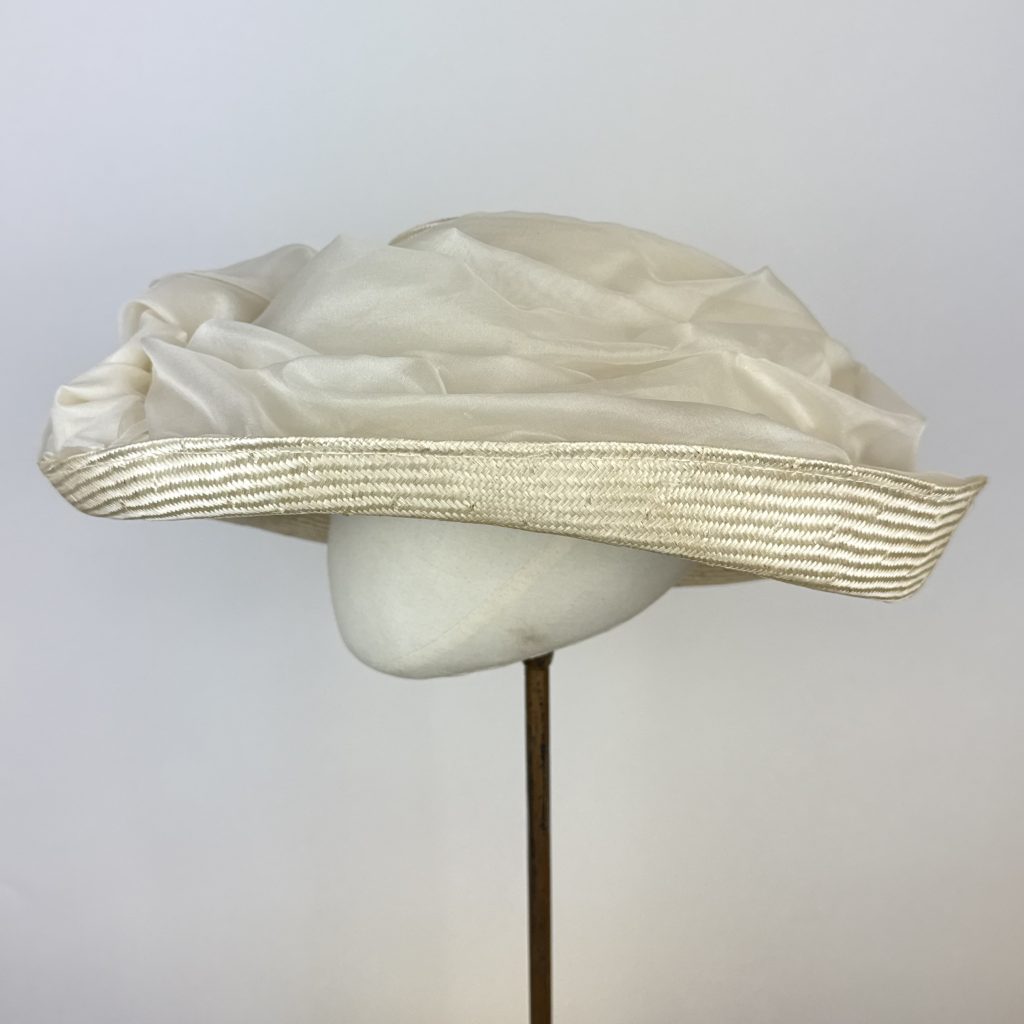

The hat we took in the worst condition, with purely the aim of recreating it into something beautiful and wearable we have n ow reimagines, using except for a new hairband and pearl trim and a perused petersham edging from an alternative hat, we exclusively using pieces that came off the original hat.
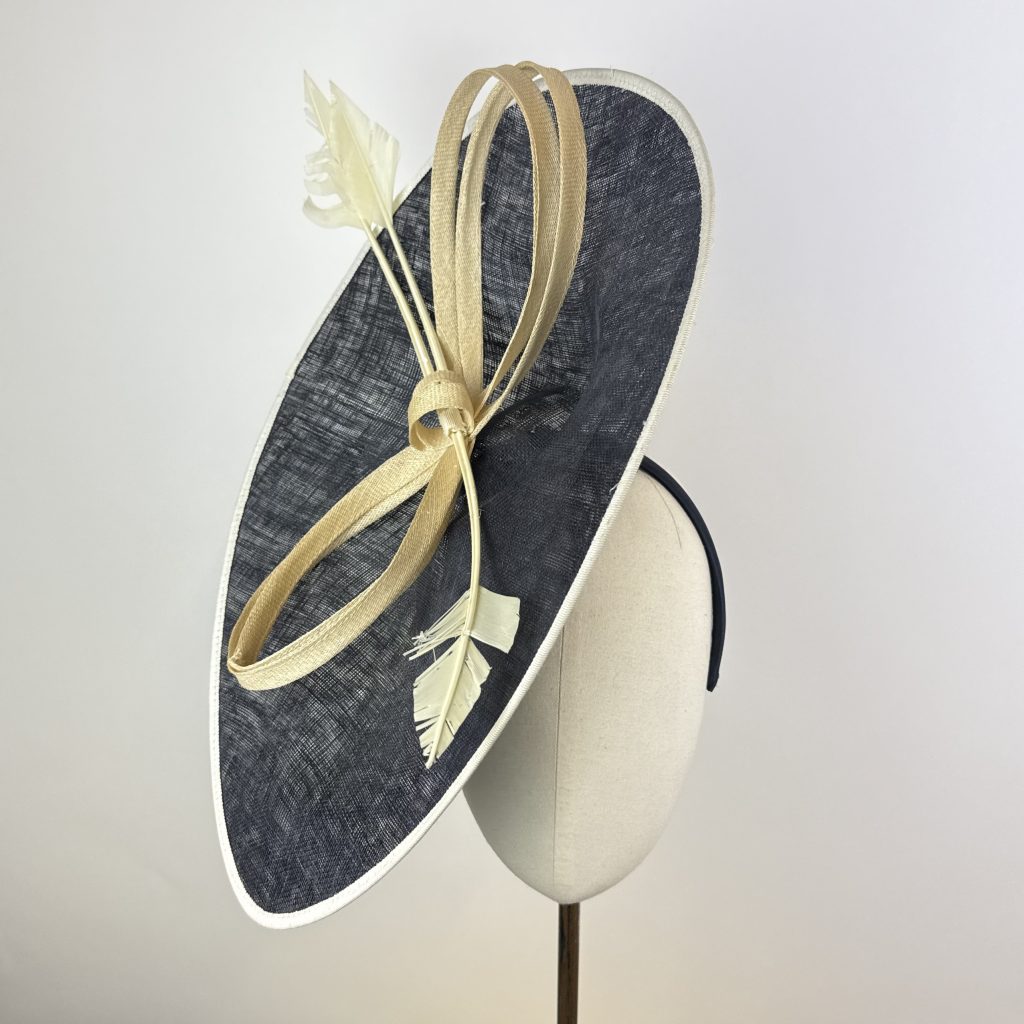
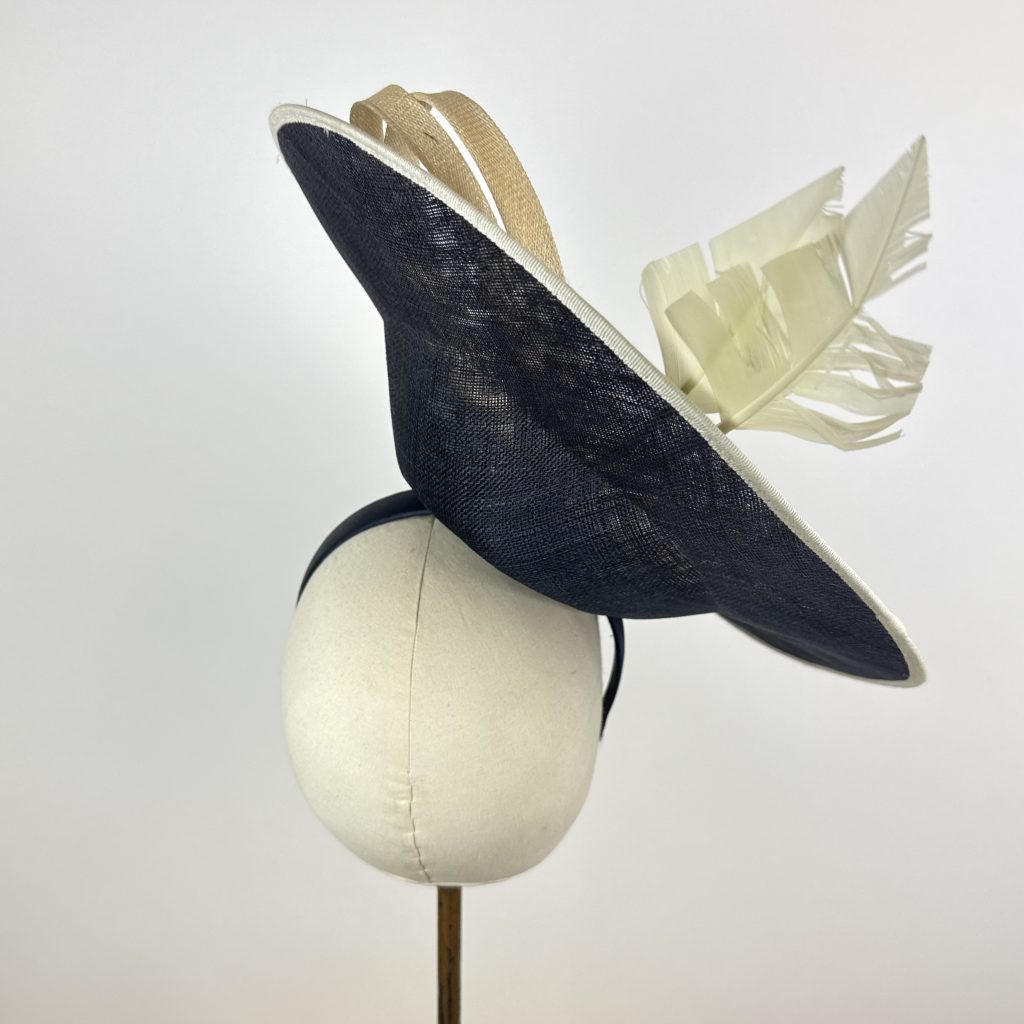
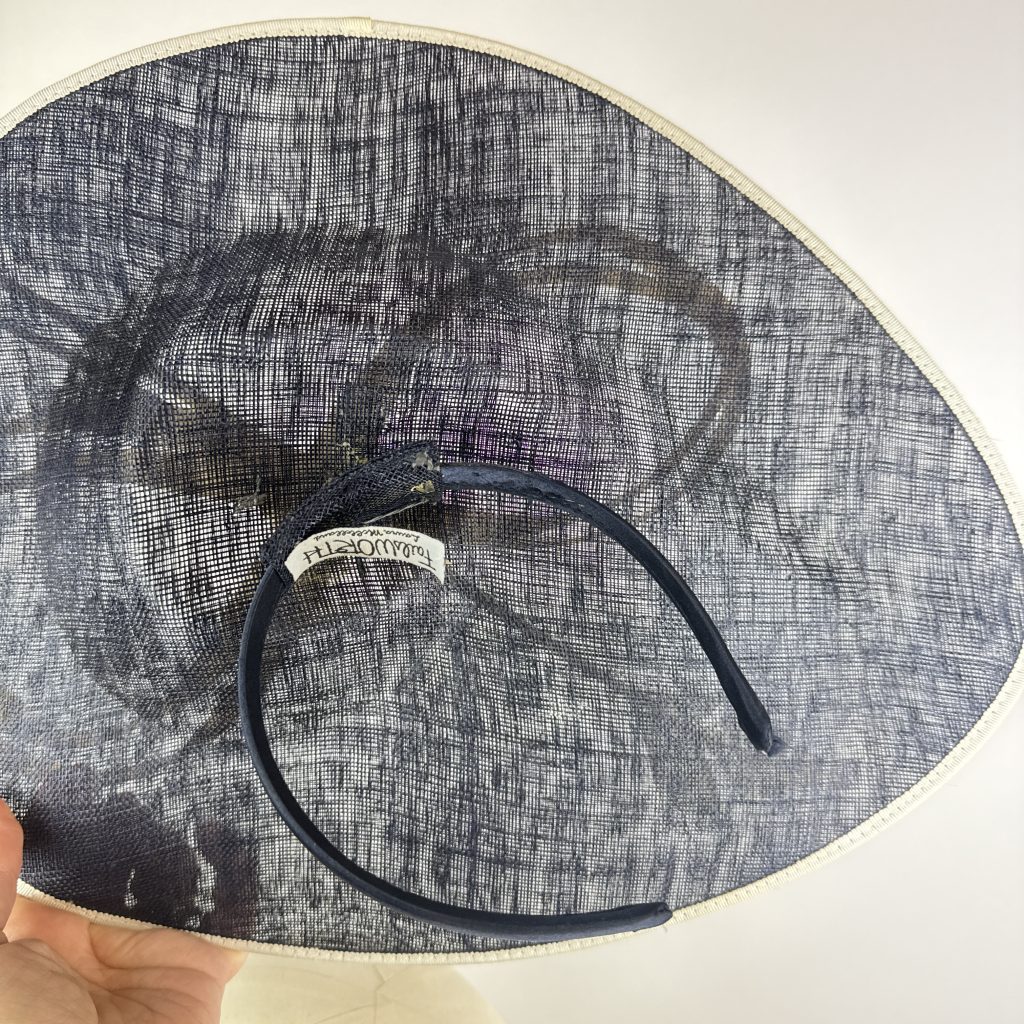
The base was a bit battered but had a nice shape blocked within it, we cut around these blocked shapes to create separated pieces, which we then wired and bound in navy, then shaped into twists. with any parts showing the glue gun glue that had been used to manufacture it the first time, positioned to be hidden by other parts. After we had removed the original petersham ribbon, it was not looking so happy, it had obvious stitching holes left in it and had some staining on it. But in the mindset of using what we had rather than adding in new materials, we decided to un-weave the petersham, time consuming so not particularly commercial, but worth it when we ended up with spools of thread that we were then able to crochet into flowers. Again, time-consuming but incredible satisfying to see beautiful hand-crafted skilled flowers appear from what would have been junk. The sinamay ribbons we kept majority the same, cutting away parts with staining or yellowed glue and re-inserting loops between our new twisted pieces. The feathers were looking worse for wear, but a trim of the stems and a stripping, reshaping and curling, two were transformed into sharp modern shapes. This piece will now be auctioned off for Phyliss Tuckwell hospice and over the next month or so I will develop a marketing plan and behind the scenes videos of the process with them for the auction. – I will upload these once ready.
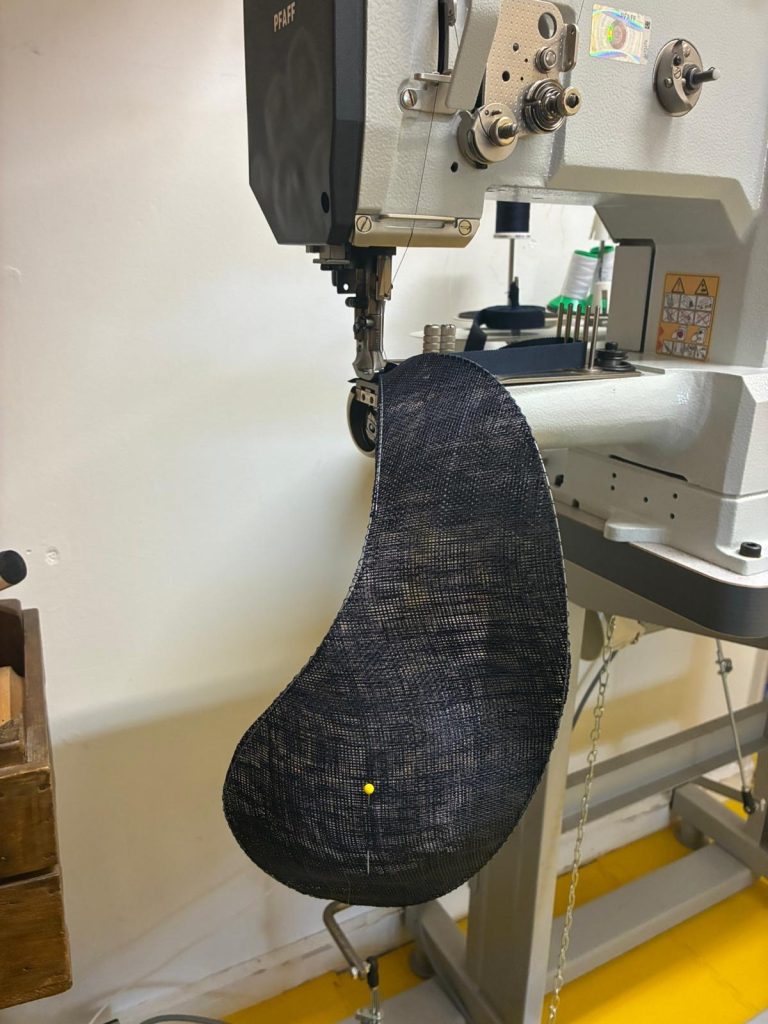



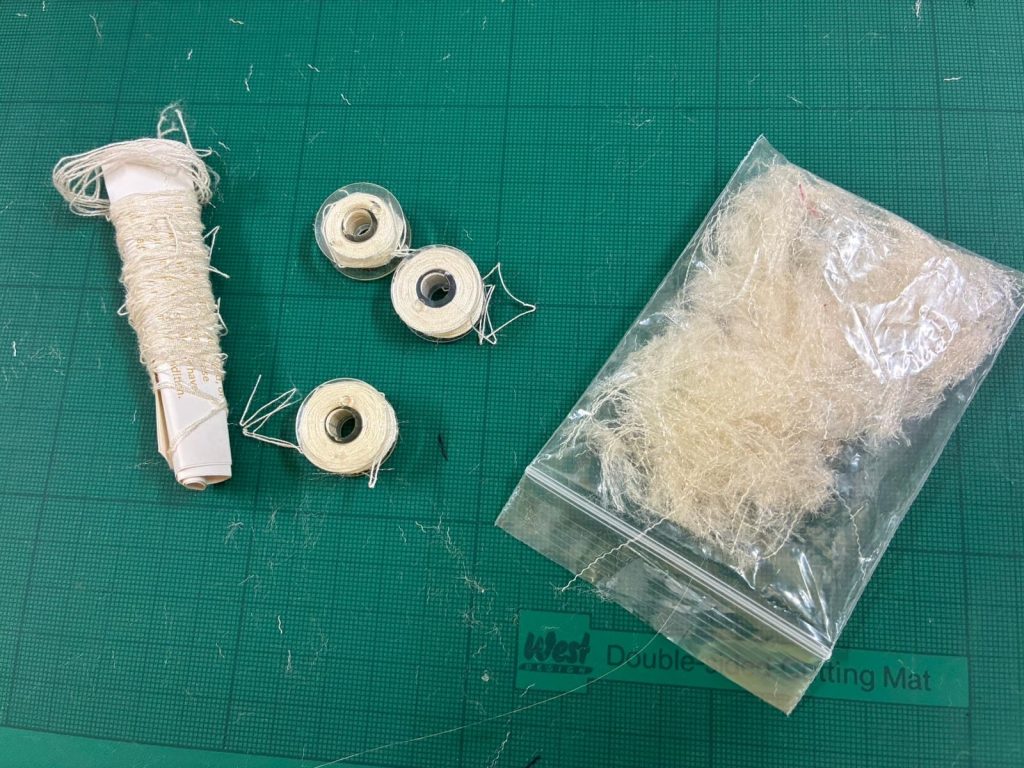


It is really satisfying seeing something so tired and sad and looking like it was ready for the bin, turn into a new life, what exists on the planet already can have a new life, I do enjoy the process of using what already exists over purchasing new. And seeing how nobody from a design perspective would questions this hats origins, it has added immense value back into it, my brand name helps that alongside the piece itself, to re-add the value, its value is now higher than the original hat would have been as a generic high street hat brand. The story the piece tells and the money it will raise for charity in the future, means that this piece only has more good stories to tell and impact moving forward, it removes from landfill, creates beauty and raises money for hospice care, improving the lives (and deaths) of those in the community. As I read in Wear Next, community is going to be key to the future of a sustainable fashion, and starting to think more about upcycling community events may be part of my business future. Because of the time consuming elements of un-weaving the petersham and the crocheting the flowers, it perhaps does not make commercial sense for my business as it is, however for community and events brand awareness and sustainability it has huge value. As does the value in employing traditional millinery skills and crochet craft skills.


1/2/26
I wanted to play with straw braid in a way that felt modern and contemporary, working with straw braid is a dying art, there is no more straw braid manufacturing in the UK anymore, despite once being the main economic industry in Luton. I wanted to play around with scale and make something that didn’t necessarily confirm to the head shape or societal norms, In the effort to be waste free, we used left over trial pieces of braid and scraps to create a tall shape.
Usually on a hat the oval of the crown is longways to match the shape of the head, on this one we juxtaposed the top of the hat shape and had the oval going across the head ear to ear. We created an uneven crown, extra deep, widening and narrowing in places and added loops, different textures, colours, and sharp angles. Rather than a brim we added and oversized almost square peak with all the strips of straw braid running in a diagonal direction, but then within that, 18th century bonnets were made using strip straw so the brim reaching out so far also has echoes of the familiarity of 18th century bonnet design.
Turning a dying material and art form into something modern and contemporary pulling inspiration from Kawakubo’s ideas of form not fitting the body and playing around with proportions as seen in Lucy Barlow’s techniques. Straw braid hats are usually quite simple sophisticated sunhat style, here I wanted to push it into a direction that has almost ended up cartoon or grunge, a little chaotic.
Whilst a mile away from my usual work, it created a really fun fashion forward piece that pushes boundaries of design whilst still feeling familiar with hints of historical refelction.


I wanted to play around with the idea of transforming rubbish, I had some transparent plastic bags that had no further use as bags, so thought I would play around with cutting and ironing them. firstly, I noticed that when I ironed the bag, any previous creases became more obvious but also the texture changed to a more vinyl-Esque finish, less noisy to handle and much softer, once folded it took on quite an iridescent hue.
I had planned to machine stitch it together by then realised that Sellotape and clear wire could create a whole ‘invisible’ piece of art. I used a design technique I have used with sinamay offcuts before, and it created a really lovely iridescent piece with movement. I like the material and the concept, but I don’t think this design was quite right for the materials used, as the rings got bigger, I think I would want more flexibility from the plastic. whilst using waste plastic bags is obviously a very sustainable way of utilising waste; by using new Sellotape and clear wire, they are new plastics that would need to be produced to create this design, so therefore the label of sustainable may not have the integrity behind it. From a conceptual point of view, it has legs in terms of seeing waste in a new way, the slightly clouded vision through a clear piece could hint towards a lesser clear pathway into what a more sustainable world looks like.
I like the concept and the effect; I need to develop my skills with this material to see what can be created from plastics, how it can be joined and how to make the most of the lovely textures it produces once cut and Ironed.



5/2/26 Research Methodology Object Crit.
In this session, we each took an object and looked at them, how they could relate to one another and how the knowledge about them was gained, looking back at the first lecture about knowledge and the terms below:
Practical – how to knowledge
Propositional – fact
Tacit – innate – riding a bike not thinking- intuitive beyond words- explanation disappointing as less than the thing itself.
Visual
Affective- impact how you feel / feelings- emotional.
Phenomenological – how it is to be a person in the world. The embodiment of being human.
All different types of knowledge and how to research.
What are we doing?
Group project/ search for a response not just academic – PowerPoint give structure.
Bafrin
Faceless
Research journey – textures/movement.
Covering face- concept of traditional taking away essences of themselves
Motion
Freeze frame video.
Almost like words in Arabic script- say something that is lost.
Colour underneath muted onto- visual story telling top distressed underneath hope.
Can we only tell our stories?
Steve
rainbow or road crossing over bride to heaven/hell.
Is red making us see negatively or positively.
Red ochre cave paining
Emotive
Motion
Do lines have a different role?
Visual knowledge
How do lines interact with paint underneath
Thinking about book whilst painting- primitivism and human version
Observe the ant, become the ant. Subject of work but also looking outwards
Rosie
Depth/perspective
colour
staircases
Repetitive print pattern
How to make pattern
Paper cuts/ collage
Pattern creation.
How it can look on different finishes/ silk/paper/fabric
Remove staircase completely from subject.
Defamiliarised
Something every day in a different outlook.
Experience
How many steps?? Around and again so many steps
Repetition and difference
Optical nature through scale
Movement of stairs on movement in stairs
Elisabetta
Statue of David
The thinker
Classical pose
Anatomical
Tree roots/ kintsugi / cracked egg / veins
Off balance
Pain / distortion
Language of body
Veins blood out and varicose veins- visceral female form internal space through the nervous system.
Physical awareness
Dance movement – awkward discomfort in pose.
Physicality of pose
Don’t think about body until you have to think about body.
Express physicality and difficulty of dance
Language of veins
Male gaze in art history women get to shave there say now on how the body is perceived.
Inefficiencies of human body
Anna
Cold
Nature taking over manmade.
Connection to rest of group speaking of veins.
Textured surface, roots, leaf veins
Vision altered
Mycelium network
Neglected
Veins in old, poured glass behind
Depth
Subject is wood, and organic growth but glass provides depth.
‘Reframing’
Play and composition of grids and rectangles
Line-membrane skin has an in and outside, but they are connected skin is the border. House glass and wood is border.
Hands and skin texture
Naroa
Hands and skin texture
Jellyfish
See equipment about process.
Touch
Colour – light – playing.
Ceramics workshop to watercolour logic less controlling way of producing photos introduce mistakes.
Challenging the traditional process of printing
Allowing yourself to make the mark
Paper reactors to any light – use mixture of light
Paper hands and ladies- no photo just development.
Taboo- not allowed to do in traditional photography developing- untraining yourself.
Spread colour (pipette) watercolour.
Light tracing- still a photo…just no camera- perspective
Beverley
Colours natural
Unusual material
Floating away ghost like
Deconstruction reveals what it is.
Convey meaning through materials.
Fantastic Mr fox construction
Peacock colour and back sticking out.
Moss on side of log
Ordinary design
Movement from the back
Back a bit like Walt’s tail when happy
Amulet- take item from another place with meaning.
Amulet magical talisman- material conveys meaning.
Does perspective change when worn.
Carries trace and connection.
Transgressive notion of hair belongs to you- leave the body becomes repulsive and taboo.
Discarded doesn’t require killing.
Carry a magical meaning.
Winter
Tailcoat- circus master character to be the showman and present.
Meeting expectations through fabrics
Function first
Decorative can be after the construction and be where the character be from
Our clothes are a performance everyday
Coats of Hope COP 24
Infuse meaning into fabric.
Patches of community groups sew patches into coat as went along.
Costume telling its own story.
Country infused into coat
Have conversations of hope whilst wearing communication of communities.
Create meaning using people meaningful things on designs.
Political and social meaning
Part of something bigger than yourself
I found it useful seeing how my classmates work is developing and how what they have done over the last term and how each step has influenced the work they are now producing. This was much more successful than my earlier crit. I presented the dog hair hat ‘When home is gone’ and the conversation flowed about the shape of the hat, being a familiar traditional shape, but made small and quirky, and the flow off the back of it perhaps also representing the showing of the materials that it was made from – sort of showing a deconstruction.
The disucssion also lead to the use of animal fur, and naturally shed material, and how ethical it is seen to use in art/craft/fashion it is almost as if once it is removed from the body it somehow becomes gross and waste, however we see feathers from a bird as beauty, look at the extensive use of feathers at Paris Couture fashion week. Would a vegan be more likely to wear a hat made out of their own dog hair than a hat with feathers naturally shed from birds? Are both ethically good or ethically bad? is one eithically better than the other, and if so which, it is a cloudy area, we know fut is bad when it is made into fashion using the skin, but is it bad when naturally shed. Is that not more ethical than shaving a sheep?
It brought up the idea of the materiality of the hat holding meaning, or part of the hat becoming a talisman, a deep personal meaning, in this case highlighting Walt’s mortality, is something that certainly could be woven into other designs, adding a personal sentimental items to create the art. This is something that in my practice already happens, clients want a special piece of jewellery in their hat, the tie of a passed relative, or something that denotes their heritage, adding depth, meaning, conversation and something bigger than oneself, creating an almost ‘magical’ meaning for the owner. There is certainly more scope in this thought of carrying connection into physical objects.
Applying types of knowledge to my work
- Propositional: Dog hair is often considered taboo once separated from the body.
- Affective: Transforming otherwise waste material into something emotional and meaningful.
- Tacit: Knowledge from previous wet felting and my Millinery knowledge to form a hat shape and finish the hat. Walt’s presence during creation added another layer of connection.
- Phenomenological Knowledge (Lived Experience) “He is my home, my safe space, and he calms me” The feeling of what home means to me cannot be reduced to facts, Creating the work on the kitchen floor with Walt present gave a more embodied creative experience.
- Practical Knowledge (Craft Skills) Wet felting technique: layering, water and soap, rubbing, rolling, matting, blocking into fedora shape, finishing the hat.
- Visual Knowledge scale represents fragility, shape represents familiarity,deconstruction shows the materiality and movement.
- Affective Knowledge (Emotional Resonance) Colour choices, calming colours, colours representing heritage, sandalwood scent for grounding.
What I still need to do
As I have developed lots of ideas and mentioned lots of potential further work above, I asked Claude AI to collate me a list of everything I have said in my work above that still needs further work or exploration to keep me on track and in the right direction. I have edited it slightly to be clearer, more relevant and up to date with other things that perhaps have not been mentioned yet. But it was a really handy use of AI to aide me creating a clear list or what I have discussed but not yet explored fully. Depending on how projects go and directions I am pulled in, I may not end up exploring all of these avenues, but they represent questions and designs that have been raised so far in my reasearch.
Artists & Movements – Further Research Needed:
- Visit Schiaparelli exhibition at V&A – “Fashion becomes art.”
- Prussian history, arts, crafts, and culture
- Alexander McQueen (mentioned by Vesna)
- Caity
Materials & Techniques to Continue Exploring:
- Wheat straw in different applications beyond traditional millinery hoods
- Contemporary uses of straw braid reflecting the state of the industry.
- Biomaterials
- Scent in millinery work – further exploration potential
- Visible mending techniques: Sashiko, Decorative Darning, Kintsugi, Crochet
- Photography, shadow, and presentation techniques – develop how pieces are photographed/presented with lighting and scale.
- Creatig Talismans
Creative Projects/Pieces Still to Make:
- Charity shop hat remake (Navy blue saucer hat for Phyllis Tuckwell auction)
- Behind the veil / under the brim, what the fashion world is hiding from you.
- Hat that fits from the shoulders rather than the head (exploring function without traditional head-fitting)
- Hat with interchangeable panels that clip/popper together
- 18th century bonnet-inspired pieces with contemporary twist (flounces and bows reimagined)
- Scaled pieces (playing with proportion)
- Shapes using padding, quilted forms that don’t conform to the head.
- Two pieces exploring “orderly vs chaos” –
- Same hat design made twice – once in neutrals/dull colours, once in bright colours (to assess emotional response)
- Pieces using unexpected placement of mundane objects in millinery context (Schiaparelli/Baroness inspired)
- Geometric shapes from Bauhaus principles as building blocks
- Developing the “luxury within chaos” concept (Jackson Pollock/Cecil Beaton tension)
- Piece exploring “nothing/nakedness as most sustainable” – body modifications/tattoos concept – shame of the naked body.
- “Trashformation” series or exhibition, |Transformational design from waste.
- Further development of negative space pieces there is still more scope and want to explore how gaze is drawn through pieces, shadows, and photography.
- Perception-based work – after realising people value pieces differently than you do.
- Developing ideas on articulating the hand-crafted nature of products in design, figures on scaffolding with needles etc.
- ½ embroidered hat
- Feather detailing
Research & Investigation:
- British Hat Guild funding proposal for Phyllis Tuckwell collaborative project/auction
- Workshop concepts for millinery upcycling (charity shop hats) – solo, group, or community engagement, ‘sewicals’
- How to make “Trashformation,” “Reclaim,” and “Renewal” framework cohesive across body of work
- Develop clear photographic/presentation strategy for existing work.
- How to run short courses – the course encourages this and you’ve identified upcycling workshops as potential.
Practical Next Steps:
- Plan and execute V&A Schiaparelli exhibition visit (March)
- Finalise and complete Phyllis Tuckwell charity auction hat (spring deadline)
- Develop photography and presentation for completed pieces.
- Decide on final direction – your work is pulling between several strong concepts (orderly vs chaos, negative space, transformation/renewal)
Key Conceptual Threads to Develop:
- Orderly vs Chaos
- Negative space and perception
- Transformation/Reclaim/Renewal framework.
- Cognitive dissonance
- Home and displacement
- Craft preservation vs. innovation.
- Develop one strong conceptual thread
- Create a cohesive body of work around your “Transformation/Reclaim/Renewal” framework.
- Focus on presentation and photography to elevate the conceptual reading of existing work.
Bibliography
Sanfilippo, C., Fiore, V., Calabrese, L., Megna, B. and Valenza, A. (2024). Effect of sodium bicarbonate treatment on the properties of sisal fibres and their geopolymer composites. Case Studies in Construction Materials, 21, pp.e03536–e03536. doi:https://doi.org/10.1016/j.cscm.2024.e03536.
NevermindPaper (2021). How to Make Recycled Paper (+ Mould & Deckle diy) | Tutorial. [online] www.youtube.com. Available at: https://www.youtube.com/watch?v=5xrWrKIVBgo.
Ghanapaperproject.com. (2025). Blocked. [online] Available at: https://www.ghanapaperproject.com/ [Accessed 9 Oct. 2025].
Hearle, J.W.S. (2000). A critical review of the structural mechanics of wool and hair fibres. International Journal of Biological Macromolecules, 27(2), pp.123–138. doi:https://doi.org/10.1016/s0141-8130(00)00116-1.
Junele (2025). JUNELE – Plant Based Glue Kit Tutorial. [online] Youtu.be. Available at: https://youtu.be/BhAyG5gxirU?feature=shared [Accessed 3 Nov. 2025].
PETA UK. (n.d.). The Barbaric Fur Trade. [online] Available at: https://www.peta.org.uk/issues/animals-not-wear/fur-trade/.
Mccartney, S. (2025). Savian: The first plastic-free fur alternative | Stella McCartney. [online] Stellamccartney.com. Available at: https://www.stellamccartney.com/gb/en/savian-plant-based-plastic-free-animal-fur-alternative.html?srsltid=AfmBOopPuU17hmPYk8c-g1nmRKCrpgo5hd-0POox6ro5asGr7IW8Gztv [Accessed 3 Nov. 2025].
www.savian.bio. (n.d.). Savian – Luxury inspired by nature. [online] Available at: https://www.savian.bio/.
Choi, Y.-H. and Lee, K.-H. (2021). Ethical Consumers’ Awareness of Vegan Materials: Focused on Fake Fur and Fake Leather. Sustainability, [online] 13(1), p.436. doi:https://doi.org/10.3390/su13010436.
PBS SoCal (2025). The Hidden Cost of Staying Trendy | Earth Focus | PBS SoCal. [online] YouTube. Available at: https://www.youtube.com/watch?v=60MqS6nPCZo.
Basso, I. (2024). Green hypocrisy: the cognitive dissonance of fashion consumption – LINEAPELLE MAGAZINE – Beyond the fair, a world of ideas. [online] LINEAPELLE MAGAZINE – Beyond the fair, a world of ideas. Available at: https://magazine.lineapelle-fair.it/en/green-corner-en/green-hypocrisy-the-cognitive-dissonance-of-fashion-consumption/.
Celik, H. and Ekici, A. (2024). ‘I Crossed My Own Line, But Here is What I do’: The Moral Transgressions of Sustainable Fashion Consumers and Their Use of Alternating Moral Practices as a Cognitive-Dissonance-Reducing Strategy. Journal of Business Ethics, 196. doi:https://doi.org/10.1007/s10551-024-05877-8.
Instagram.com. (2017). Lucy Barlow (@lucybarlow.hats) • Instagram photos and videos. [online] Available at: https://www.instagram.com/lucybarlow.hats/ [Accessed 11 Dec. 2025].
Elkins, J. (2025). What is Research. [online] Youtu.be. Available at: https://youtu.be/7VgOOMn93NM?si=swAyAaK_Ztd8fKmd [Accessed 9 Oct. 2025].
Marx, K. and Engels, F. (1848). The Communist Manifesto. Penguin.
Grose, A. (2023). Fashion: A Manifesto. New York Review of Books.
Baudrillard, J. (2001). The precession of simulacra.
Georges Bataille (1988). The accursed share. New York: Zone Books.
Ferrari, J. (n.d.). What are Studio Habits of Mind (SHoM)? [online] Available at: https://www.studiothinking.org/uploads/1/1/7/5/117528172/shom_resource.pdf
Muthoni, D., Nyambura and Kiu Publication Extension (2024). Exploring the Intersection of Fashion and ART: A Historical and Contemporary Analysis. Exploring the Intersection of Fashion and ART: A Historical and Contemporary Analysis, [online] 3(1), pp.15–17.
McCartney, N. and Tynan, J. (2021). Fashioning contemporary art: a new interdisciplinary aesthetics in art-design collaborations. Journal of Visual Art Practice, 20(1-2), pp.143–162. doi
Miller, S. (2007). Fashion as Art; is Fashion Art? Fashion Theory, 11(1), pp.25–40. doi:https://doi.org/10.2752/136270407779934551.
Zest (2025). New Work, Shop Online, Art Practice | Nolan Art. [online] Nolan Art. Available at: https://www.nolanart.com.au/ [Accessed 26 Dec. 2025].
Anthropic (2025). Claude. [online] Claude.ai. Available at: https://claude.ai/.
Lesso, R. (n.d.). Sonia Delaunay: Wearable Art. [online] the thread. Available at: https://blog.fabrics-store.com/2024/02/18/sonia-delaunay-wearable-art/.
François Baudot (1997). Elsa Schiaparelli. London: Thames And Hudson.
Thill, V. (2018). Elsa von Freytag-Loringhoven, the Dada Baroness Who Invented the Readymade. [online] Artsy. Available at: https://www.artsy.net/article/artsy-editorial-elsa-von-freytag-loringhoven-dada-baroness-invented-readymade.
Winton, A.G. (2016). The Bauhaus, 1919–1933. [online] Metmuseum.org. Available at: https://www.metmuseum.org/essays/the-bauhaus-1919-1933.
Anon, (2021). ‘Like an Empress from Another Planet’: Elsa von Freytag-Loringhoven’s couture d’ordures. [online] Available at: https://decoratingdissidence.com/2021/02/08/elsa-von-freytag-loringhoven-couture-dordures/.
Carelli, F. (2016). Sonia delaunay: a life in theavant-garde. London Journal of Primary Care, 8(4), pp.72–74. doi:https://doi.org/10.1080/17571472.2016.1204009.
Blum, D. (2003). SHOCKING! THE ART & FASHION OF ELSA SCHIAPARELLI Philadelphia Museum of Art. [online] Available at: https://legacyweb.philamuseum.org/doc_downloads/education/ex_resources/schiaparelli.pdf.
Stephens, L. (2022). Women Crush Wednesday: Elsa von Freytag-Loringhoven, the Baroness Who Shocked Society – Village Preservation. [online] www.villagepreservation.org. Available at: https://www.villagepreservation.org/2022/11/02/women-crush-wednesday-elsa-von-freytag-loringhoven-the-baroness-who-shocked-society/.
Press, C. (2023). Wear Next. Thames & Hudson Australia.
Fashion Feed (2026). Schiaparelli Haute Couture | Spring/Summer 2026 | Haute Couture Week. [online] YouTube. Available at: https://www.youtube.com/watch?v=5aFWNrRG7qw [Accessed 30 Jan. 2026].