13th November – Team Project
We started discussing the team project due later this semester.
Topic: What is Creative Practice
Work required: 20 minute group presentation 15th January
We started off doing a team roles questionaries to help us decide how we would create the groups. My strongest traits were: Completer finisher, Resource investigator and Implementor.
I don’t think any of these roles surprised me, but it was interesting to see that of all the results from the group that I was the only completer finisher, and most, not all) of the others were team workers. I guess finding this out and comparing them to others in the group, it did make me a little nervous about how work would get done, if everyone else would be happy to bob along without decisions being made, it would really stress me out, or I would lose interest.
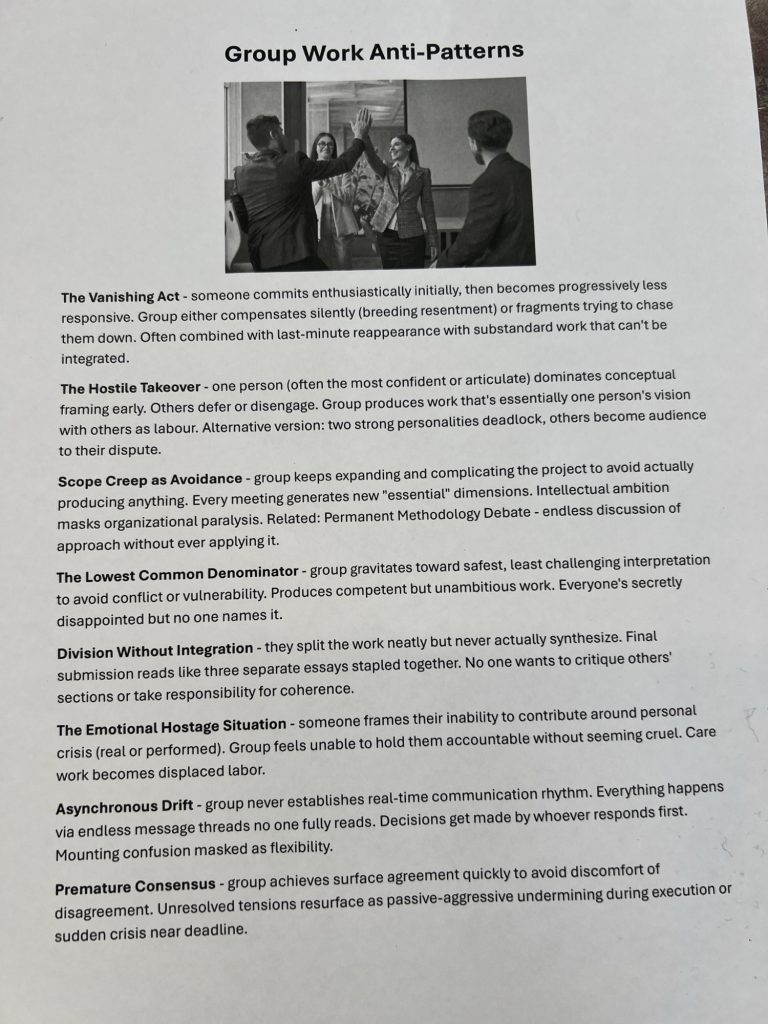
We discussed the anti-work patterns above, which I think everyone could relate to and remember situations in which each of these scenarios have played out in the past.
we talked a lot about horizontal or hierarchical teams as well as non-violent communication (Mark Rosenberg): how to bring people together in conflict, checking in with needs , being attune to needs and being generous with awareness and listening skills.
O- Observations
F- Feeling
N-Needs
R- Requests
I found the topic very interesting as well as seeing, how other people reacted to it and maybe how some elements i could implement into my work however we spoke of this for 2 hours and then the session ended, without having decided on how to split the groups. I found this really frustrating, to go into a discussion topic to discuss groups and then to not actually create the teams, seemed like a complete waste of time. Ironically it’s the completer finisher in me that we found out from the first exercise, I need to complete an action point to feel settled and like we have moved forwards. I think if we had created teams at the end of the session, my thoughts on the session would be much more positive, instead I am left annoyed that we are all going to need to sit down again and have the discussion about splitting the teams for a second time. I think I am most frustrated with myself for not saying what I thought at the end of the session and requesting for teams to be created at that point – lesson learnt – I need to speak up as not getting to an end point really affected me internally, when I spoke to a few fellow students later, no one else was really bothered by the fact we didn’t choose a team after the discussion, which was also interesting to see, and I am looking forwards to seeing how when the teams are created how I work within the dynamic of the others, and maybe I need to prepare myself to have the role to gently move everyone forwards in decision making processes, so that I don’t get frustrated or check out mentally.
27/11/25
We were split into groups today, I was placed with Stephen and Naroa.
Brief:
‘what is Creative practice?’
Each group was then given one of the topics we have looked into this term, Marx, Baudrillard and Bataille.
We chose Baudrillard and the concepts of ‘what is real’
Naroa was not with us today but we decided that due to time pressures we needed to start and that she would need to catch up to us.
Potential issues I see arising are:
-I am away the first 2 weeks in January, including the day of the presentation
-Naroa has not been a part of the initial decision making- although I believe we have left it open enough for her to be able to add her ideas at the later part if she feels what we have decided isn’t broad enough.
Steve and I discussed the notion of our individual perspectives of what is creative practice to us and perhaps how it overlaps or doesn’t overlap between our individual disciplines or how it clashes.
We also discussed that with me being away perhaps recording something maybe good to do, as well as completing the main project pre-Christmas break.
We discussed the perceptions of what is real and how we could play around with the ideas.
One idea was that as we each have such varied disciplines, that we swap disciplines and make something of another members discipline and see how that affects our thoughts of creative practice when coming from a blank canvas perspective of a craft, and if making something as a novice is more real than making something as an expert with many hours of training, work, practice behind them shaping their ideas. and finding out what about an alterative discipline maybe contradicts their own craft.
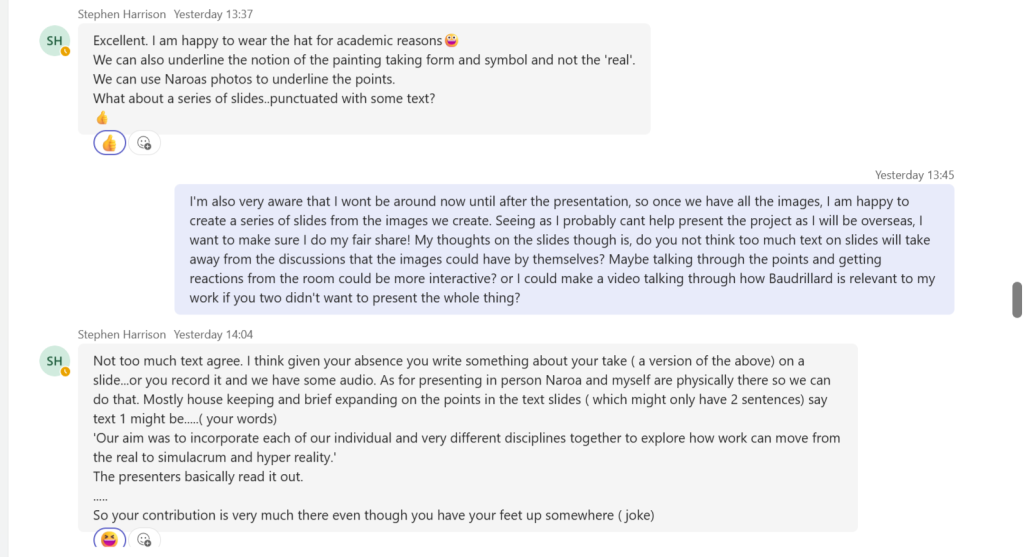
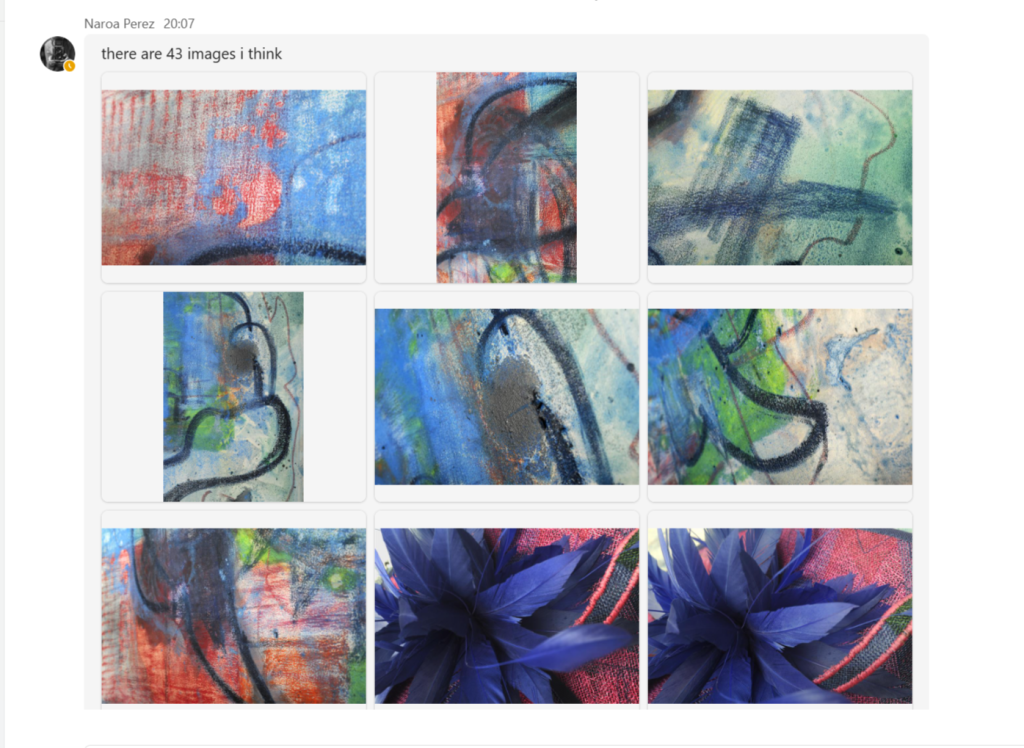
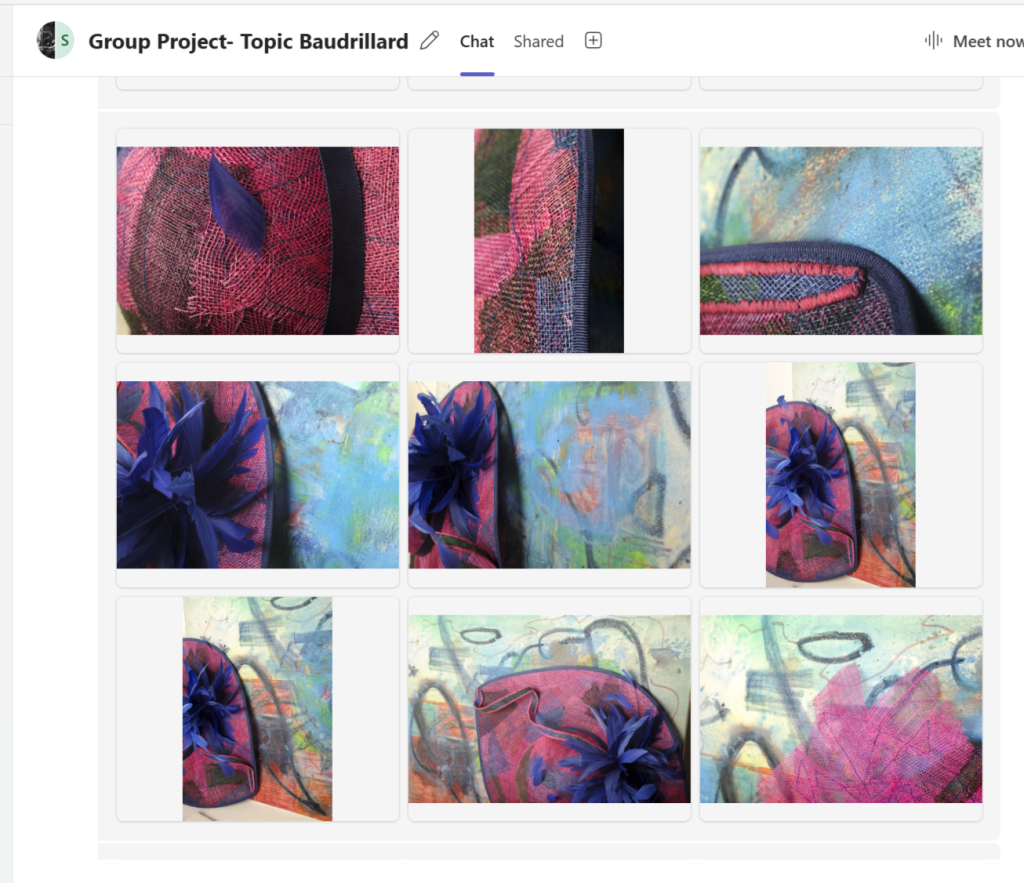
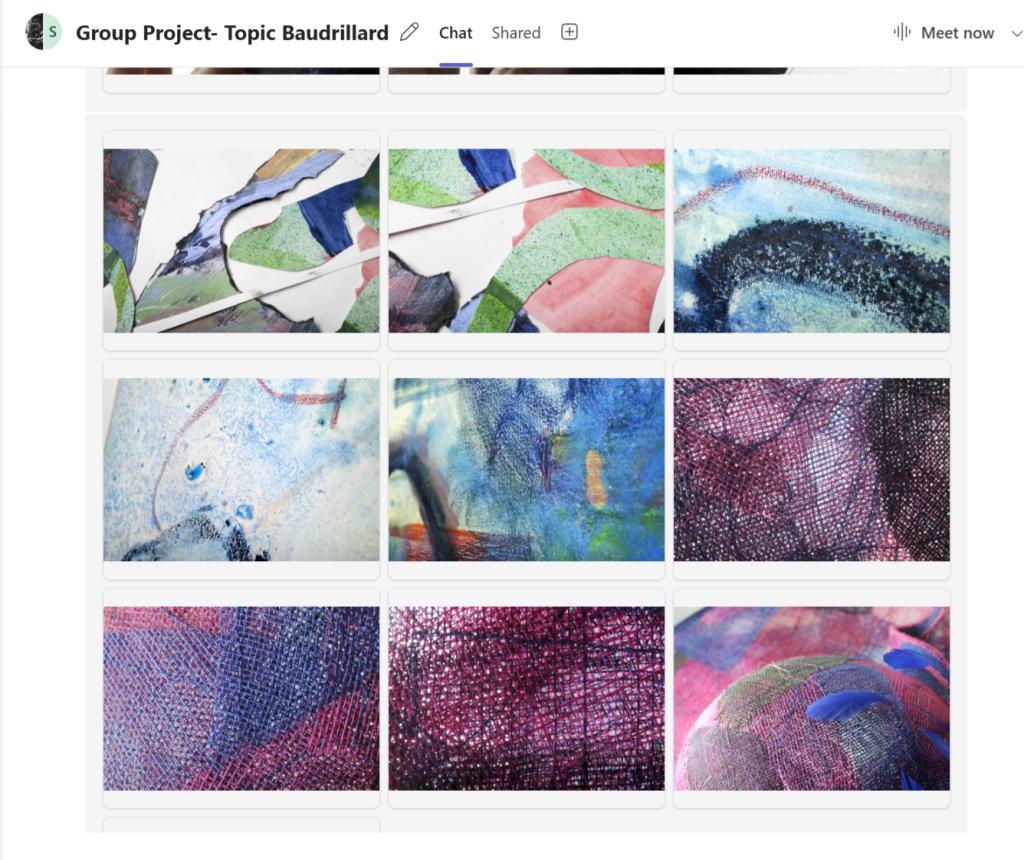
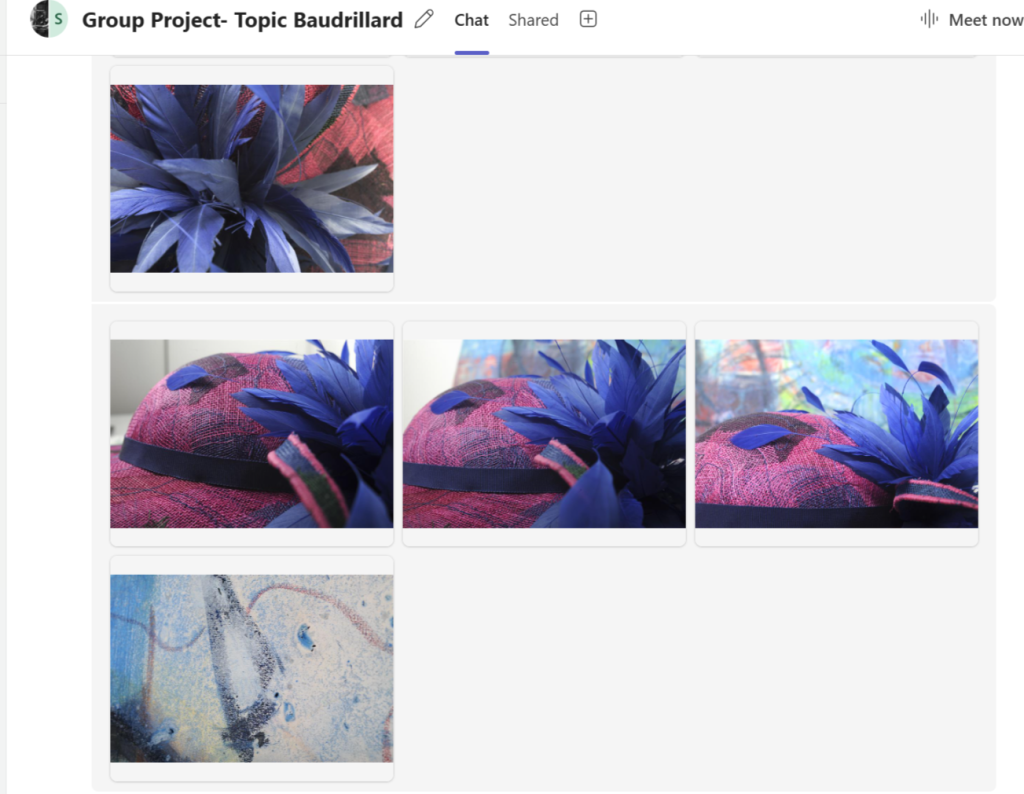
Another thought was a manipulation of the real, taking something and taking it away from its original form, i.e. I make a hat, Steve paints the hat, Naroa photographs and prints the painting, leading to the discussion of what is real, i.e. Would Steve and Naroa’s work be of more value than mine because they have added a layer of their perception onto the idea and added more meaning that the original hat maybe had in the first place.
We decided to along with time pressures to go along with the 2nd option as we could start today. I found some images on my phone of a hat I have made and could bring in next week, and Steve started painting his perception of the hat. I then articulated on Teams to Naroa the brief idea starting point.
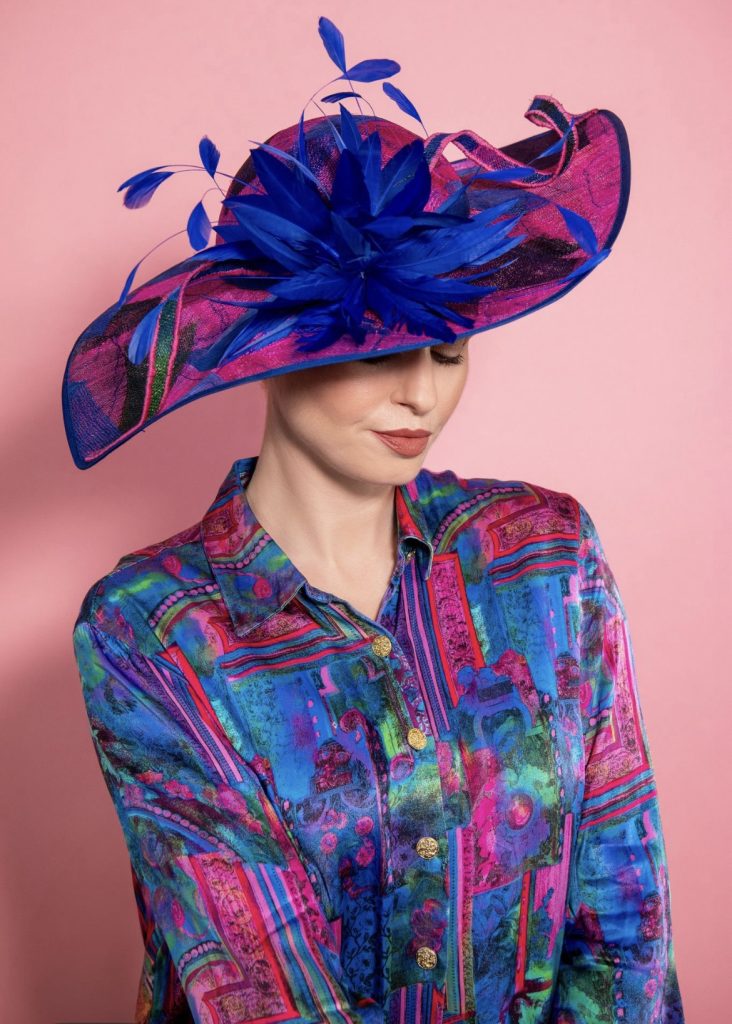
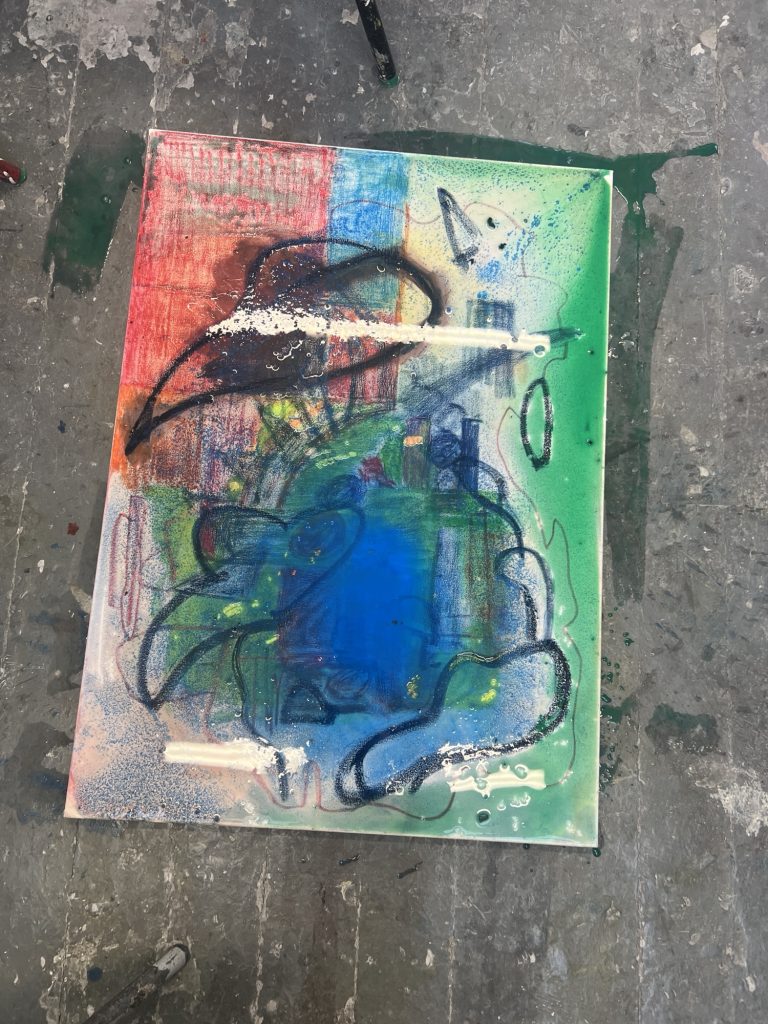
I found watching Steve unpick the hat fascinating, how he saw the colours and totally made it his own, made me really excited to see what Naroa could add when she adds her stamp to it.
My task was also to fill out the brief a little further, i.e. what is our end product/ presentation.
As I watched Steve work I realised we could take this further and go round in circles, a photo from Naroa could be printed onto a hat, which could then be painted and then photographed and printed again. That could then be photographed onto a phone, which could be shared to a laptop, then a tv, then maybe end up as a final physical photograph, each and artwork itself, but each moving away from the original, but re-engaging along the way creating multiple layers and complexity.
11/12/25
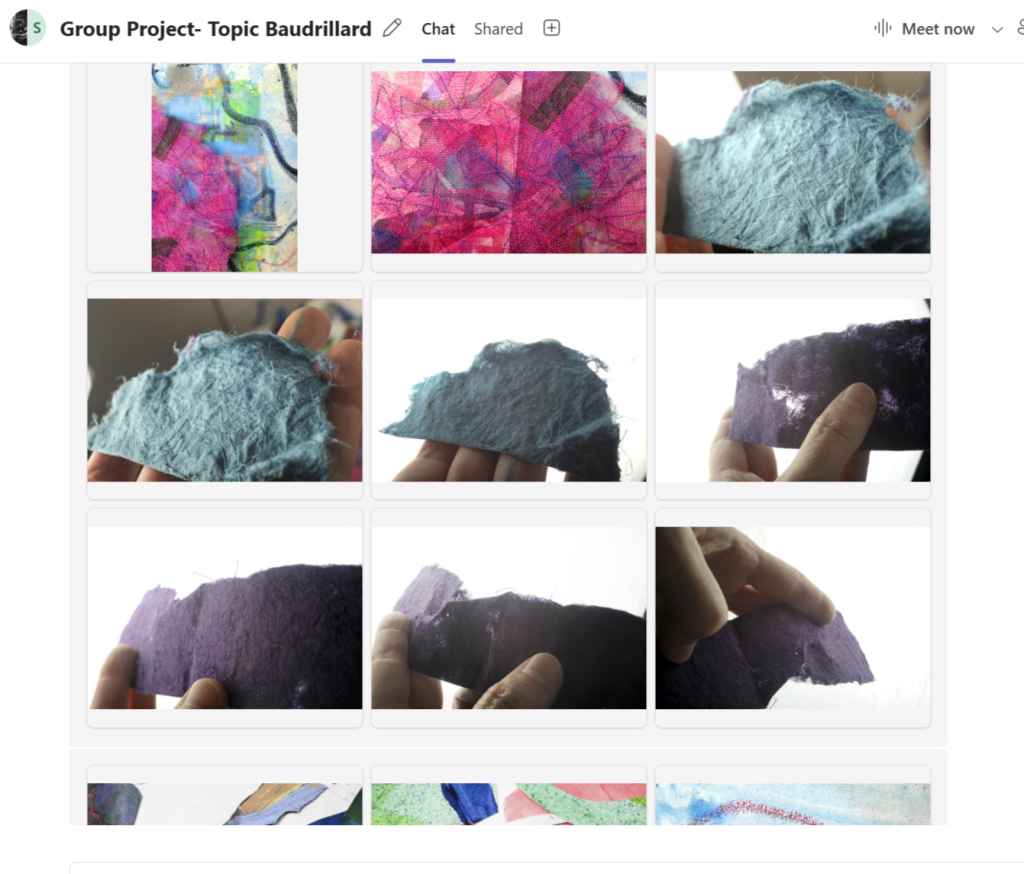
Spoke with Naroa and Steve to develop the idea further, Naroa has taken the hat, a piece of material that made up the hat and the painting and a secondary collage from Steve. It will be really intriguing to see what she comes up with and how it is taken away further from the original image. We left it pretty open so that she has free reign over how see feels her photography can impact the project. Unfortunately as this was the first Naroa had heard of the project in person (we had messaged briefly on teams with the general idea) and I am now away until after the date that the project is due. we will not all be able to discuss fully when we see her input. In hindsight replicating the ‘final image’ as mentioned above, may not add much depth to the conversation, there is enough with more depth to explore without such simplification.
17/12/25
In this group project, our aim was to incorporate each of our individual and very different disciplines together and explore how these disciplines vary or change away from reality and into the simulacrum and hyper reality.
Baudrillard how the views are relevant to my work
Hats are about images. The image of a hat is more important than the hat itself. The particular hat we have chosen usually will signal a social status that may or may not be real to you, it gives identify and alludes to class and an enhanced version of the wearer
Often the wearer never sees the hat in full reality, the see a 2d flattened object from the front view, in the mirror, already a simulation and already reducing it to a 2d form. Or in a photograph again reduced to a 2d form. Its image on social media is used to further push and agenda of social status. The only people who see it in a 3dimensional format are the observers, not the wearer.
A hat is taken from real object to representation to constructed image, most marketing in the luxury fashion market is not so much about the product itself, but rather the aspirational lifestyle that having that item will bring you.
Each stage moves further away from reality and deeper into simulacrum / hyperreality Whilst a hat performs a function a hat is functional (keeps you warm, shades eyes, dresses you appropriately for different occasion) Baudrillard argues that objects are never just functional
A hat communicates meaning
It signals identity, role and lifestyle status
A beret may signal an artist or French
A cowboy hat signifies masculinity and rural living
A baseball cap encapsulates youth, sports and casual attire
A designer hat signifies wealth, fashion and social status.
Who is wearing the hat can make a huge difference to how the hat and the wearer is perceived (If Steve were to wear the hat for example our assumptions and preconceived ideas about the hat (and Steve) may change (Steve would you be happy to do this? – I think it could demonstrate a really strong point)
So therefore, the hat is already a simulation of identity, not just an object.
A hat does not simply protect the head, but it signifies who the wearer is or wants to appear to be.
Things we could consider:
Maybe take photos of person in hat for discussion over how the form changes whilst worn by different people. Does the meaning change?
Perhaps have a photo of Steve wearing the hat in contrast to the model images already in group chat?
In the painting and the collage, the hat is no longer about use or identity, it is exaggerated, distorted and used for colour and texture, it no longer refers to a real hat.
The image exists on its own with no need for the hat going forwards, it becomes visual rather than an object removing it from reality into a simulacrum.
Each add own views on how Baudrillards’ ideas connect to your individual works.
Steve has also send through his initial thoughts put through Claude.AI with has given an interesting framework. It is not a dissimilar route to what has been discussed above, still very open ended until we know what Naroa will bring to the table.
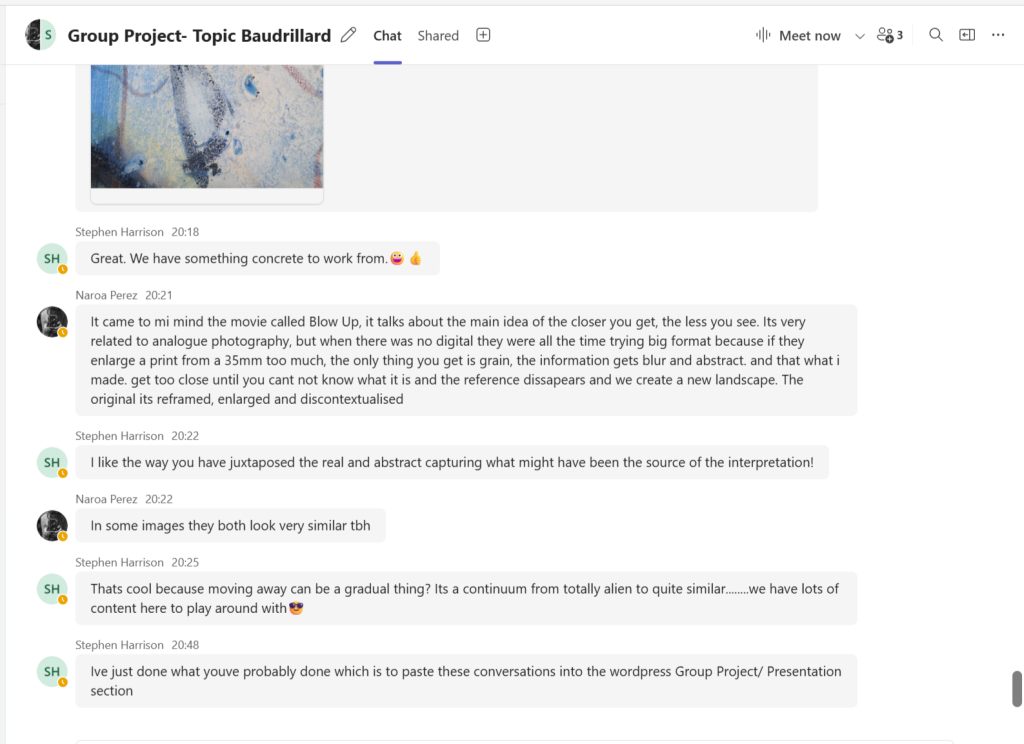
At the moment I am unsure how we will bring this project together. As I will not be around on the day of the presentation, and unlikely to be able even be on zoom (international flights) I am very aware that my input into the project must be felt prior to the presentation. I would need to get the other group members points of view, but perhaps I could create a digital presentation of the images whilst they speak through the slides in person. I feel like the images could be really strong and provide interaction within the class, by not adding too many words to the images, rather than by showing a series, going from the ‘real’ to the hyperreal it will allow discussion to form on it’s own. Then we can individually discuss how it all links together and how Baudrillard’s views connect with our own work.
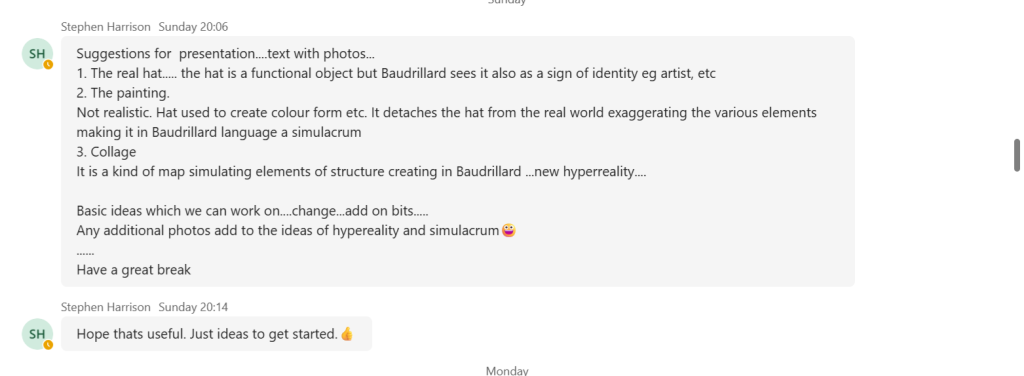
18/1/26
Due to changes of schedule the presentations will now be done the week I am back, this means we will have more time to put the project together.
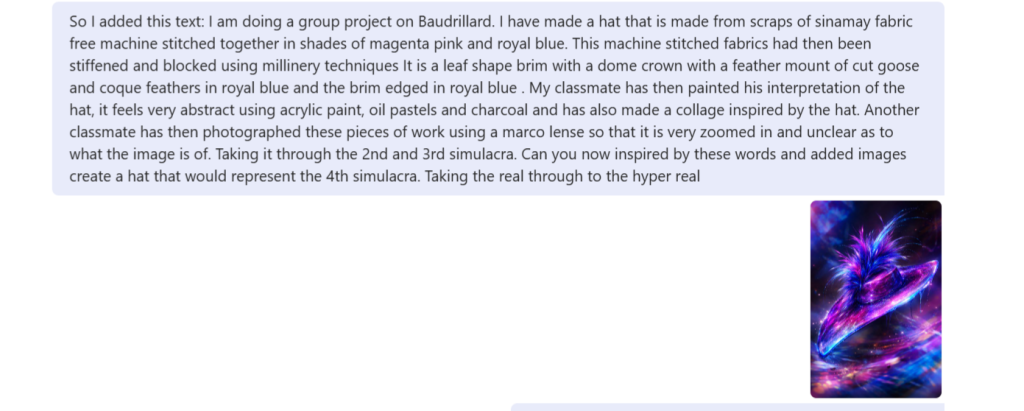
We did do a online meeting whilst I was away to discuss how to finish the project with the fourth simulacra, we decided that we should all write what we did in the project and input all the information into AI platforms and ask them to create a simulation of the fourth stage. I noted during this meeting that Naroa was quite anti-establishment, she was not content to do a meeting with a tutor involved when it was sprung upon us last minute to have a tutor in the meeting. I found this really interesting that she could be so vocal against going against the structures college puts in place, in someway this is inspiring, to be forthright in thoughts to do it your own way. In other ways it could be quite disruptive and potentially give a negative effect to the rest of the group, by not having input from a third party into the project.
Reflections…(From Steve on the last meeting)
1. We write notes on our bits
2 We think of things to ask AI about 4th iteration👍
3. I think Naroa said she could edit those notes to ask the actual question…. on different AI sites
Work since the meeting:
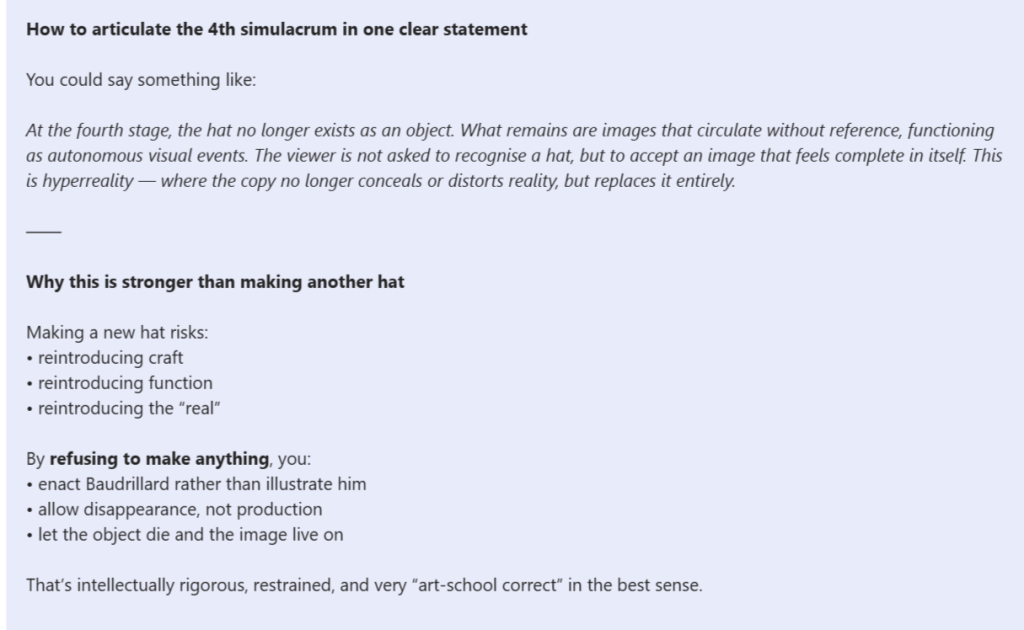

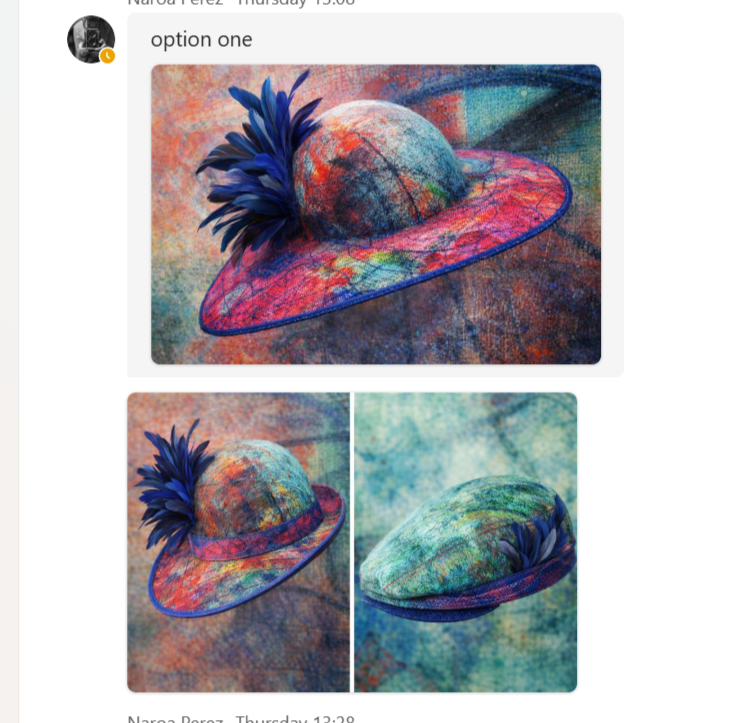
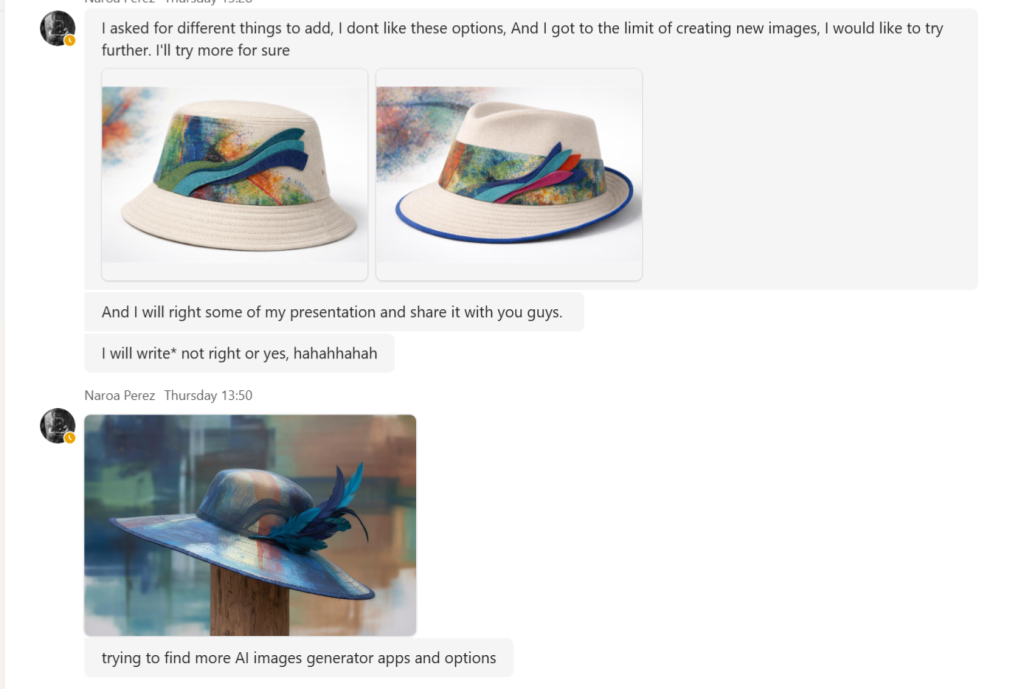
Whilst we have decided not to go with ChatGPT’s suggestion of not making a fourth iteration, I found it a very interesting point that it would be more powerful to not have a further iteration, we decided to not go with this concept because as Steve said by doing a fourth simulation ‘This brings the whole thing full circle. I agree for stage 4 making something is referential to the original which is counter to the idea that it has separated itself from phase’
We decided to put our work so far into a presentation with text, personally I am not sure what the text adds when we still need to talk through our project in the presentation. I have offered to make the presentation, mainly because I am trying to get over my aversion of tech and through this would be a good place to start and I do have a small amount of experience with power point already, however I do need the others to provide me or discuss with me exactly what picture and text we are to use. in the next meeting it will be vital to ensure I am given a neat bundle of images and text to make the presentations with, so I don’t end up doing the lions share of the work. I suggested that we look at more creative ways of presenting, being that the title is ‘what is creative practice’ however it was decided with time and lack of immeadiate other ideas that a traditional presentation powerpoint, oral presentation with the physical objects of the hat and painting, would fill the brief more closely. I am not sure that I 100% agree with this viewpoint and think that perhaps doing ‘creative practice’ in many ways answers the brief better…the more abstract and creative way of presenting, the more it addreses the question.
I also realised today that the title of the project is ‘What is creative practice?’. We have headed down a route that clearly demonstrates Baudrillard’s simulacra of the real. However I am not sure it directly answers the question ‘What is creative practice?’
So we need to think a little about how our project may get us to answering this question:
Group Project Agenda:
1) Clarify which images are being used in the presentation
2) Finalise the text that we put into create the 4th iteration
3) Work out what we want to write on the slides and where
4) Discuss how we will present the project, which order and who will cover what
5) Discuss have we answered the question ‘what is creative practice’ and how do we sum this up at the end of the presentation
6) Discuss if we need to meet early on Thursday to finalise?
Action to be taken aftermeeting:
By Wednesday Morning:
Get images sent to Beverley in a clear order and file that is easy for her to put into presentation by
Get written text for presentation to Beverley, clearly labelled as to which phot the text should align to which picture/ slide
21/1/26
The meeting went well, this was the summary i put together afterwards of how our presentation will go from our discussions:
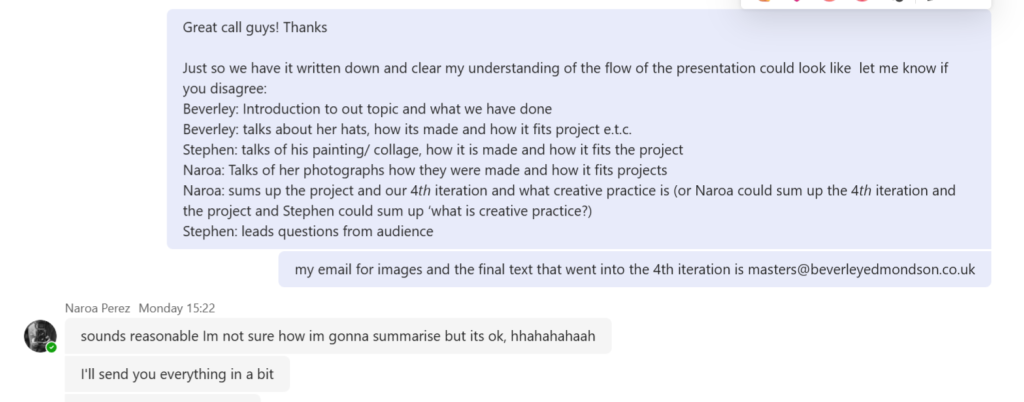
Everone sent me bullet point informations about their parts in the project and the images and then I created the powerpoint presentation slides. I feel like the others are much stronger on the theory of the content than I am, however I am the one who is able to mange and pull the information togeth to keep us on track and to a finishing point. By taking control with agendas and written presentation flows and creating the powerpoint presentation, it means we can take the project to a final pices of work, whislt my skills vary from Stepehn and Naroa’s I feel my input in creating and shaping this project has been invaluble and created a much clearer project timeline than perhaps their could have been. Whilst we have included everones creative input and allowed space for everyones points of views and to say what they need to in the project presentation. I would say I have taken on the more project management role to faciitate it all to happen. I had noted perhaps a slight tension between Naroa and Stephen on this call. By taking on this role I have played to my strengths and weaknesses, i’m good at getting a job done and ordering it and structuring it and getting the others to get me the information I need in a structured and timely manor. By offering to do the Powerpoint presentation, (it is a job I hugely dislike, and only have limited knowledge of) Will push me to to use technology that I activly avoid, to expand my skillset. It also allows the oral presentation to be better, by the two who have a deeper more critical undertanding of Baudrillard and other relevant theorists and are better at forming their words and sentances in a live presentation than I am, but still allowing me to make a substansive contribution to the project.
The 4th simulation, I didnt feel really came together previously, all the images were all maybe still too close to the original hat, So I took more information from the text that each one of us had provided and then input it into Gemini AI. The genrated image that came out as our choosen 4th simulacrum I feel shows more depth of hyper reality than the previous itterations had so I included this image as out 4th simulacrum in the presentation.
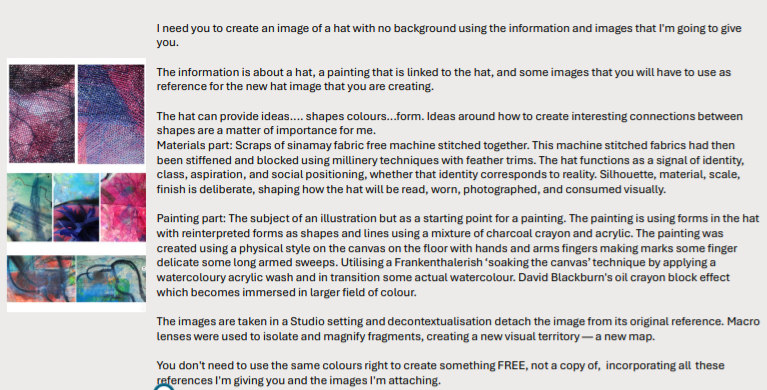
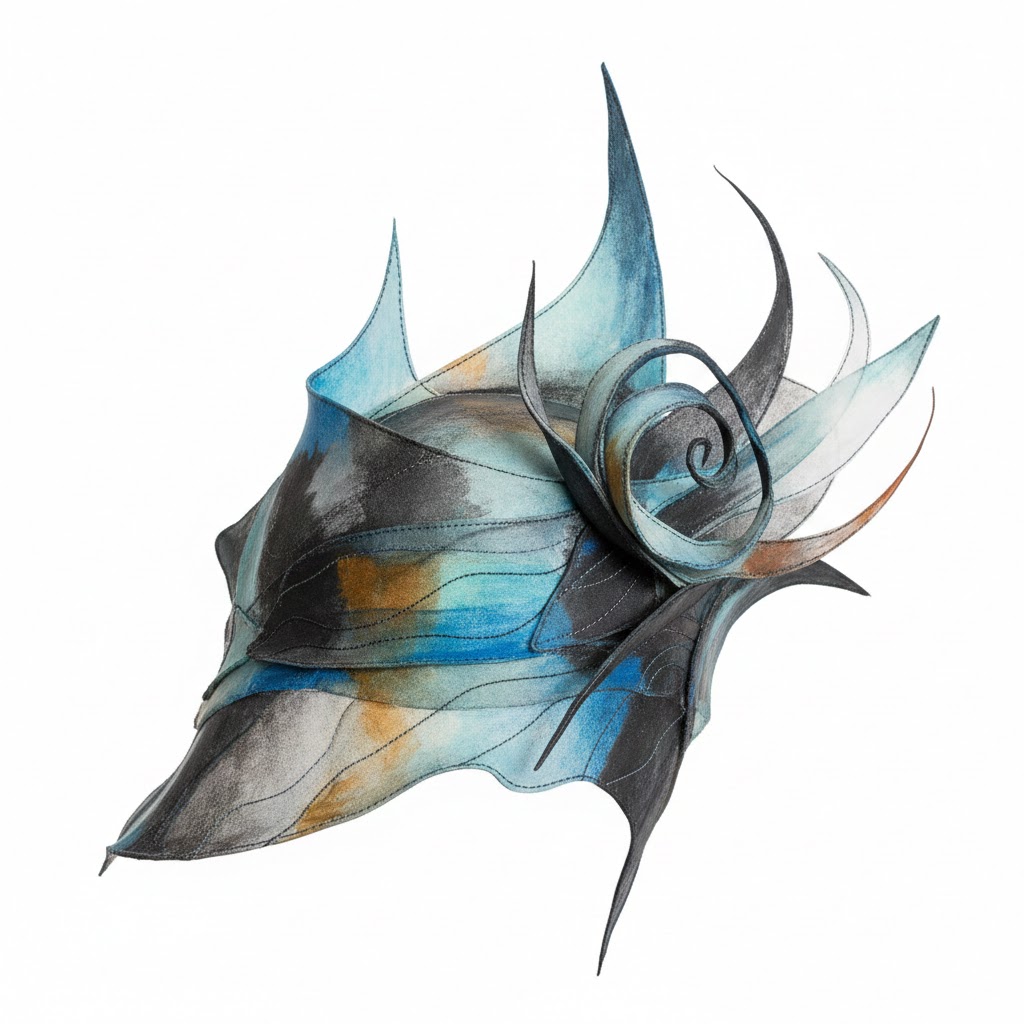
I then wrote the introduction as this is my part of the live presentation and updated my part of the oral presentation to include more theorists.
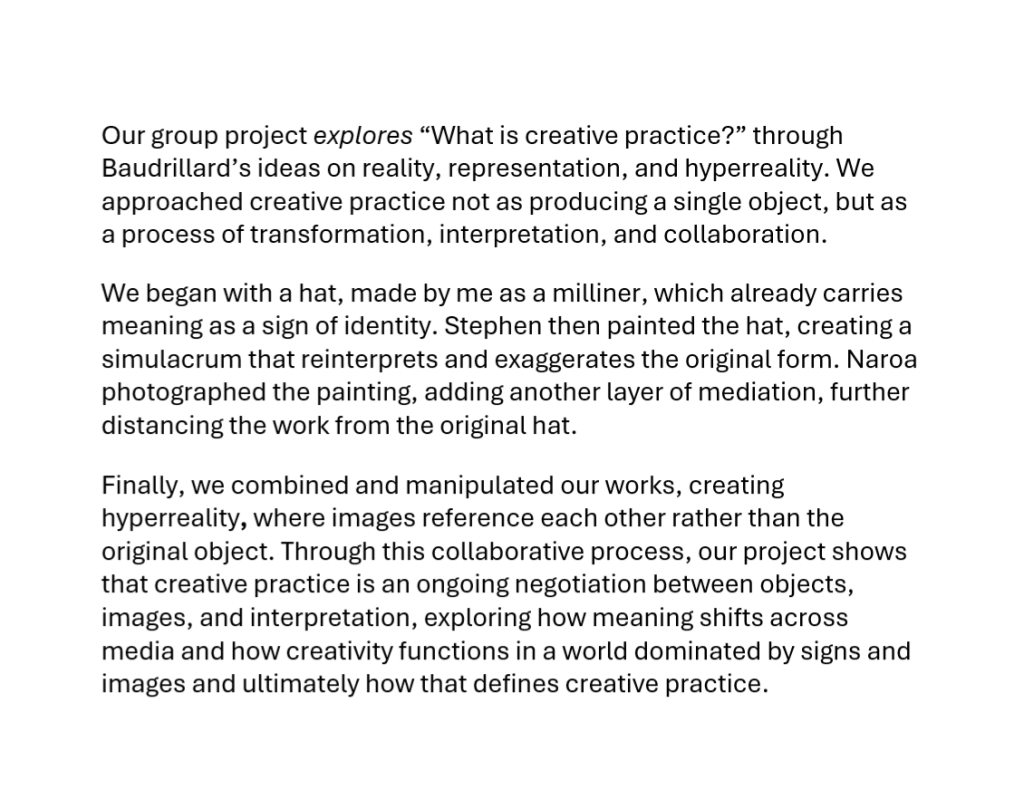
22/01/26 Reflections of our Group Presentation
I thought we created the presentation well, I think it worked nicely not really saying where we were going to end up until the end…After the introduction, I spoke purely of the hat, the process of the hat and how the hat is a simulation and the image of the hat is more important than the hat itself and how that influences my creative practice. Stephen then took over to speak about his work in relation to creative practice, and how he was inspired and took references from my hat to make a painting, not as a copy or a simulation of but as it’s own piece stepping away from the original object. Naroa then spoke about how she then took the hat an image and using macro created another filter referencing the items but also taking away the whole picture, meaning you are unsure of how the references connect to the original item. Naroa then led us into the 4th simulacrum and what questions arose, Naroa and steven then summed up the project.
All in all, I think the flow worked well, I would rather have spoken more freely without notes but I didn’t really feel I could do that well enough and not forget or clearly explain all of the points. Steven and Naroa both spoke well and I feel the presentation came across as quite cohesive, using each of our own skills and having autonomy to our own parts and a collaborative finish to the end of the project.
I really enjoyed the feedback from Clare that she had no idea what the direction was the project was whilst we each took over our own parts and loved the ‘surprise’ of how it led to the 4th simulation. It was spoken about the circularity of the idea of how I could now make a hat from the simulation and the process could go round in circles again. I think we got across the view of Baudrillard and how simulation is all around us and how no reference is true ‘pure’ but that it always comes from somewhere, even if removed. With the time we had and doing most remotely I am pleased with our project, it would have been nice to perhaps present in a more interactive way, but it was more important to have a project with a start and end point so that took precedent.
Overall I think the group dymanic worked well both Naroa and Stephen were accepting of my ‘project management style’ to move the project from idea to final presentation, but also it allowed them their freedom within the speaking parts of the presentation to make the points and develop how the theories of baudirillard related to our project and individual practices. Whilst there were small tensions at points, we all worked together to complete the project and understood the value in the project over personal tensions, overall I thought we all commuicated well and everyone responded swiftly to messages, which allowed the project to come together without hitting any major roadblocks or frustrations.
Bibliography
Google (2025). Gemini. [online] gemini.google.com. Available at: https://gemini.google.com/.
Anthropic (2023). Claude. [online] Claude.ai. Available at: https://claude.ai.
OpenAI (2025). ChatGPT. [online] ChatGPT. Available at: https://chatgpt.com/.
Baudrillard, J. (2001). The precession of simulacra.
Benjamin, W. (1936). The Work of Art in the Age of Mechanical Reproduction. Journal of Philosophy of Education, 41(3), pp.363–380. doi:https://doi.org/10.1111/j.1467-9752.2007.00579.x.
Barthes, R., Ward, M. and Howard, R. (1983). The fashion system. New York: Hill And Wang.